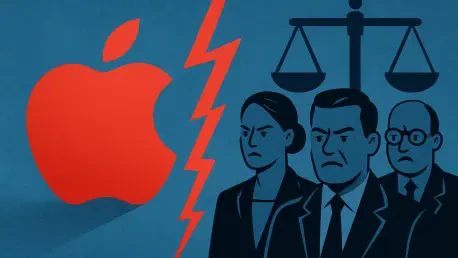

Apple Inc. now commands a staggering $4.05 trillion market capitalization, a figure that suggests impenetrable dominance, yet the technology giant is navigating one of the most precarious moments in its recent history. The company finds itself caught in a powerful crosscurrent, simultaneously facing a coordinated global regulatory assault aimed at dismantling its lucrative App Store fortress while being subjected to immense Wall Street pressure to deliver a revolutionary artificial intelligence experience. This dual-front battle defines Apple’s strategic landscape, where the very foundations of its high-margin Services business are being challenged just as investors have pinned the stock’s future growth on the timely and successful launch of a completely reimagined virtual assistant, dubbed “Siri 2.0.” Every legal ruling, regulatory settlement, and product roadmap delay sends significant ripples through the market, forcing investors to weigh the company’s proven ability to innovate against the growing risk of a forced restructuring of its digital ecosystem.
The Global Regulatory Gauntlet
The most persistent and material threat to Apple’s financial outlook is no longer a series of isolated skirmishes but a synchronized global campaign targeting its platform control. Regulators across multiple continents appear to be adopting a “copy-paste” strategy, replicating antitrust challenges that strike at the heart of the App Store’s business model. This intensifying pressure threatens to gradually erode the commission-based revenue stream that has made the Services division Apple’s most important growth engine. A landmark settlement with Brazil’s antitrust authority, CADE, stands as a stark example of this trend. The agreement forces Apple to fundamentally alter its iOS ecosystem within the country, mandating support for third-party app stores and alternative in-app payment systems. While the company maintains that these changes introduce significant security and privacy risks for users, the market has interpreted this concession as a critical precedent. Investors are less concerned with the immediate financial hit in Brazil and more focused on the high probability that other nations will now feel emboldened to demand similar, if not identical, terms, signaling a long-term erosion of Apple’s tightly controlled digital marketplace.
Further compounding these challenges, the regulatory focus has expanded beyond commercial practices to scrutinize Apple’s core privacy initiatives. Italy’s competition authority, AGCM, recently imposed a significant fine, alleging that Apple’s App Tracking Transparency (ATT) framework constituted an abuse of a dominant market position. The regulator argued that Apple applied more restrictive privacy policies to third-party developers than to its own services, effectively using its privacy platform as an anticompetitive tool. Although the fine itself is financially negligible for a company of Apple’s size, its implications are profound. This ruling opens a new front in the antitrust wars, transforming Apple’s highly publicized commitment to user privacy into a potential liability. For investors, this signals a shift from dealing with one-time financial penalties to engaging in what could be described as “ongoing policy trench warfare,” where even the company’s most celebrated user-centric features are subject to intense regulatory review and legal challenges, particularly where they intersect with the sprawling digital advertising economy.
A Shifting Legal and Political Landscape
While the international environment presents mounting headwinds, the legal landscape within the United States has offered Apple a measure of temporary relief. In a notable victory for the company and other platform holders, a federal judge in Texas granted a preliminary injunction that blocked the enforcement of a state law requiring stringent age-verification systems and parental consent for users under 18. The court found that the law likely violated First Amendment free speech protections, a ruling that allowed Apple to pause its costly and complex preparations for compliance. This development provides immediate near-term relief, averting a significant redesign of the App Store’s user access model in a major market. However, astute investors recognize that the underlying political and social momentum to regulate minors’ access to online content remains a powerful force. This issue is widely considered not to be resolved but merely delayed, with the expectation that it will resurface through legislative appeals or in the form of similar laws proposed in other states, ensuring that the debate over platform responsibility remains a persistent operational and legal concern.
Beyond the courtroom, Apple’s future is inextricably linked to its ability to navigate a complex and often tense geopolitical environment, particularly concerning its relationship with China. The country plays a critical dual role as both the linchpin of Apple’s global supply chain and a massive consumer market, making any disruption in relations a significant risk factor for the company’s valuation. In this context, diplomatic engagements are closely watched by the market as a barometer for stability. A recent meeting between Apple COO Sabih Khan and China’s Vice Commerce Minister served as a reminder of the delicate balance the company must maintain. Such high-level discussions are crucial for ensuring smooth operations and market access. For investors, the stability of U.S.-China trade relations is a macro factor to which Apple’s stock remains highly sensitive, adding another layer of external pressure that exists independently of the direct regulatory challenges to its business model. This geopolitical tightrope walk requires constant management and represents a significant variable in the company’s long-term risk profile.
The Immense Pressure of the AI Mandate
While external forces seek to constrain Apple’s existing empire, an equally powerful internal and market-driven pressure demands that the company forge a new one in the field of artificial intelligence. The consensus narrative on Wall Street has decisively pivoted from a hardware-centric story to one where software and AI are the primary catalysts for future growth. The trajectory of Apple’s stock is now widely believed to depend on its execution in delivering a transformative AI experience that can re-energize its ecosystem. At the very center of this high-stakes forecast is a significant upgrade to its virtual assistant, widely referred to as “Siri 2.0.” After reported delays, analysts and investors are anticipating a major unveiling in the early part of 2026. The bullish thesis posits that a genuinely more capable, intelligent, and proactive Siri, deeply integrated with a suite of features branded as “Apple Intelligence,” could stimulate a massive iPhone upgrade cycle as users seek hardware optimized for these new capabilities. Furthermore, it could unlock entirely new monetization opportunities within the Services division, potentially through a freemium model where basic AI features remain free while advanced capabilities are offered as a premium subscription.
This AI-centric narrative is not just a topic of discussion but is actively shaping financial models and investment strategies. Prominent analysts, such as Morgan Stanley’s Erik Woodring, have explicitly linked their upgraded price targets for Apple stock to the company’s ability to successfully deliver on its AI promises, particularly the major Siri release. The market’s focus has shifted from questioning whether Apple can “win AI” from a pure research perspective to whether it can successfully ship sophisticated AI features at its unprecedented scale, ensuring they are reliable, private, and seamlessly integrated into a business model that protects the company’s famously high-profit margins. Reports that Apple is considering licensing external AI models from competitors like Google further reinforce the idea that the primary objective is effective and timely product delivery, rather than in-house development at all costs. This intense focus on execution means that any perceived delays or shortcomings in the AI rollout could disproportionately impact investor sentiment and the company’s stock valuation, making the upcoming product cycle one of the most critical in its history.
A Precarious Balance for the Future
The convergence of these powerful forces left Apple at a critical juncture at the close of 2025. The company’s stock performance was being driven by an intense tug-of-war between its established platform dominance, which regulators were actively trying to dismantle, and its unproven potential in the next generation of artificial intelligence. The bull case for the company hinged on its ability to successfully thread a very fine needle: strategically complying with new “open ecosystem” rules in key markets while finding innovative ways to preserve its economic model, and simultaneously delivering a compelling AI upgrade with Siri 2.0 that could re-ignite hardware growth and justify its premium market valuation. The bear case, conversely, feared a domino effect from global regulatory actions that would steadily compress App Store margins, leaving a highly valued stock dangerously exposed to any disappointments or delays in its ambitious AI roadmap. Investors concluded the year with their attention firmly fixed on several upcoming catalysts that were expected to shape the narrative, including the next quarterly earnings report for hard data, the 105-day implementation deadline in Brazil to gauge Apple’s compliance strategy, and any credible signals on the progress of the Siri revamp, which represented the market’s consensus for the “next big thing” in Apple’s growth story.