
The dream of transforming a classic, established building into a cutting-edge smart home often collides with the harsh reality of its physical structure, where the prospect of chasing walls to run new cables is not just disruptive and expensive but sometimes simply impossible. For decades, the KNX standard has been the benchmark for robust, reliable, and interoperable building automation, but its traditional reliance on twisted-pair (TP) wiring has presented a significant barrier for modernization projects. This has left many property owners in a difficult position, forced to choose between preserving their building’s integrity and embracing the convenience and efficiency of smart technology. The emergence of wireless solutions has long promised a compromise, yet skepticism has persisted regarding their stability and security compared to their hardwired counterparts. The central question remains: can a wireless system truly deliver the same rock-solid performance that has made wired KNX the industry gold standard for so long, or are there inherent trade-offs in cutting the cord?
The Technical Foundation of Wireless Stability
Ensuring Secure and Confirmed Communication
A cornerstone of any reliable automation system is the certainty that commands are not only sent but also received and executed without fail, a principle that wireless systems must rigorously uphold to be considered viable alternatives to wired networks. The KNX RF Multi protocol addresses this fundamental requirement through a sophisticated “Fast Acknowledge” mechanism, which transforms one-way transmissions into a secure, two-way dialogue. Every single data packet sent by a device, whether a command to dim a light or a request for a temperature reading, must be promptly confirmed by the intended recipient. If this acknowledgment is not received within a very short time frame, the system instantly recognizes a potential communication failure. Rather than leaving the command to chance, the sending device automatically re-transmits the message, ensuring the instruction is delivered. This closed-loop communication virtually eliminates the risk of lost commands, a common pitfall in less advanced wireless protocols. This process is further fortified by the integration of KNX Secure, which provides state-of-the-art encryption to protect all data transmissions from unauthorized access and tampering, ensuring that the network is not only reliable in its operation but also fundamentally secure against external threats.
Achieving Stability Through Multi-Channel Operation
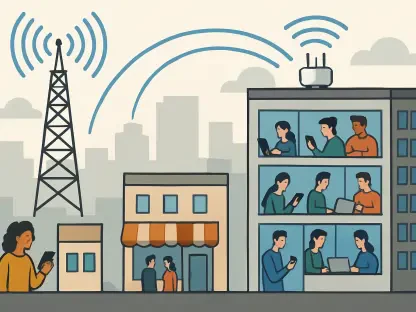
The modern building environment is a notoriously crowded space for radio frequencies, with Wi-Fi routers, Bluetooth devices, and countless other wireless technologies competing for a limited spectrum, creating a high potential for signal interference that can disrupt communication. To overcome this significant challenge, the KNX RF Multi system was engineered for exceptional resilience by operating across multiple parallel wireless channels simultaneously. Unlike systems that are locked into a single frequency and are therefore vulnerable to disruption, devices within this network possess the intelligence to independently monitor the airwaves. If a device detects interference on its current channel, it can autonomously and seamlessly switch to a clearer, unoccupied frequency to transmit its message. This dynamic frequency-hopping capability dramatically increases the overall stability and reliability of the network, ensuring that communication pathways remain open even in environments with heavy wireless traffic. This proactive approach to interference avoidance is critical for maintaining the high level of data quality and responsiveness expected from a professional-grade automation system, allowing it to perform with the consistency and dependability typically associated with a dedicated, physical wire.
Practical Integration and System Expansion
Bridging Wired and Wireless Worlds
The true power of a wireless KNX solution lies in its ability to seamlessly extend the functionality of an existing wired installation without requiring invasive structural modifications, a task masterfully handled by the Gira RF Multi/TP media coupler. This crucial component acts as a sophisticated bridge, creating a secure and reliable link between the wireless RF Multi components and the established wired KNX TP backbone of the building. For installers and property owners, this means that expanding a smart home into a newly renovated room, an extension, or an area where cabling is impractical is no longer a major construction project. The coupler translates the signals between the two mediums, allowing wireless sensors and actuators to communicate with their wired counterparts as if they were all part of a single, unified system. In larger buildings or those with challenging layouts, the media coupler can also be configured to function as a repeater, intelligently boosting the wireless signal to extend its range and ensure robust coverage throughout the entire property. This dual functionality provides a flexible and scalable method for modernization, enabling a comprehensive smart home upgrade while preserving the building’s original structure.
A Comprehensive Ecosystem for Modernization
A successful smart home modernization depends on a diverse portfolio of devices that can address a wide range of automation needs while maintaining a consistent user experience and aesthetic. The KNX RF Multi system offers a comprehensive suite of components designed for flexible expansion. For instance, the RF Multi servo provides a simple yet powerful way to integrate radiators into the central KNX system for intelligent and automated heating control, optimizing energy consumption room by room. Its remarkable energy efficiency, driven by a “Slow Low Energy” mode, allows it to operate for up to two typical heating seasons on a standard pair of AA batteries, minimizing maintenance. Elsewhere, RF Multi operating top units can be placed on existing Gira System 3000 inserts, instantly converting conventional switches for lighting, dimming, or blind control into fully functional, wirelessly controlled KNX actuators. This approach maintains a cohesive design language throughout the home by fitting into Gira’s standard switch ranges. Finally, the Gira RF Multi data interface provides a wireless connection point for the ETS programming software, liberating installers from physical connections and enabling remote programming, diagnostics, and maintenance, which significantly streamlines both initial setup and ongoing service.
A New Paradigm in Smart Home Modernization
The development of a robust and secure wireless protocol effectively bridged the long-standing gap that existed between the unparalleled stability of wired KNX and the inherent flexibility of radio-frequency technology. Through a multi-faceted approach that prioritized confirmed data transmission, intelligent interference avoidance, and exceptional energy efficiency, this wireless standard proved that it could deliver a level of performance and security on par with traditional hardwired installations. This advancement fundamentally changed the landscape for retrofitting and modernization projects, making comprehensive and reliable smart home automation accessible to countless existing buildings where running new cables had previously been a prohibitive obstacle. The seamless integration of wireless devices into wired systems, facilitated by media couplers, provided a practical and non-disruptive pathway for expanding intelligent control. Ultimately, it offered a powerful and future-proof solution that empowered property owners to embrace the full potential of smart building technology without compromising the integrity of their structures.