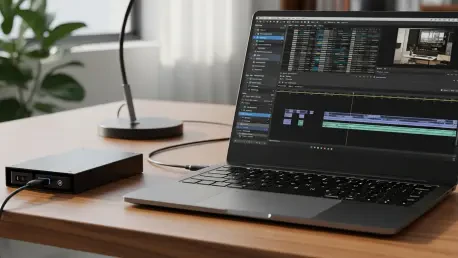

High-end computing has long been a game of waiting for the progress bar to finish, but the M5 Max finally turns that agonizing pause into a distant memory for power users. The latest silicon architecture targets the subtle latencies that disrupt high-stakes professional workflows. For the editor waiting on a 4K export or the data scientist crunching massive datasets, seconds saved per task aggregate into hours of reclaimed productivity. This hardware iteration represents a fundamental shift in how core architecture and storage communicate toward a higher ceiling of mobile computing.
The End of the Pro-Grade Bottleneck
While Apple’s transition to its own silicon was revolutionary, many professionals remained parked on M2-era hardware, waiting for a justification significant enough to warrant a total system refresh. The M5 Max was strategically engineered to address this demographic, bridging a widening gap in processing efficiency. Understanding its value required looking past branding and into the real-world implications of “super core” designs and unprecedented data throughput that targeted the limitations of previous-generation hardware.
Dissecting the Architecture: Super Cores and Storage Breakthroughs
The most striking advancement is the 18-core CPU configuration. By introducing a “super core” design—six specialized super cores and twelve performance cores—multicore benchmarks rose 14% over the M4 Max. However, the true “force multiplier” lies in storage. The 16-inch model records write speeds of 17.8 GB/s, a 123% increase that effectively makes the SSD a seamless extension of the system memory for high-resolution video work and complex simulations.
Quantifying the Professional Edge: Benchmarks and Real-World Gains
In graphics-heavy tasks, the M5 Max achieved an 18% boost in Metal rendering and a 26% jump in OpenCL performance. For a video editor, this resulted in a 10% faster export time for 4K projects compared to the M4 Max. When viewed through a long-term cycle, the contrast was even more dramatic: the chip nearly doubled the multicore performance of the M2 Max, marking it as the most significant leap for professionals in over three years.
Evaluating the Upgrade Path: Is the M5 Max Right for Your Workflow?
Determining the value of this hardware depended on specific baseline needs. For M4 Max users, gains were largely incremental; however, for those on M2 Max or Intel-based systems, this became the definitive upgrade point. The combination of doubled multicore performance and revolutionary storage speeds transformed the laptop into a portable workstation. Organizations sought these machines for 8K RAW video and machine learning models where data transfer rates provided a distinct edge.