
The hum of a corporate office in 2026 is no longer just the sound of keystrokes and clicks, but the subtle processing of localized artificial intelligence agents reshaping workflows from the inside out. The rise of on-device AI represents a significant advancement in enterprise computing, moving beyond theoretical promise to become a practical cornerstone of modern business. This review explores the evolution of AI PCs, their key features, performance metrics, and the tangible impact they now have on various business applications. It provides a thorough analysis of the technology’s current capabilities and its future trajectory, examining the convergence of hardware and software that has set the stage for a new era of productivity and security.
Defining the Shift to On-Device AI
The core principle of the Enterprise AI PC is the strategic transition from cloud-based AI processing to localized, on-device intelligence. For years, complex AI tasks were offloaded to powerful remote servers, a model that introduced latency, incurred significant operational costs, and raised valid concerns about data privacy. The shift to on-device AI fundamentally inverts this paradigm by placing the computational power directly in the hands of the user, ensuring that tasks are executed instantly and sensitive data never has to leave the security of the local machine.
This evolution is driven by both technological advancements and pressing business needs. Fundamentally, it is enabled by two pillars: specialized processors capable of handling demanding AI models and an emerging software ecosystem designed to harness that power. In a business landscape increasingly focused on data sovereignty, cost efficiency, and hyper-personalized productivity, the AI PC has emerged as a critical tool, providing a direct answer to some of the most persistent challenges of the cloud-centric era.
Key Technologies Enabling the AI PC
The Hardware Revolution Next-Generation Processors
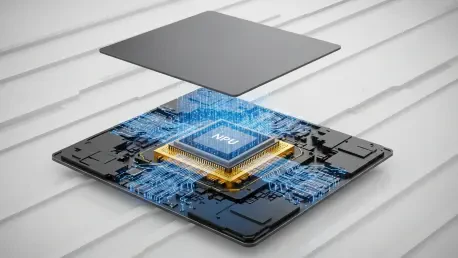
The viability of on-device AI hinges on the development of specialized hardware capable of handling complex workloads without a connection to the cloud. This hardware revolution is exemplified by chips like Intel’s “Panther Lake,” which feature a redesigned architecture specifically for AI performance. These next-generation processors integrate not just CPUs but also advanced Graphics Processing Units (GPUs) and Neural Processing Units (NPUs) onto a single die, creating a powerhouse for localized intelligence. The significant increase in on-chip processing power, such as a threefold boost in GPU tiles, enables complex AI models to run efficiently and directly on a user’s device.
This architectural strategy is crucial for broad adoption. While NPUs are highly efficient for specific, optimized AI tasks like background blurring, the immense power of integrated GPUs provides the flexibility needed to run a diverse range of generative AI models “out of the box.” This versatility was a key factor in overcoming the initial software gap, as it allowed developers to deploy AI features without needing to program for highly specialized hardware. Consequently, modern AI PCs can now support hundreds of AI-driven features and large language models from day one, transforming them into truly intelligent platforms.
The Software Ecosystem The Rise of Agentic AI
Powerful hardware is only one half of the equation; it requires a sophisticated software layer to unlock its true potential. This is where the concept of “agentic” AI comes into play, transforming the operating system and applications from passive tools into proactive assistants. Platforms like LLMware’s ModelHQ have been instrumental in this shift, offering environments where users can create and deploy customized AI workflows by chaining together specialized models, often without writing a single line of code.
This democratization of AI development is being mirrored at the system level. Microsoft has steadily evolved Windows into an “agentic OS,” where the operating system itself acts as an intelligent coordinator for on-device data and AI tools. This creates a cohesive user experience, allowing for new forms of human-computer interaction that are more collaborative and goal-oriented. Instead of executing direct commands, users can now assign complex tasks to AI agents that leverage local applications and data to deliver results securely and efficiently.
Current Trends and Adoption Timeline
The journey of the AI PC has been one of rapid maturation. The initial rollout in 2024 was met with a degree of skepticism, as the market faced a classic chicken-and-egg scenario: the hardware was ready, but the ecosystem of compelling offline applications was still in its infancy. This period, however, served as a crucial proving ground, allowing developers to understand the capabilities and limitations of first-generation on-device AI hardware.
Fast-forward to today, and the landscape has transformed. The industry consensus for widespread adoption has been realized, with enterprises now routinely including AI PCs in their hardware refresh cycles. This acceleration was driven by the strategic alignment between hardware manufacturers and software developers, who worked in concert to build a robust application ecosystem. The result is a seamless user experience where the power of on-device AI is integrated directly into the tools employees use every day, solidifying the AI PC’s position as an indispensable business asset.
Enterprise Use Cases and Strategic Advantages
Optimizing Costs and Fortifying Data Security
One of the most compelling arguments for AI PC adoption is the dual benefit of financial savings and enhanced data security. By localizing AI processing, enterprises significantly reduce their reliance on expensive cloud services, which charge for data transfer, computing instances, and API calls. As noted by industry leaders, the initial investment in AI-capable hardware is often offset by these long-term savings, providing a clear and tangible return on investment.
Moreover, processing sensitive information locally mitigates the inherent risks of transmitting data to third-party servers. This is a critical advantage for organizations that handle confidential client information, proprietary research, or intellectual property. Keeping data on the device ensures compliance with stringent data protection regulations and provides enterprises with full data sovereignty, allowing them to leverage the power of AI without compromising their security posture.
Boosting Productivity with Intelligent Workflows
The practical applications of on-device AI are already delivering significant productivity gains through the creation of “agentic workflows.” Employees can now stack specialized AI models to streamline complex, multi-step processes that were once manual and time-consuming. For example, a financial analyst can use a local AI agent to extract data from a secure internal document, perform a sentiment analysis, and generate a summary chart, all within a sandboxed, offline environment.
These intelligent workflows do more than just accelerate existing tasks; they enable new capabilities and allow employees to offload cognitive burdens. By automating routine processes, AI PCs free up human capital to focus on high-value strategic work, such as creative problem-solving, client relationship management, and long-term planning. This shift leads not only to gains in individual efficiency but also to a more innovative and agile organization.
Accelerating Workforce Upskilling and AI Literacy
Beyond immediate productivity benefits, AI PCs serve as a powerful platform for continuous employee development. Providing hands-on access to advanced AI tools within the daily work environment creates a natural and effective setting for upskilling. Employees can experiment with different AI models, learn how to build simple agentic workflows, and integrate AI into their tasks organically, fostering a culture of practical learning and innovation.
This widespread access is critical for building the AI literacy necessary for the future economy. As AI becomes further embedded in all business functions, a workforce that is comfortable and proficient with these tools becomes a significant competitive advantage. AI PCs act as the primary delivery vehicle for this essential, ongoing training, equipping employees with the skills required to thrive in an increasingly AI-driven world.
Addressing Current Hurdles and Limitations
Despite its successful integration, the path of the AI PC was not without its challenges. Early adopters faced performance constraints with first-generation hardware and an initial scarcity of compelling applications that could operate fully offline. This created a gap between the hardware’s potential and its real-world utility, leading to some initial user skepticism that had to be overcome through tangible software improvements.
Today, while the foundational hurdles have been cleared, new challenges have emerged. The focus has shifted from basic functionality to issues of scale and sophistication. These include ensuring seamless interoperability between different AI agent platforms, managing the thermal and power consumption demands of running high-intensity models for extended periods, and establishing standardized security protocols for managing fleets of on-device AI agents across an enterprise.
Future Outlook The Path to Mainstream Integration
Looking ahead, the evolution of the AI PC is set to accelerate further. The next frontier lies in deeper integration, where on-device AI becomes fully predictive and hyper-personalized, anticipating a user’s needs based on their unique workflows and habits. This will be coupled with greater convergence with other edge devices, such as augmented reality glasses and smart office peripherals, creating a truly ambient computing experience where intelligence is seamlessly distributed across a user’s personal technology ecosystem.
This trend will have a profound long-term impact on enterprise computing infrastructure. The role of the centralized cloud will likely transition from a center for data processing to one of orchestration, model training, and governance. The bulk of real-time AI inference will be handled at the edge by powerful AI PCs. This emerging hybrid model promises to redefine productivity, collaboration, and innovation in the workplace, cementing the AI PC as the central hub of an individual’s digital work life.
Final Assessment The Inevitable Rise of the AI PC
The development of the enterprise AI PC began with significant promise but was initially hindered by a disconnect between its hardware capabilities and the availability of a mature software ecosystem. The dedicated collaboration between chip designers, operating system developers, and third-party application creators was the critical catalyst that ultimately bridged this gap. This synergy was essential in unlocking the technology’s potential and moving it from a niche concept to a mainstream business tool.
Its success was ultimately sealed by a powerful and multifaceted value proposition. The AI PC directly addressed the persistent enterprise challenges of escalating cloud costs, stringent data security requirements, and the unending pursuit of greater employee productivity within a single, cohesive platform. Its widespread adoption established a new and elevated baseline for enterprise computing, which proved that the powerful combination of localized hardware and sophisticated agentic software was the definitive future of work.