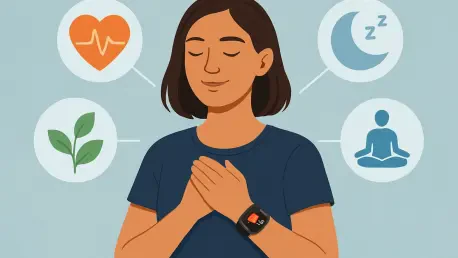

The subtle vibration on your wrist is no longer just a notification for a text message; it is a silent, data-driven conversation about the intricate state of your internal well-being. What began as a simple digital pedometer has quietly morphed into a sophisticated health-monitoring ecosystem, fundamentally reshaping our relationship with personal wellness. This evolution marks a pivotal transition from a culture of reactive healthcare, where problems are addressed after they arise, to one of proactive, continuous self-management. By capturing a constant stream of biometric data, today’s wearables are empowering individuals with unprecedented insight into their bodies, turning abstract feelings of stress or fatigue into quantifiable metrics that can inform daily choices and foster long-term health.
Beyond the 10,000-Step Goal What Is Your Smartwatch Really Tracking
The era of defining digital health by a single, arbitrary metric like the 10,000-step goal has decisively ended. Modern wearables have transcended this narrow focus, posing a much more profound question: what is this device truly learning about you? The answer lies in a suite of advanced sensors capable of capturing physiological data once accessible only within the confines of a clinical setting. These devices are no longer just counting movements but are actively listening to the body’s most subtle signals, providing a dynamic, real-time portrait of your internal environment.
This technological leap reveals an unexpected depth of personal health information available directly on a user’s wrist or finger. For instance, integrated electrocardiogram (ECG) sensors on devices like the Apple Watch Series 10 can detect signs of atrial fibrillation, a common heart rhythm irregularity. Meanwhile, Heart Rate Variability (HRV) analysis from a WHOOP band or Oura Ring offers a window into the autonomic nervous system, quantifying recovery and resilience to stress. This continuous monitoring transforms the device from a passive accessory into an active health companion, flagging potential concerns and providing the context needed to understand the body’s response to sleep, diet, and daily stressors.
The New Health Paradigm From Reactive Fixes to Proactive Well-being
The most significant impact of this evolution is the critical move away from sporadic, clinical measurements toward continuous, real-world data collection. A traditional annual physical provides a single snapshot in time, a static picture that fails to capture the dynamic interplay of factors influencing health day to day. In contrast, wearables offer a continuous narrative, tracking how heart rate, sleep quality, and stress levels fluctuate in response to a demanding workday, an intense workout, or a restful night. This constant stream of information provides a far more accurate and nuanced understanding of an individual’s unique physiology.
This trend is directly connected to a growing consumer desire for personalized health insights and preventive care. Individuals are no longer content to be passive recipients of medical advice; they seek to become active participants in their own wellness journeys. By providing accessible data on everything from sleep apnea indicators to blood pressure trends, as seen in devices like the Samsung Galaxy Watch 7, wearables empower users to identify and address small lifestyle imbalances before they escalate into significant health concerns. This proactive stance represents a fundamental reorientation of personal health management.
Consequently, the focus of wellness technology has broadened from the singular pursuit of peak athletic performance to the more universal goal of achieving sustainable, long-term balance. While elite athletes still leverage these tools to optimize training and recovery, the technology’s greatest impact is now felt by the general population. The goal has shifted from running a faster marathon to managing daily stress, improving sleep quality, and understanding hormonal cycles. This democratization of health data fosters a holistic vision of well-being, where recovery is valued as much as exertion and balance is the ultimate objective.
Unpacking the Data The Key Pillars of Modern Health Monitoring
At the core of this transformation is the integration of sophisticated sensors that illuminate the deep connection between cardiovascular health and mental state. On-demand ECGs and photoplethysmography (PPG) sensors provide crucial screening for arrhythmias by monitoring heart rhythms. However, the data extends beyond simple mechanics. By analyzing Heart Rate Variability (HRV), wearables from Oura and WHOOP quantify the body’s recovery status and its capacity to handle stress, offering a direct look at the balance of the autonomic nervous system. Further, electrodermal activity (EDA) sensors, a key feature in the Fitbit Charge 6, measure minute changes in skin conductance, providing real-time feedback on the body’s “fight-or-flight” response and prompting guided interventions like breathing exercises to restore calm.
Simultaneously, wearable technology is revolutionizing the field of reproductive and hormonal health, an area historically underserved by convenient tracking methods. For individuals planning a family, continuous basal body temperature tracking offers a far more precise and effortless method for predicting ovulation than traditional manual charting. Devices worn through the night can detect the subtle thermal shift that signals ovulation, providing clear, data-driven insights. This same technology is proving invaluable for managing the menopausal transition, as it can objectively track and quantify vasomotor symptoms and sleep disturbances, giving users and their healthcare providers a clearer picture to inform management strategies.
Looking ahead, the next wave of wearables is set to become even more integrated and invisible, moving beyond watches and rings to seamless form factors. Smart patches that adhere to the skin, intelligent clothing with woven-in sensors, and even sensor-equipped contact lenses are poised to make health monitoring a completely passive and effortless part of daily life. These emerging platforms promise to unlock non-invasive tracking of complex metrics such as continuous glucose levels and real-time hydration status, further blurring the line between consumer technology and medical-grade monitoring tools and pushing the boundaries of preventive health.
Evidence in Action How Technology Is Validating the Holistic Shift
The industry’s pivot toward comprehensive health is validated by the advanced sensor technology now standard in mainstream devices. The analysis of metrics like HRV and blood oxygen saturation (SpO2) is not built on proprietary algorithms alone but is grounded in decades of established physiological science, adding a significant layer of credibility to the insights provided. This scientific foundation ensures that the data, while not diagnostic, is a reliable reflection of the body’s internal state, allowing users to make informed decisions based on recognized biological principles.
The true power of this hardware, however, is unlocked by the increasingly intelligent software that supports it. Raw biometric data is complex and often unintelligible to the average user. This is where AI-driven platforms play a crucial role, interpreting billions of data points to identify patterns, trends, and correlations. These systems transform raw numbers into a personalized health narrative, offering actionable insights such as a “readiness score” or a “sleep score” that distill complex physiological information into a simple, understandable metric.
Dedicated applications serve as compelling case studies for this successful translation of data into a holistic health overview. Platforms like Clue and Oura have built their entire ecosystems around this principle, taking continuous streams of data—including temperature, heart rate, and movement—and synthesizing them into a cohesive view of a user’s reproductive cycle or overall recovery. These applications demonstrate how continuous monitoring, when paired with intelligent analysis, can provide a truly comprehensive understanding of personal health that was previously unattainable.
Leveraging Your Wearable A Practical Framework for a Healthier Life
To truly benefit from this technology, it is essential to move beyond generic tracking and define a clear, personal health objective. Whether the primary goal is to improve sleep quality, manage daily stress, or better understand a reproductive cycle, having a specific focus allows a user to filter the noise and concentrate on the metrics that matter most. This targeted approach transforms the wearable from a passive data collector into an active tool for achieving a specific wellness outcome, making the experience more meaningful and effective. It also encourages a shift in perspective, training users to interpret long-term patterns over weeks and months rather than reacting to normal daily fluctuations, which provides a more stable and accurate picture of their health trajectory.
Ultimately, the data from a wearable should be viewed as a catalyst for conversation and a source of context, not as a diagnostic tool. These devices provide valuable information that can illuminate the impact of lifestyle choices and can serve as a powerful resource to share with healthcare professionals, offering them a longitudinal view of a patient’s health between appointments. This informed dialogue is best supported by consistent data, which requires aligning the device with a user’s daily routine. Choosing a form factor—be it a ring that is comfortable for sleep, a watch integrated with daily apps, or a discreet patch—that fits seamlessly into one’s life is paramount for ensuring the continuous, high-quality data collection needed to generate the most accurate and powerful insights.
The evolution of wearable technology fundamentally reshaped the landscape of personal health management. By moving beyond simple fitness metrics, these devices provided a continuous and holistic view of well-being, capturing the intricate interplay between physical activity, stress, sleep, and physiological recovery. This constant stream of personalized data empowered individuals to transition from a reactive to a proactive stance on health, armed with the awareness to make small, consistent adjustments. The technology fostered a new kind of literacy—the ability to read and understand one’s own body—and served as a data-driven companion that encouraged balance and long-term wellness over short-term achievements.