
The landscape of high-performance computing has shifted so rapidly that the silicon powering last year’s workstations already feels like a relic of a simpler time. With the official rollout of the M5 chip family, the tech industry is witnessing a transition where raw speed is no longer the only metric of success. This new generation of hardware—spanning the M5, M5 Pro, and M5 Max—represents a fundamental architectural pivot toward a high-density, AI-driven ecosystem. By moving beyond the incremental updates that defined previous cycles, this hardware is specifically engineered to meet the escalating demands of modern professional workflows. This roundup explores how the integration of “Fusion Architecture” and dedicated neural hardware is set to transform the efficiency and capabilities of the MacBook and Studio Display lineups.
The Dawn of the Fusion ErApple’s Bold Leap in Silicon Evolution
The introduction of the M5 chip family marks a pivotal moment in the transition toward a highly integrated computing environment. Industry analysts note that this generation of silicon is not merely about adding more transistors; it is about redefining the boundaries of mobile and desktop productivity through a more cohesive design philosophy. By embracing a new internal structure, the hardware seeks to solve the long-standing problem of data bottlenecks that occur when moving information between the processor and memory.
This shift suggests a move toward a “Fusion Architecture” that prioritizes local intelligence over cloud-based processing. The integration of dedicated neural hardware directly into the silicon allows for a more responsive user experience, particularly in software that relies on real-time data analysis. Professionals are finding that these advancements reduce the friction between creative intent and final output, making the system feel like an extension of the user’s thought process rather than just a tool for execution.
Engineering a Powerhouse: The Technical Foundations of the M5
Breaking the Monolithic Barrier with Fusion Architecture and Super Cores
The M5 Pro and M5 Max depart from traditional chip design by utilizing a sophisticated dual-die system integrated into a single System on a Chip (SoC). This “Fusion Architecture” allows for scaling hardware resources massively while maintaining the low-latency advantages of unified memory that have become a hallmark of the platform. With an 18-core CPU configuration featuring six “super cores,” the silicon is specifically tuned for heavy multithreaded tasks such as 3D rendering and complex software compilation.
Technical experts observe that this architectural pivot results in a 30% performance boost over the previous generation without the thermal issues often seen in high-performance processors. By avoiding the typical efficiency losses of high-core-count designs, the hardware manages to stay cool under pressure. This approach proves that increasing core counts can be achieved sustainably, allowing the system to maintain peak performance levels for extended periods during intense production cycles.
Specialized AI Acceleration and the New Standard for Ray Tracing
While raw CPU power is impressive, the true innovation lies within the GPU’s new “Neural Accelerator.” This dedicated hardware is engineered to handle artificial intelligence operations locally, making the M5 chips significantly faster for AI-driven tasks compared to their predecessors. Furthermore, a 35% improvement in ray-tracing performance signals a major leap for visual effects artists and game developers who require high-fidelity lighting and shadow calculations in real time.
By embedding these capabilities directly into the graphics cores, the design ensures that high-end computational tasks can be executed fluidly on a mobile workstation. This change effectively democratizes specialized rendering techniques that were once the exclusive domain of high-end desktop rigs with massive power draws. The ability to handle complex mathematical simulations and visual renders on the go changes the expectations for what a professional can accomplish outside of a traditional office environment.
Democratizing High-End Power via the M5 MacBook Air
The M5 transition is not limited to the “Pro” models; the MacBook Air now benefits from an architecture that brings enterprise-level performance to a consumer-grade device. Internal benchmarks suggest the M5 Air is nearly ten times faster than the original M1 model, effectively bridging the gap between casual use and professional creative work. This allows students and entry-level professionals to access tools that were previously restricted by hardware limitations.
Even with a slight increase in entry-level pricing, the doubling of base storage speeds and the inclusion of the N1 wireless chip for Wi-Fi 7 support suggest that the “Air” is no longer just a portable machine. It has evolved into a viable entry point for high-speed professional connectivity. The focus on high-bandwidth wireless standards ensures that these lighter devices can still function effectively within a modern studio environment that relies on fast network transfers and cloud collaboration.
Redefining the Mobile Studio with Thunderbolt 5 and XDR Enhancements
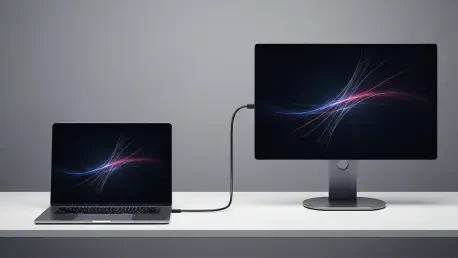
The flagship MacBook Pro models paired with the new Studio Display XDR create a unified ecosystem built for high-bandwidth data environments. The integration of Thunderbolt 5 provides the necessary overhead for complex multi-monitor setups and lightning-fast external storage transfers. This update addresses the needs of video editors and data scientists who frequently move terabytes of data between devices and require a lag-free experience when working with external assets.
On the visual front, the Studio Display XDR’s move to Mini-LED technology with 2,000 nits of peak brightness and a 120Hz refresh rate addresses specific needs in the medical and post-production fields. These updates indicate a shift toward pro-level standardization, where high-end features like nano-texture glass and spatial audio are integrated to solve specific software and environmental bottlenecks. The hardware is no longer just displaying an image; it is providing a calibrated reference point for critical decision-making.
Navigating the Shift: Strategic Takeaways for Professionals
The transition to the M5 ecosystem requires a strategic approach to hardware investment, as the value proposition has shifted toward long-term “future-proofing.” Professionals are encouraged to prioritize memory bandwidth—reaching up to 614 GBps on the Max models—to handle the increasing demands of on-device Large Language Models (LLMs). Those who invest in higher memory tiers now will likely find their machines remain relevant for much longer as software continues to integrate more complex local processing requirements.
For organizations looking to upgrade, it is often recommended to leverage the improved base specifications of the M5 Pro to offset the higher entry price. Utilizing the new Thunderbolt 5 infrastructure will be essential for those managing high-resolution video assets or large datasets. Ensuring that the hardware remains compatible with the next generation of peripherals is a key consideration for maintaining a competitive edge in fast-moving industries like software development and digital media.
The Future of Performance: Consolidating the Professional Edge
Apple’s M5 chip family represented more than just a seasonal refresh; it established a cohesive vision of the modern workstation where hardware and software synergy was absolute. By centralizing AI compute through Neural Accelerators and scaling performance via Fusion Architecture, the design successfully navigated the technical challenges of silicon maturity. As these devices reached the hands of creators and engineers, the impact on industry standards—from local AI execution to medical imaging—was profound.
Moving forward, the focus should shift toward optimizing software to fully utilize the parallel processing capabilities of the “super cores.” Organizations must evaluate their current digital infrastructure to ensure that their networking and storage solutions can match the increased speeds provided by Thunderbolt 5 and Wi-Fi 7. The era of the M5 demonstrated that the future of professional performance depended on specialized, high-bandwidth silicon that anticipated the next decade of computational demands. Professionals who adopted these tools early gained a distinct advantage in handling the data-heavy workloads that have now become the global standard.