
The conversation around home automation has fundamentally shifted from a collection of standalone gadgets to a sophisticated, interconnected ecosystem where artificial intelligence serves as the central nervous system. This transition is not about novelty but about creating a living environment that is truly responsive, efficient, and attuned to the rhythms of daily life. The market reflects this profound change, with projections indicating it will expand into a $620 billion industry over the next decade, driven by consumer demand for a new standard of convenience. At the core of this evolution are emerging standards like Matter 1.5, which are finally breaking down the walled gardens of different brands, allowing devices to communicate seamlessly under the orchestration of voice assistants like Alexa. This creates a unified home where products do more than just perform tasks; they anticipate needs, learn from user habits, and work in concert to enhance comfort and optimize resource consumption, delivering a lifestyle that was once the domain of science fiction.
The Dawn of an Intuitive Home Ecosystem
The modern smart home is defined by its ability to operate as a cohesive and intelligent entity, moving far beyond the simple command-and-response interactions of its predecessors. This integrated approach is powered by advanced artificial intelligence that learns the unique patterns and preferences of a household, enabling a level of proactive automation that was previously unattainable. Instead of users manually programming every action, the home itself begins to anticipate needs—adjusting the lighting as evening approaches, preparing the climate control before a resident’s arrival, and managing energy consumption in the background without any direct input. Major technology companies are pioneering this shift, focusing on developing platforms that allow devices from various manufacturers to communicate and collaborate. This seamless interoperability means that a trigger from one device, such as a security camera detecting a car in the driveway, can initiate a cascade of actions across the home, from turning on entry lights to adjusting the thermostat, creating a truly responsive and welcoming environment.
A key driver of this integrated ecosystem is the pursuit of unprecedented energy efficiency and personalized comfort, most notably realized through intelligent climate control systems. Innovators in this space have moved beyond the single smart thermostat to offer dynamic, room-by-room management that allows for distinct temperature settings in different areas of the house simultaneously. These systems leverage AI to learn a family’s daily and weekly schedules, preemptively heating or cooling specific zones just before they are needed, thereby eliminating the wasteful practice of conditioning unoccupied spaces. This intelligent allocation of resources not only ensures optimal comfort for every member of the household but also yields significant financial benefits, with documented energy savings of up to 23% on annual utility costs. The ability to monitor and adjust these settings remotely via a smartphone further empowers users, providing them with granular control over their home’s environment from anywhere and cementing the smart home’s role as both a comfort enhancer and a powerful tool for sustainable living.
Redefining the Heart of the Home
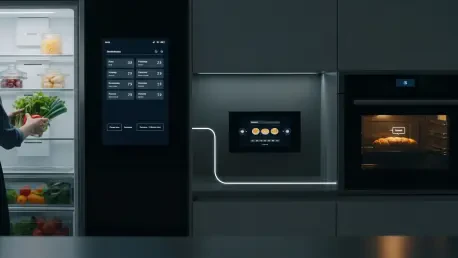
Nowhere is the impact of AI-driven automation more apparent than in the kitchen, which is rapidly transforming into a hub of culinary intelligence and efficiency. The latest generation of smart refrigerators, for example, function as “culinary sherpas,” using internal cameras and sophisticated object recognition to maintain a real-time inventory of their contents. This technology is instrumental in reducing food waste by suggesting recipes that utilize ingredients nearing their expiration date and automatically generating shopping lists for depleted items. This seamless integration extends to the cooking process itself, as the refrigerator can communicate with other smart appliances, like ovens or cooktops, to pre-program settings based on the selected recipe. This interconnected culinary ecosystem streamlines meal preparation, minimizes manual effort, and empowers home cooks to explore new dishes with confidence, knowing their appliances are working together to ensure a successful outcome.
The wave of kitchen innovation also extends to specialized appliances designed to perfect specific culinary experiences with remarkable precision and convenience. For instance, AI-powered smokers have revolutionized the art of smoking meat by automating the entire process, from maintaining precise temperature and humidity levels to regulating smoke density for optimal flavor infusion. This eliminates the constant monitoring traditionally required, making a once-laborious cooking method accessible to enthusiasts of all skill levels. In a similar vein, countertop beverage chillers provide both aesthetic organization and perfectly chilled drinks on demand, while a new breed of ice cube makers operates quickly and quietly, often with voice-activated controls for ultimate convenience. These devices exemplify the broader trend in home automation: they are not just smart but also purposeful, designed to elevate everyday routines and deliver a superior quality of life through thoughtful and intelligent design.
The Synthesis of Smart Living
The evolution of the smart home had clearly moved past the era of isolated, single-function devices. It was no longer about a smart speaker that could play music or a thermostat that could be adjusted remotely; instead, the focus had shifted to the creation of a truly unified and responsive living space. The advancements in artificial intelligence and the widespread adoption of interoperability standards like Matter had paved the way for an environment where technology worked invisibly in the background, anticipating needs and simplifying daily routines. The integration seen in kitchens and climate control systems served as a blueprint for the entire home, where convenience, efficiency, and comfort were not just added features but the fundamental principles of the design. This period marked the point where the promise of a truly automated and intelligent home was finally realized.