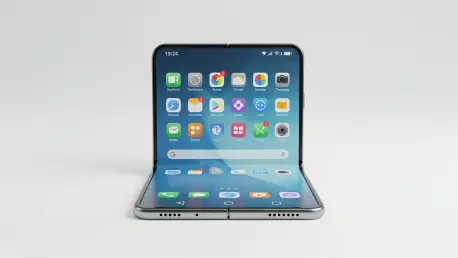

Despite years of technological breakthroughs and relentless marketing that positioned them as the inevitable future of mobile computing, foldable smartphones have yet to ignite a true market revolution, remaining instead in a state of commercial purgatory. What was once heralded as the next great leap forward has become a curious sideshow, a niche product category for early adopters and tech enthusiasts while the vast majority of consumers remain loyal to the traditional glass slab design. The promised future feels perpetually delayed, stuck on the runway due to a complex interplay of fundamental challenges that span price, durability, software, and overall market dynamics. The core question has shifted from “Can we build a phone that folds?” to a much more difficult one: “Why should anyone actually buy one?” The industry has successfully answered the engineering challenge but has so far failed to provide a compelling answer to the consumer.
The Unsolved Equation of Price and Practicality
The most significant and immediate barrier to mainstream adoption remains the prohibitive cost associated with the foldable form factor. Premium book-style devices, such as those in Samsung’s Galaxy Z Fold series, carry price tags approaching $1,800, positioning them firmly as luxury items well beyond the budget of the average buyer. This pricing strategy places them in direct competition with the absolute best conventional smartphones available, including the iPhone 15 Pro Max and Samsung’s own Galaxy S24 Ultra. These established flagships offer demonstrably superior camera systems, longer battery life, and, most importantly, the proven reliability of a solid-state design without moving parts. The high cost is a direct consequence of the complex and expensive engineering required for the multi-part hinge mechanism and the novel Ultra-Thin Glass display. This expense, passed on to the consumer, creates a steep financial hurdle that the perceived benefits of a folding screen have yet to justify for the mass market.
Compounding the issue of high cost is the pervasive concern over durability, which creates a significant psychological barrier for potential buyers. The visible crease running down the center of the main screen serves as a constant, unavoidable reminder of the display’s inherent fragility compared to the hardened glass on a conventional phone. While manufacturers have made impressive strides, achieving IPX8 water resistance in many models, a complete seal against dust—a critical and persistent threat to intricate, multi-part hinge mechanisms—has not yet been perfected. This lingering vulnerability is a major liability for a device that costs nearly two thousand dollars. Consumers have become accustomed to phones that can withstand the rigors of daily use without special care, and the idea of investing a premium price in a product that feels less resilient is a difficult proposition. The high cost of potential out-of-warranty repairs only exacerbates this fear, making the traditional flagship a safer and more practical investment for most.
A Software Experience in Search of a Purpose
Beyond the significant hardware compromises, the software ecosystem for foldable devices remains underdeveloped and has thus far failed to deliver a definitive “killer application.” The core marketing promise of enhanced, tablet-like productivity through advanced multitasking is a compelling concept in demonstrations, but its practical, real-world utility for the majority of users is highly questionable. A major stumbling block is the slow pace of third-party app development tailored to the unique form factor. Many popular applications still do not offer an optimized interface for the larger, squarer screen, instead simply stretching to fit the expanded real estate. This lazy implementation completely negates the potential advantages of having more screen space and often results in a subpar user experience. The absence of a unique software feature or a must-have app that is impossible on a traditional phone leaves the core value proposition feeling hollow and incomplete.
In contrast to the nascent and fragmented software experience on foldables, the single-screen user interface of conventional flagship phones has been refined over more than a decade to a point of near perfection. This mature ecosystem effectively serves the dominant mobile activities of the average user, such as social media scrolling, instant messaging, and content consumption. For these core tasks, a larger, folding screen offers minimal tangible benefit. The added complexity of a foldable interface, with its need for managing multiple windows and adapting to different screen sizes, fails to provide a compelling reason to switch for a user base that is perfectly content with the simplicity and reliability of their current devices. Until the software can offer undeniable, unique value that directly enhances common user behaviors, it will continue to be a secondary consideration rather than a primary reason to embrace the foldable form factor and its associated trade-offs.
A Shifting Competitive Landscape
For several years, Samsung effectively created and dominated the foldable category, but its long-held leadership is now facing its most substantial test due to a recent influx of highly competitive devices from other manufacturers. A wave of innovation, primarily from Chinese brands, is pushing the boundaries of design and directly addressing key consumer pain points that have long plagued the market. The Honor Magic V2, for example, gained widespread acclaim for its remarkably thin and light design, making it nearly indistinguishable from a conventional flagship phone when closed. Similarly, the OnePlus Open has been praised for its development of a near-invisible crease and a more sophisticated, intuitive software approach to multitasking. This rising tide of competition is a crucial catalyst for the entire category, as it forces innovation in hinge technology, helps drive down component costs, and provides consumers with a much wider array of choices beyond a single brand’s vision.
Despite this new energy and innovation, the overall pace of market expansion is moderating, suggesting that new players alone cannot solve the fundamental challenges holding the category back. According to recent data from the International Data Corporation (IDC), while foldable shipments experienced growth through 2023, the rate is slowing as the industry collectively searches for a path toward a more accessible and mainstream price point. The arrival of new competitors has validated the form factor and introduced welcome improvements, but it has not yet triggered the inflection point needed for mass adoption. The market remains in a state of flux, with multiple brands now vying for a slice of a relatively small pie. This indicates that while the technology is improving, the core value proposition is still not resonating with enough consumers to justify the premium, regardless of who manufactures the device.
The Future in Flux
The road to mainstream adoption for foldable phones has proven to be long and fraught with fundamental challenges that the industry has yet to fully resolve. While the engineering feat of creating a phone that can reliably fold in half has been achieved, the more crucial task of convincing the majority of consumers why they should buy one remains a work in progress. It was a journey defined by ambitious promises that struggled against the practical realities of cost and durability. A true breakthrough in the market was contingent upon a confluence of factors that never fully materialized: a premium model priced accessibly under the psychological barrier of $1,000, a display that was perceptibly as durable as traditional hardened glass, and a software experience that offered undeniable, unique value. Though many had pointed to 2026 as a potential turning point, that projection appeared more hopeful than certain. In the end, the foldable smartphone remained an impressive technological showcase, a solution still searching for a problem, and a revolution that was still waiting for its market-defining moment of clarity.