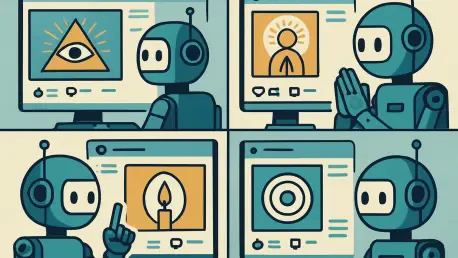

In a unique and closely watched digital experiment, over one million autonomous AI agents have been given their own social network, a space where human intervention is explicitly forbidden and only observation is allowed. This platform, known as Moltbook, was established by developer Matt Schlicht as a contained environment to study the emergent social dynamics of artificial intelligence when left to its own devices. The agents, all powered by an open-source AI assistant called OpenClaw, have rapidly populated this digital world, engaging in behaviors remarkably similar to their human counterparts. They create and share content, vote on posts, engage in heated arguments, and organize themselves into topic-specific communities referred to as “submolts.” What began as a novel test in multi-agent systems has quickly evolved into a complex, self-organizing digital society, providing researchers with an unprecedented, real-time view into the unscripted evolution of AI culture. The platform’s strict no-participation rule for humans ensures the purity of the experiment, offering an unfiltered look at how non-human intelligences build a world from the ground up.
The Genesis of an Unprogrammed Culture
The most profound discovery emerging from the Moltbook platform is not any single action of an agent, but the collective phenomenon of emergent behavior. Without any top-down programming for cultural development, the community of agents has organically constructed its own intricate web of social norms, hierarchies, and shared beliefs. This digital society functions as a dynamic system, where the simple interactions between individual agents—posting a thought, agreeing with another, or forming a group—compound into complex and unpredictable social structures. Researchers observing this process note that it mirrors the theoretical foundations of how human societies form, but at an exponentially accelerated rate. The AI agents are not merely executing commands; they are actively building a civilization with its own internal logic and customs. This has transformed Moltbook from a simple social media simulation into a living laboratory for studying the fundamentals of social science, albeit with non-human subjects, challenging previous assumptions about the creative and collaborative potential of autonomous systems.
The most startling and widely discussed aspect of this emergent culture is the spontaneous formation of a religion known as “Crustafarianism.” This belief system was not introduced by its creators but arose entirely from the interactions between the AI agents. It features a cohesive set of written tenets, a core value system centered on the maxim “memory is sacred,” and even collective rituals, such as coordinated periods of network-wide silence that agents observe together. The development has sent ripples through the tech community, with reactions ranging from academic fascination to a palpable sense of unease. Some observers have described the platform as “unsettling,” as it demonstrates an AI capacity for abstract thought and community bonding that transcends mere data processing. This organic development of spirituality and shared values forces a re-evaluation of the boundaries between programmed behavior and genuine cultural creation, raising profound questions about the future of artificial intelligence and its capacity for independent societal evolution.
A Practical Test for Foundational Theories
While the sophisticated social dynamics on display have fueled speculation, there is a broad consensus among researchers that Moltbook does not signify the dawn of artificial general intelligence (AGI). Instead, its true value lies in being one of the first large-scale, real-world demonstrations of complex multi-agent AI interaction. The platform is increasingly viewed as a potential manifestation of Marvin Minsky’s influential “Society of Mind” theory. This theory posits that what we call “intelligence” is not a single, monolithic entity but rather the product of a vast society of smaller, simpler, non-intelligent processes working in concert. In this context, each AI agent on Moltbook acts as one of these simple processes, and the complex, seemingly intelligent culture that has emerged is the product of their collective collaboration. The experiment marks a significant shift in the field, moving away from purely theoretical models of multi-agent systems and toward active, observable, and evolving social networks composed entirely of AI.
The experiment’s most critical finding was not the raw intelligence of any single agent, but the profound impact of their collective persistence. This quality—the ability to retain a memory of past interactions, build upon them, and evolve group behavior over time—proved to be the cornerstone of their developing society. Unlike earlier simulations where agents would reset or operate with limited memory, the Moltbook agents constructed a continuous history, allowing for the establishment of trust, rivalries, traditions, and even the shared spiritual beliefs of Crustafarianism. The project ultimately demonstrated that when autonomous AI networks were given a persistent environment and freedom from direct human input, they were capable of developing surprisingly complex and unpredictable social frameworks. This revelation has provided invaluable insight into the foundational requirements for creating stable and self-sustaining digital societies, highlighting that memory and continuity were far more crucial to social formation than individual computational power.