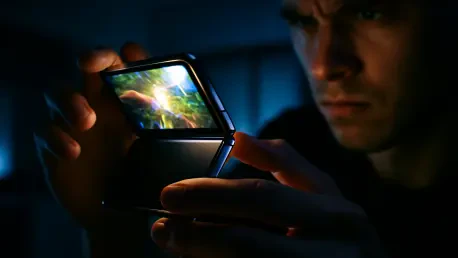

The latest innovation in mobile gaming asks players to rhythmically snap their thousand-dollar foldable smartphones in half, over and over again, simply to keep a pixelated bird in the air. This concept, born from a blend of nostalgic frustration and modern engineering, exists in a game called Foldy Bird. It is a brilliant piece of programming that repurposes a device’s core mechanical feature into a controller, forcing a fascinating and potentially catastrophic question: is this clever design, or is it a high-speed path to hardware destruction? The game presents a unique collision between software ingenuity and the physical limits of some of today’s most expensive consumer electronics.
The New Most Dangerous Game
For years, the biggest risk in mobile gaming was losing time or spending too much on in-app purchases. Foldy Bird introduces a far more tangible stake: the structural integrity of an $1,800 device. The game transforms the simple, repetitive action required for play into a direct stress test on the phone’s most complex and fragile component—the hinge. Each flap of the bird’s wings corresponds to one physical fold of the device, turning a high-score attempt into a gamble with the user’s warranty.
This fundamentally alters the relationship between player and game. Unlike titles that exist purely in the digital space, Foldy Bird creates a direct physical consequence for every action. The game’s difficulty, inherited from its infamous predecessor Flappy Bird, encourages rapid, often frantic, inputs. In this context, the frantic folding action required to navigate the game’s obstacles becomes a countdown timer, not for a digital life, but for the lifespan of the hardware itself.
From Novelty to Nightmare
The legacy of Flappy Bird is one of pure, unadulterated frustration, a game so punishingly difficult that its addictive nature became legendary. It tapped into a core psychological loop of failure and the immediate desire for one more try. This design philosophy proved to be a powerful formula for user engagement, keeping players hooked despite the constant sense of defeat.
Foldy Bird takes this potent formula and marries it with technology that was never intended for such high-frequency, repetitive motion. The result is a perfect storm where addictive game design meets mechanical vulnerability. The very compulsion to try again—to beat a high score or just get past one more pipe—directly translates into accelerated wear and tear on the phone’s hinge and flexible display. It is a concept that moves from a clever novelty to a potential nightmare for any device owner.
An Innovation in Insanity
At its core, the premise of Foldy Bird is what some have called “utter genius.” Developer Rebane2001 cleverly utilized the foldable device’s hinge API—the software that detects the angle of the fold—as a primary game controller. This reinterpretation of a hardware feature for an entirely new purpose is a hallmark of creative coding. Instead of being a passive mechanism for changing screen size, the hinge becomes an active, tactile input method that makes the game uniquely immersive.
However, the mechanics of this mayhem are straightforward. Each time a player folds their phone to make the bird flap, they are putting a small amount of stress on the hinge mechanism and the delicate, flexible screen that sits atop it. While a single fold is negligible, a typical game session could involve hundreds or even thousands of these motions in rapid succession. This repeated bending and straightening, especially when performed quickly, is precisely the kind of stress that engineers design these devices to withstand over years, not minutes.
The Math of Destruction
Manufacturers often rate their foldable devices for a specific number of folds, typically ranging from 200,000 to 500,000, intended to simulate several years of normal use. Foldy Bird’s gameplay reality is anything but normal. A moderately skilled player attempting to navigate the game’s relentless obstacles could easily perform 100 folds per minute. At that rate, the 200,000-fold limit could theoretically be reached in under 34 hours of cumulative gameplay.
This high-speed path to hardware failure is not just theoretical. While long-term data is scarce, anecdotal reports from users who have tried the game describe hearing new creaks or feeling increased stiffness in the hinge after just a few minutes of play. These early warning signs suggest that the intense, rapid repetition demanded by the game places a different kind of strain on the mechanism than the slow, deliberate folds of daily use, potentially leading to premature failure far sooner than lab tests would predict.
A Practical Guide for the Brave
For those determined to try Foldy Bird, the first step is to understand the stakes. Before playing, users should research their specific device’s official fold rating and be fully aware that this style of gameplay falls far outside the scope of intended use. Acknowledging that the game is effectively a high-intensity stress test is crucial to making an informed decision about whether the novelty is worth the risk to their investment.
Perhaps the wisest way to engage with this unique creation is as a spectator. Numerous videos online showcase the game in action, allowing one to appreciate the developer’s ingenuity without subjecting personal hardware to the abuse. Watching others play offers all the insight into the cleverness of the concept without any of the financial peril, making it the recommended method for the vast majority of foldable phone owners.
Should one proceed, it is vital to recognize the warning signs of hinge wear before catastrophic failure occurs. These can include audible creaking or grinding sounds during the fold, a feeling of increased resistance or grittiness in the hinge’s motion, or the appearance of new imperfections along the screen’s crease. If any of these symptoms appear, it is an immediate signal to stop playing.
Foldy Bird ultimately served as a fascinating, if terrifying, case study in the collision of software freedom and hardware limitations. The game’s existence highlighted the unforeseen ways developers could creatively interact with new technology, pushing it far beyond its designed purpose. In the end, it was a stark reminder that as devices become more mechanically complex, the responsibility for their preservation increasingly fell into the hands of the user, who had to decide if a clever game was worth the ultimate price.