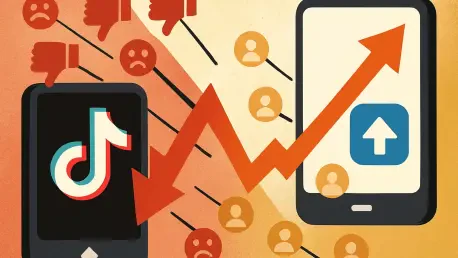

A seismic shift is underway in the digital town square as the recent restructuring of TikTok’s U.S. operations has triggered a significant user exodus, challenging the platform’s long-held dominance in the short-form video market. This widespread user discontent, fueled by mounting concerns over privacy and potential censorship under its new American-majority ownership, has created a fertile ground for emerging competitors. Among the primary beneficiaries of this digital migration is UpScrolled, a relative newcomer that has experienced an explosive surge in popularity by positioning itself as a transparent, user-centric alternative. The sudden pivot away from an established giant highlights a growing demand among social media users for platforms that prioritize data protection and viewpoint neutrality, signaling a potential new era where user trust is the most valuable currency. This evolving dynamic serves as a stark reminder that in the fast-paced world of social media, loyalty is fleeting and market leadership can be contested overnight.
A Crisis of Confidence in TikTok
The primary catalyst for the user backlash was the finalization of a complex deal that established a new, majority American-owned joint venture to oversee TikTok’s stateside operations. Under the new structure, TikTok’s Chinese parent company, ByteDance, saw its stake reduced to less than 20%, with prominent American firms such as Oracle, Silver Lake, and MGX assuming control. This transition, intended to alleviate national security concerns, ironically sparked a new wave of apprehension among the platform’s user base. A significant portion of users expressed fears that the new corporate stewardship could introduce political biases into the content moderation and algorithm, potentially altering the very nature of the platform. Compounding these worries was the rollout of an updated privacy policy that granted the app permission to track users’ precise GPS coordinates, a move that intensified long-standing privacy fears and led to widespread calls across social media for users to abandon the platform in favor of more secure alternatives.
These anxieties were quickly amplified by a series of technical issues and user-reported anomalies that occurred shortly after the takeover was announced. Numerous high-profile creators and everyday users reported significant difficulties in searching for or discovering content critical of U.S. Immigration and Customs Enforcement (ICE), as well as information related to ongoing protests in Minneapolis. Accusations of deliberate censorship and shadowbanning spread rapidly, feeding the narrative that the platform’s new ownership was already influencing content visibility. While TikTok’s official statement attributed these discovery problems to a temporary data center outage, the explanation did little to quell the growing skepticism. For many users, the incidents were perceived as a validation of their initial fears, solidifying their decision to seek out platforms that promised greater transparency and a more impartial approach to content moderation, thus accelerating the search for viable alternatives.
The Meteoric Rise of a New Contender
In this climate of widespread distrust, UpScrolled emerged as a formidable alternative, strategically capitalizing on the very concerns driving users away from TikTok. Founded by technologist Issam Hijazi, the platform was built on a core promise to deliver a social media experience free from “hidden algorithms or outside agendas.” This foundational pledge directly addressed the prevailing user anxieties. The company’s marketing emphasized a commitment to impartiality, explicitly stating it would not engage in shadowbanning and would ensure all user posts have an equal and fair opportunity to be seen. By blending popular features from established platforms like Instagram and X, UpScrolled presented a familiar yet fundamentally different user experience. It was marketed not just as another app but as a complete digital ecosystem engineered to restore power, transparency, and control to its user base, a value proposition that resonated powerfully with a disillusioned audience.
The market’s response to UpScrolled’s user-first philosophy was nothing short of dramatic. According to data from Appfigures, the application witnessed an unprecedented 2,850% increase in daily downloads in the immediate aftermath of the TikTok deal announcement. In a mere three-day span, it attracted approximately 41,000 new users, a figure that accounted for nearly one-third of its entire 140,000 lifetime installs. This explosive growth propelled UpScrolled up the download charts, securing the 12th overall position in Apple’s App Store and an impressive second place in the highly competitive social networking category. The company, which candidly described itself as a “tiny team,” publicly acknowledged the immense strain this unexpected influx of traffic placed on its servers. It issued statements assuring new and existing users that it was actively working to scale its infrastructure to meet the surging demand, further cementing its image as a responsive and transparent organization.
A Shifting Social Media Landscape
The surge experienced by UpScrolled was not an isolated phenomenon but rather a clear indicator of a broader, industry-wide trend. As users grew more critical of established platforms, other emerging networks also reported significant gains. Skylight, another application marketed as a TikTok alternative with a focus on privacy and creator-friendly policies, similarly announced a substantial increase in new sign-ups during the same period. This parallel growth suggested a collective movement among a discerning segment of social media users who were actively seeking out new digital spaces. These users were no longer content with the status quo and were migrating toward platforms they perceived as being more transparent, private, and politically neutral. This collective action signaled a potential maturation of the social media consumer, who now weighs factors like data governance and content neutrality as heavily as user interface and network effects when choosing where to invest their time and content. This period marked a pivotal moment where the balance of power appeared to tilt, at least partially, back toward the user, whose collective decisions began to reshape the competitive landscape.