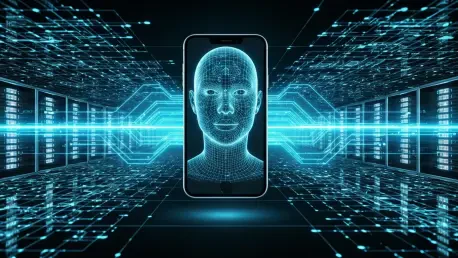

A powerful new facial recognition application deployed by U.S. Immigration and Customs Enforcement has ignited a firestorm of controversy, transforming smartphones into mobile surveillance devices and raising profound questions about the future of privacy and policing in America. Known as Mobile Fortify, the app equips ICE agents with the ability to conduct real-time biometric scans on individuals anywhere in the country, instantly cross-referencing their faces against a colossal network of government databases. This technology represents a significant escalation in the federal government’s capacity to track people far from the nation’s physical borders, prompting a fierce national debate among civil liberties advocates, legal scholars, and lawmakers over the creation of a “digital dragnet” that could fundamentally alter the relationship between citizens and the state. The debate centers on whether this tool is a necessary modernization for law enforcement or a dangerous step toward a society of pervasive, warrantless surveillance.
The Architecture of a Digital Dragnet
At its technical core, Mobile Fortify functions as a handheld key to an expansive biometric surveillance apparatus, leveraging sophisticated algorithms to turn a simple photograph into a potential identity match within seconds. The process begins when an agent captures a person’s facial image using a standard smartphone camera. This image is then transmitted and analyzed against the vast photographic repositories contained within Customs and Border Protection’s (CBP) Traveler Verification Service (TVS). Originally designed for border security, the TVS database holds images of millions of individuals, including a substantial number of U.S. citizens who have traveled internationally. The app’s seamless integration with this system allows an agent on a domestic street to perform an identity verification that was once exclusively the domain of ports of entry, effectively erasing the geographical lines that have traditionally constrained such powerful surveillance technologies and making every community a potential checkpoint.
The application’s reach, however, extends far beyond a single border-focused database, connecting to a much broader and more intricate web of government information. Reports indicate that Mobile Fortify plugs into an interconnected network of databases holding biometric data—ranging from photographs to fingerprints—on over 270 million individuals, sourced from a variety of federal, state, and local agencies. This deep integration means an agent’s query can trigger a cascade of data retrieval, potentially pulling from state driver’s license records, past visa applications, and other law enforcement systems. The app does not operate in isolation; it serves as the field-based component of a larger artificial intelligence ecosystem used by ICE, which includes services from data-mining firms to analyze disparate information. In practice, a non-consensual facial scan during a routine encounter could become the catalyst that unlocks and aggregates an individual’s entire digital footprint, creating a comprehensive profile without their knowledge or consent.
A Fractured View on Necessity and Overreach
From the perspective of the Department of Homeland Security (DHS) and ICE, Mobile Fortify is presented as a crucial and logical evolution of law enforcement technology. Officials defend the app as a vital tool for improving both agent safety and operational effectiveness in the field. Proponents argue that its ability to rapidly confirm or refute an individual’s identity in high-stakes encounters—such as fugitive operations, deportations, or interactions with persons who have outstanding warrants—is invaluable. A former ICE official emphasized that while biometric technology has long been a part of the agency’s toolkit, the innovation of Mobile Fortify lies in its portability, streamlining these powerful capabilities into a device that every agent can carry. DHS maintains that the application is deployed within established privacy frameworks and that all data usage is strictly confined to authorized law enforcement missions, positioning it as a targeted instrument for specific investigations rather than a tool for indiscriminate, mass surveillance of the general public.
In stark contrast, a wide-ranging coalition of civil liberties organizations, privacy advocates, legal experts, and bipartisan members of Congress has mounted a formidable opposition, articulating a comprehensive critique of the program’s very existence. Central to their argument is the assertion that Mobile Fortify dangerously erodes the distinction between border enforcement and interior policing. A technology conceived for managing the flow of people at national frontiers is now being used for domestic law enforcement, which critics contend is a significant overreach of federal authority that effectively extends the “border” to any location an ICE agent is present. This expansion has triggered serious Fourth Amendment alarms regarding unreasonable searches and seizures, as scans are conducted without consent, an opt-out option, or a judicial warrant. Senators Ron Wyden, Jeff Merkley, and Ed Markey have been vocal in their demands for ICE to cease using the app, citing a profound lack of oversight and the grave risk it poses to fundamental constitutional protections.
The Inherent Flaws of Automated Identification
A significant point of contention revolves around the inherent fallibility and potential for bias within facial recognition technology itself. The accuracy of the algorithms powering Mobile Fortify can be significantly compromised by a variety of real-world factors, including suboptimal lighting, partially obscured faces, or the viewing angle of the camera, all of which increase the risk of misidentification. Such an error is not a minor inconvenience; it could lead to catastrophic consequences, including the wrongful arrest, detention, or even deportation of an innocent person, potentially including U.S. citizens who are misidentified as subjects of interest. This risk is compounded by the opaque nature of the algorithms, which often makes it difficult to challenge or even understand the basis of an automated match, leaving individuals with little recourse in the face of a machine-driven accusation that could irrevocably alter their lives.
Furthermore, the technology’s deployment threatens to amplify existing patterns of systemic bias in policing. Numerous independent studies have consistently demonstrated that facial recognition systems often exhibit higher error rates when identifying people of color, women, and younger individuals. When deployed by law enforcement, this technological bias could exacerbate racial profiling, leading to a disproportionate number of false positives and unwarranted scrutiny for already marginalized communities. The concern is that the app, far from being an objective tool, will instead reinforce human biases with a veneer of technological impartiality. This could result in minority communities being subjected to a higher degree of surveillance and a greater likelihood of erroneous identification, deepening mistrust between law enforcement and the public while undermining efforts to achieve equitable and just policing practices across the nation.
A Defining Moment for Privacy and Policing
The controversy surrounding Mobile Fortify crystallized a broader societal reckoning with the rapid integration of biometric surveillance into the fabric of American life. The deployment of such a powerful tool without robust public debate or comprehensive regulatory frameworks established a concerning precedent, signaling a shift toward the normalization of real-time, remote identification by government agents. Critics argued that this development represented more than just a new enforcement gadget; it was a paradigm shift in domestic surveillance capabilities. The app’s continued use set a dangerous example that could encourage state and local police departments to adopt similar technologies for general law enforcement, potentially paving the way for a future where facial scans become a routine and unavoidable part of navigating public spaces. The public discourse reflected a growing apprehension about this “slippery slope” toward a society of constant monitoring, drawing parallels to the dystopian surveillance states once confined to fiction.
Ultimately, the fierce debate ignited by the app’s rollout forced a national conversation about the acceptable trade-offs between security and liberty in a technological age. Civil liberties organizations and legal advocates had pressed for a complete moratorium on its use until comprehensive safeguards could be implemented. The proposed reforms were extensive, including requirements for judicial warrants for scans in non-emergency situations, mandates for explicit and informed consent from individuals being scanned, and the establishment of independent, third-party audits to verify the technology’s accuracy and assess its potential for bias. Greater transparency through the public release of usage policies, error data, and audit results was also a key demand. The path forward that emerged from this conflict centered on the urgent need for vigilant legislative and judicial oversight to ensure that the pursuit of enforcement efficiency did not come at the expense of fundamental constitutional rights. The societal and legal response to Mobile Fortify became a critical test case that would likely define the landscape of privacy in the United States for years to come.