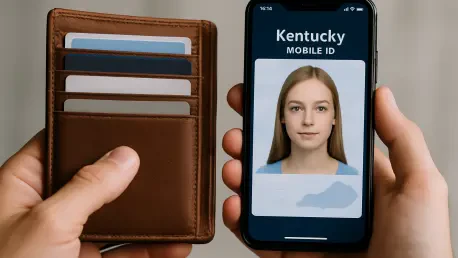

The long-held concept of a physical wallet filled with plastic cards is being fundamentally challenged as Kentucky introduces a state-of-the-art mobile identification program, placing the Bluegrass State at the forefront of a national shift toward digital credentials. In a strategic partnership with IDEMIA Public Security North America, the Kentucky Department of Vehicle Regulation has launched a free mobile application that transforms a resident’s smartphone into a secure and versatile form of ID. This initiative moves beyond mere convenience, representing a paradigm shift in how personal information is managed, shared, and protected. It offers a glimpse into a future where citizens have granular control over their own data, using a device that is already an indispensable part of modern life. This move positions Kentucky not just as an early adopter but as a key player in defining the standards for secure digital identity across the United States, raising important questions about the speed and scope of a nationwide transition away from traditional identification methods.
A New Era of Digital Convenience
The most immediate and tangible advantage for Kentuckians is the significant enhancement of the air travel experience, effectively modernizing one of the most common and often stressful identity verification processes. Residents can now use their mobile ID at Transportation Security Administration (TSA) checkpoints within the state’s major aviation hubs, including Cincinnati/Northern Kentucky International Airport (CVG), Louisville Muhammad Ali International Airport (SDF), Blue Grass Airport (LEX), and Barkley Regional Airport (PAH). This adoption also extends to a growing network of participating airports across the country that have integrated the necessary technology. The system allows for a quick, contactless verification where travelers simply present their digital credential on their smartphone, streamlining security lines and reducing physical touchpoints. This initial application serves as a powerful demonstration of the technology’s potential to simplify and secure everyday interactions that have long been dependent on antiquated physical documents, offering a practical solution that aligns with the digital-first expectations of today’s public.
While the convenience at airport security is a compelling starting point, the vision for Kentucky’s mobile ID extends far beyond the terminal, aiming to establish a comprehensive and interactive identity tool for a multitude of scenarios. The underlying technology, built upon IDEMIA’s proprietary and patented systems, is engineered for broad interoperability, enabling its use for both in-person and online identity verification by a diverse range of entities. The platform is intended to be a single, trusted source of identity for government agencies, financial institutions, healthcare providers, and retailers. This creates the potential for a seamless ecosystem where a Kentuckian could use their mobile ID to prove their age for a restricted purchase, securely access online government services, verify their identity to open a bank account, or check in for a medical appointment. The emphasis on creating a versatile and widely accepted digital credential is a key aspect of its design, promising a future where a single secure app can replace a wallet full of disparate plastic cards.
Fortifying Identity with Digital Safeguards
At the core of the Kentucky mobile ID is a robust, multi-layered security architecture designed to protect against unauthorized access and fraud, offering protections that a traditional physical card cannot. The application is fortified with security protocols that require the user to authenticate their identity each time the digital ID is accessed. This is accomplished using the smartphone’s built-in biometric capabilities, such as a fingerprint scan or facial recognition, or through a personal six-digit PIN created by the user during setup. This critical security feature ensures that even if the physical mobile device is lost, stolen, or otherwise compromised, the digital ID remains secure and inaccessible to unauthorized individuals. This approach effectively separates the credential from the physical device, transforming the phone from a simple carrier of information into a secure vault that requires the owner’s explicit and verified presence to unlock its contents, a significant leap forward in personal data protection.
Perhaps the most revolutionary aspect of the mobile ID is its foundational commitment to user privacy, which is achieved through a “privacy-by-design” framework that places unprecedented control in the hands of the individual. A significant limitation of a physical driver’s license is that presenting it for any reason exposes all the information printed on it—full name, address, date of birth, and physical descriptors—regardless of what information is actually required. In stark contrast, the mobile ID operates on a principle of consent-based, selective information sharing. For every transaction, the user must explicitly authorize the release of their data. More importantly, the technology enables data minimization, meaning only the information strictly necessary for a given transaction is shared. As articulated by state officials, a user can cryptographically prove they are of legal age to purchase a restricted item without ever revealing their specific date of birth or home address. The app can simply transmit a “yes” or “no” confirmation, dramatically enhancing consumer privacy and mitigating the risk of personal data being unnecessarily exposed or copied.
Paving the Way for a National Standard
Kentucky’s initiative is not operating in isolation; it serves as a critical component in a much larger, national effort to establish a trusted and interoperable framework for digital identity. The credibility of the state’s mobile ID program is significantly bolstered by its formal inclusion in a major national cybersecurity project. The application has been designated as the first official use case within the National Cybersecurity Center of Excellence’s (NCCoE) mobile driver’s license project, which operates under a collaborative research and development agreement (CRADA). This participation is highly significant, as it indicates that the technology has been rigorously vetted against stringent federal standards for both security and privacy. By serving as a real-world test case, Kentucky’s program is actively contributing to the development and refinement of a nationally recognized and trusted framework for mobile identities, helping to shape the standards that other states will likely follow in the coming years.
The endorsement from state and industry leaders further cements the program’s importance as a forward-thinking public service enhancement. Governor Andy Beshear emphasized the dual benefits for citizens, positioning the mobile ID as a tool that not only provides more convenient options for air travel but also offers superior protection against identity theft and the oversharing of sensitive personal data. Similarly, Kentucky Transportation Cabinet Secretary Jim Gray highlighted the practical advantages, clarifying that the mobile ID serves as a digital companion to the physical card rather than a replacement, while underscoring the transformative privacy benefit of user-controlled information sharing. From the private sector, Rob Gardner, CEO of IDEMIA Civil Identity, praised Kentucky for its leadership in adopting innovative technology, framing the launch as a landmark achievement in a rapidly evolving digital identity market and reaffirming a commitment to advancing secure solutions that improve citizens’ daily lives.
A Glimpse into the Future of Identity
The launch of Kentucky’s mobile ID, developed through a thoughtful partnership with IDEMIA, marked a significant milestone in the evolution of digital identity management within the United States. It successfully provided residents with a highly secure, convenient, and privacy-preserving alternative to their physical identification cards. The system’s core strengths were found in its user-centric design, which incorporated robust multi-factor authentication and gave individuals granular control over their personal data through consent-based, selective sharing. Its alignment with national cybersecurity standards via the NCCoE project underscored its technical integrity and its pivotal role in fostering a future of interoperable digital identities. The collective perspective of state and industry leaders confirmed that this initiative was not merely a technological upgrade but a strategic move that enhanced citizen safety, protected privacy, and fully embraced the future of secure digital interaction, setting a powerful precedent for the nation.