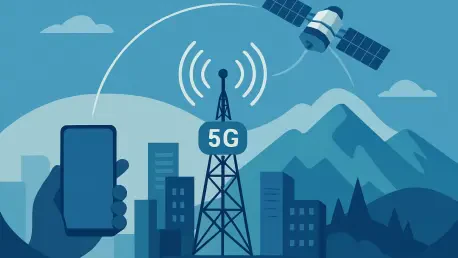

The persistent frustration of a dropped call or a nonexistent data signal in a remote area might soon become a relic of the past, as a groundbreaking initiative aims to blanket the entire globe with uninterrupted mobile connectivity. Japan’s national space agency, JAXA, has ignited this ambition by awarding a substantial research and development grant, potentially valued at $71.9 million, to a powerful collaboration between Rakuten Mobile and the University of Tokyo. This funding, channeled through the country’s Space Strategy Fund, is dedicated to a pioneering project that seeks to seamlessly merge terrestrial 5G networks with direct-to-mobile satellite communications. The core objective is to create a unified, intelligent network where a standard smartphone can effortlessly switch between a cell tower and an orbiting satellite, effectively eliminating the concept of a “dead zone” for good. This multi-year endeavor represents a significant leap forward in the quest for universal connectivity, moving beyond niche satellite phones and toward a future where every mobile device remains online, regardless of its geographical location.
A New Frontier in Network Integration
The project, titled “Satellite and Terrestrial Network Integration for Seamless Frequency Sharing,” represents a significant step toward solving one of the most complex challenges in modern telecommunications. By leveraging existing partnerships and strategic investments, including a long-standing collaboration with the University of Tokyo and a key stake in AST SpaceMobile, Rakuten is positioned to spearhead this technological revolution. This ambitious program, scheduled to run from March 2026 through March 2031, is designed to build a future-proof communications infrastructure that is both ubiquitous and resilient. The research will not only focus on the theoretical aspects of network integration but will also develop practical, deployable technologies that can be integrated into commercial mobile networks. This initiative’s success could set a new global standard for how mobile connectivity is delivered, particularly in underserved rural and remote areas, and provide a critical communications backbone during natural disasters or other emergencies when terrestrial infrastructure is compromised.
The Challenge of Spectrum Scarcity
A primary technical hurdle that the research aims to overcome is the pervasive issue of spectrum congestion, which occurs when too many signals compete for the same limited frequency bands. To solve this, the project will develop sophisticated dynamic frequency sharing protocols, a technology that allows Low Earth Orbit (LEO) satellites and ground-based cellular towers to intelligently use the same spectrum simultaneously without creating mutual interference. This is a delicate balancing act that requires real-time coordination and predictive analysis to ensure that signals from space do not disrupt terrestrial communications, and vice versa. The development of these protocols is fundamental to the project’s success, as it unlocks the ability to significantly expand network capacity and coverage without requiring new, dedicated spectrum allocation, which is both costly and scarce. By enabling this harmonious coexistence, the initiative will pave the way for a more efficient and expansive global mobile network.
At the heart of this frequency-sharing solution lies the application of advanced artificial intelligence and machine learning algorithms. These AI systems will be tasked with continuously monitoring the network environment to manage interference in real time, a process far too complex and rapid for human intervention. The algorithms will also actively compensate for the Doppler effect—the shift in frequency that occurs as fast-moving LEO satellites pass overhead—which can otherwise degrade or drop the connection. Furthermore, the AI will be responsible for intelligent traffic balancing, dynamically routing data between the satellite and terrestrial layers of the network to optimize performance and prevent congestion. A critical success metric for the project is ensuring that this entire complex process remains invisible to the end-user, allowing standard, unmodified smartphones to transition seamlessly between ground and space networks without any interruption in service, whether during a voice call or a data session.
Building a Resilient Communications Future
Beyond extending coverage to remote and maritime regions, a major emphasis of the initiative is on enhancing national disaster resilience. When earthquakes, typhoons, or other calamities damage or destroy ground-based infrastructure like cell towers and fiber optic cables, communications are often one of the first essential services to be lost. This project directly addresses that vulnerability by creating a system of “coverage from above.” By enabling direct satellite-to-mobile connectivity, the network can maintain a vital communication lifeline for first responders, government agencies, and the general public, even when the terrestrial network is completely offline. This capability is crucial for coordinating rescue efforts, disseminating emergency information, and allowing affected individuals to connect with loved ones. The ultimate goal is to build an infrastructure that is not just expansive but inherently robust against catastrophic events.
According to Rakuten’s Chairman and CEO, Hiroshi Mikitani, the overarching vision is to leverage this integrated network technology to achieve 100% geographical coverage across Japan and potentially beyond. This ambitious goal aims to provide unwavering and reliable connectivity for all customers, whether they are in dense urban centers, remote mountainous areas, or out at sea. Upon the successful completion of the research and development phase, the plan is to integrate these advanced, AI-driven protocols directly into Rakuten’s commercial mobile network. This will complement the company’s separate launch of a mobile satellite service, also planned for 2026, creating a multi-layered, hybrid network that stands as one of the most advanced and comprehensive in the world. The project serves as a clear statement of intent to redefine the boundaries of mobile communication and ensure that connectivity is a universal utility.
The Dawn of a Connected Planet
The project initiated by JAXA, Rakuten Mobile, and the University of Tokyo represented a pivotal moment in the evolution of global communications. Its focus on solving the core technical challenges of spectrum sharing and seamless network handoffs laid the essential groundwork for a new era of hybrid satellite-terrestrial networks. By proving that standard mobile devices could connect directly to satellites without interference, the initiative fundamentally altered the industry’s approach to closing the digital divide and ensuring connectivity during emergencies. The successful development of AI-driven protocols for managing these complex networks provided a scalable and efficient model that other nations and providers could adopt. This breakthrough has accelerated the journey toward a world where geographical location no longer dictates access to reliable communication, transforming what was once a technological aspiration into an achievable reality for millions.