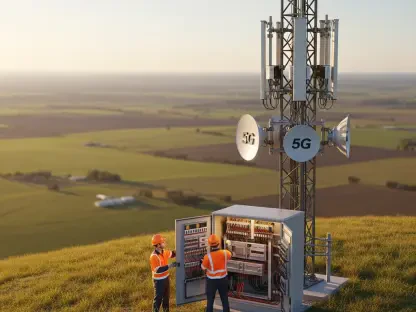

While the technology industry casts its gaze toward the horizon of sixth-generation wireless connectivity, a significant portion of the business world remains firmly planted in the present, grappling with the often-unfulfilled promises of 5G. This dichotomy raises a critical question for enterprise leaders: does it make sense to plan for a future defined by 6G when the foundational capabilities of its predecessor are still a work in progress? The conversation around 6G is not merely about the next incremental upgrade; it represents a potential redefinition of what a network can be. However, this forward-looking ambition must be carefully weighed against the immediate, practical connectivity challenges that organizations face today, creating a complex landscape for strategic planning and investment. This analysis explores that tension, synthesizing expert perspectives to balance future potential with present-day realities.
A Paradigm Shift Beyond Speed
The vision for 6G represents a deliberate pivot away from the traditional metrics that have defined previous cellular generations. Unlike the leaps from 3G to 4G or 4G to 5G, where headline-grabbing increases in raw speed and reductions in latency were the primary selling points, the evolution to 6G is anticipated to be far more nuanced. Industry analysts suggest the performance jump from a mature 5G network to an early 6G one may be less dramatic than in the past. Instead, the true revolution is expected to lie in a fundamental paradigm shift toward an “AI-native” network. This concept reimagines the network not as a passive conduit for data but as an intelligent, self-optimizing, and resilient system. Experts like Ian Fogg of CCS Insight articulate a future where machine learning is deeply integrated into the core architecture, not only to enhance operational efficiency and resource allocation but also to provide a foundational platform explicitly designed to support the complex, AI-driven applications of tomorrow. This native integration is seen as the key to unlocking truly autonomous systems and making ubiquitous AI-powered edge computing a reality.
Further expanding this vision, another transformative theme is the idea of the network as a pervasive sensor. The ambition for 6G extends beyond communication to include sophisticated sensing and computing capabilities, effectively turning the network into a spatially aware system that can perceive, interpret, and interact with the physical world. Christophe Firth, a partner at Kearney, explains that this fusion of functionalities could enable profound and safety-critical applications, such as the seamless coordination of autonomous vehicle fleets, highly advanced industrial automation, and the creation of dynamic, city-scale “digital twins” for managing urban infrastructure with unprecedented precision. This is complemented by the goal of achieving truly “ubiquitous connectivity.” As emphasized by Gökhan Tok of Access Partnership, this involves the seamless integration of terrestrial cellular networks with non-terrestrial platforms like satellites and high-altitude systems. The ultimate objective is to weave a single, cohesive network fabric capable of delivering reliable, high-performance connectivity anywhere on the globe, effectively eliminating the coverage “dark spots” that persist in rural and remote areas.
The Overriding Primacy of 5G
Despite the exciting long-term potential of 6G, the most powerful and unanimous consensus among industry experts is the immediate and overriding importance of 5G. A strong majority cautions businesses against getting caught up in the 6G hype cycle while the foundational work on 5G remains incomplete. The prevailing sentiment is that organizations must first concentrate on extracting the full, promised value from existing 5G technology before diverting significant attention to the next generation. This pragmatic stance is grounded in several critical observations that highlight the gap between 5G’s promise and its current state. The most pressing issue is that reliable 5G coverage is far from universal. As noted by CTO Jason Gilmore, many regions and businesses still lack access to consistent service, making any discussion of 6G purely academic for them. For these organizations, the immediate, measurable benefits lie not in future-gazing but in optimizing current infrastructure and advocating for broader 5G deployment to address their present-day connectivity needs.
Furthermore, the fundamental requirements of most businesses today are not centered on the futuristic capabilities promised by 6G. Experts like Alex Kugell and Matt Beucler argue that enterprises are still seeking the foundational improvements that 5G was intended to deliver but has not yet consistently provided. These core needs include unwavering network reliability, end-to-end data integrity, comprehensive traceability for all transactions, and built-in compliance and security features that can be trusted implicitly. As Beucler states, what is truly needed are “stable, secure, low-latency networks,” which are promises inherent to the 5G specification itself. Therefore, the actionable advice for IT leaders is clear: concentrate on the present. This involves extending 5G infrastructure, exploring and scaling private 5G networks to gain greater control over security and performance, integrating edge computing to process data closer to its source, and scaling Internet of Things deployments securely. Mastering these 5G-centric technologies is the most direct path to tangible business value today and will lay the essential groundwork for a smoother migration to 6G in the future.
A Measured View of the Path Forward
A critical assessment of the conversation surrounding 6G also reveals a significant component of industry hype that decision-makers must navigate carefully. Several experts express a healthy skepticism, noting that the “6G” label is often leveraged by vendors to maintain investor excitement and perpetuate investment cycles, a pattern observed with the rollout of previous generations. Panayot Kalinov and Alex Kugell both suggest that a substantial portion of the current narrative is more of a strategy to keep investment flowing into research and development rather than a direct response to genuine, articulated business needs from the market. There is a palpable caution within the industry to avoid the overpromising and subsequent disillusionment that hampered early 5G adoption. Ian Fogg even speculates that 6G might be deliberately “under-hyped” by the time it arrives as a strategy to manage expectations more effectively. Amidst this hype, however, it is acknowledged that substantial and legitimate research is underway, creating a distinct challenge for observers to separate market speculation from true technological innovation.
The analysis ultimately concluded that the relevance of 6G was best understood through a dual lens of “yes, and not yet.” Yes, 6G mattered immensely as a long-term vision. If successfully realized, its evolution into an AI-native, sensing, and globally integrated network had the potential to become the transformative intelligent fabric underpinning the next era of automation, computation, and human communication. However, the more immediate and pressing answer for contemporary businesses was “not yet.” The real work and tangible value remained firmly rooted in the successful implementation and optimization of 5G. The industry’s unmistakable message was that the most critical task at hand was making current networks deliver on the long-standing promises of reliability, coverage, and security. Fulfilling these commitments was not only what mattered most in the present but was also the essential foundation upon which a credible and successful transition to 6G could one day be built.