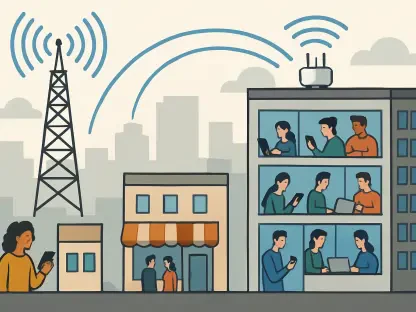

The thunderous applause echoing through the halls of MWC Barcelona this year confirmed a monumental shift as Huawei walked away with a staggering eight GLOMO Awards. This unprecedented achievement serves as a definitive marker for the global telecommunications industry, signaling that the era of experimental 5G has concluded to make way for the massive commercialization of 5G-Advanced (5G-A). By securing victories across diverse categories ranging from core infrastructure to digital inclusion, the company demonstrated that its role has evolved from a traditional hardware provider into the primary architect of an intelligent, autonomous ecosystem. This transition reflects a broader movement within the sector toward networks that do not just carry data but actively interpret and optimize it in real-time.
The significance of these accolades extends far beyond corporate prestige, as the Global Mobile Awards are determined by a rigorous panel of independent analysts and industry experts. The 2026 ceremony highlighted a consensus that 5G-A is now the cornerstone of the digital economy, providing the necessary bandwidth and latency improvements required for the next generation of mobile services. This recognition underscores a shift in how the world perceives connectivity, moving away from simple pipe-building toward the creation of value-driven, intelligent environments. As these technologies move from the lab to the city streets, the infrastructure showcased at the event is already beginning to redefine the boundaries of what a mobile network can achieve.
The Milestone at MWC Barcelona 2026: A Clean Sweep for Innovation
The sweep of eight GLOMO Awards at this year’s Mobile World Congress represented more than just a successful trade show appearance; it was a validation of a multi-year strategy focused on 5G-A and AI integration. By winning the “Best Mobile Network Infrastructure” award, the industry acknowledged that the hardware underpinning our digital lives has reached a new level of maturity. This infrastructure is no longer just about raw speed but about the sophisticated orchestration of spectrum and energy. The awards recognized that the transition to 5G-Advanced is a global reality, moving from localized trials to nationwide deployments that support everything from industrial automation to high-fidelity consumer media.
Moreover, the diversity of the awards suggests that innovation is no longer siloed within purely technical domains. Recognitions for social responsibility and financial inclusion indicate that the telecommunications landscape is becoming more human-centric. The industry is witnessing a pivot where the success of a technology is measured by its ability to solve real-world problems, such as bridging the educational divide or providing banking services to the unbanked. This holistic approach to innovation has set a new benchmark for global competitors, forcing a re-evaluation of how technology companies contribute to the broader socio-economic fabric while maintaining their competitive edge.
Why the Shift to 5G-Advanced and AI Matters Now
Global data consumption is currently reaching a critical inflection point where traditional 5G networks struggle to maintain the balance between performance and sustainability. The industry is grappling with a dual crisis: an insatiable demand for massive bandwidth driven by generative AI and immersive media, alongside an urgent requirement to meet carbon neutrality goals. This pressure has made the convergence of 5G-A and AI not just an advantage, but a necessity for survival in the modern market. Human-managed networks have reached their operational limits, unable to handle the millisecond-level adjustments required to optimize traffic in a world of billions of connected devices.
Consequently, the industry is moving toward “experience monetization,” a strategy that moves the conversation away from selling simple gigabytes. Carriers are now looking for ways to ensure profitability by offering guaranteed service levels for specific applications, such as cloud gaming or remote surgery. This shift requires a network that is intelligent enough to prioritize traffic dynamically without wasting energy or resources. By integrating AI into the very core of the network, operators can finally break the link between increased traffic and increased operational costs. This evolution ensures that the telecommunications sector remains a viable engine for growth while adhering to the stringent environmental standards of a green-tech era.
The Pillars of Huawei’s Technological Dominance
Sustainable infrastructure remains the fundamental pillar of this new era, with a focus on hardware that maximizes performance while minimizing the environmental footprint. Recent breakthroughs in ultra-broadband and multi-antenna systems have enabled carriers to deploy 5G-A networks that deliver ten times the capacity of early 5G iterations. These systems utilize advanced energy-saving algorithms that allow the network to “breathe,” consuming power only when active traffic is detected. This backbone provides the essential stability required for a decade of mobile communication that will be dominated by high-speed, low-latency demands from both consumers and industrial sectors.
Another cornerstone of this dominance is the rise of the autonomous network, powered by swarm intelligence. The introduction of the world’s first carrier-grade A2A-T multi-agent communication protocol has pushed networks toward Level 4 autonomy. In this framework, AI agents collaborate across different domains to solve operational bottlenecks, self-heal during outages, and optimize coverage without human intervention. This shift reduces the complexity of managing modern networks, allowing for a more resilient digital environment. Furthermore, the integration of Non-Terrestrial Networks (NTN) has expanded connectivity beyond the cell tower, linking standard smartphones directly to satellites. This ensures seamless coverage in maritime and remote regions, effectively eliminating the “dead zones” that have long plagued global communication.
Expert Insights and Real-World Impact
Industry experts have increasingly pointed to the social implications of these technological leaps, particularly in the realm of digital equity. The “Qingjiao Plan” has emerged as a landmark example of how 5G-A can be used to bridge the digital divide in rural regions. By utilizing high-speed connectivity and cloud-based collaboration tools, students in remote areas are now accessing the same quality of education as their urban counterparts. This application of technology demonstrates that the true value of 5G-A lies in its ability to facilitate social mobility and provide equal opportunities to underserved populations, regardless of their geographic location.
In the financial sector, the impact of mobile-first innovation is reshaping entire economies, as seen with the Ziidi Wealth Platform in Kenya. Developed to bypass traditional banking hurdles, this platform integrates real-time credit risk control with mobile money systems, allowing low-income populations to participate in the formal economy. Simultaneously, the transformation of the phone dialer into an AI-driven service hub via “5G New Calling” is changing the nature of communication itself. Experts noted that by turning a simple call into a portal for health monitoring and real-time consultations, the mobile device has become a proactive assistant. These real-world applications prove that 5G-A is not just a faster connection, but a catalyst for systemic change across healthcare, finance, and education.
Strategies for Navigating the Era of Agentic Networks
To remain competitive in this rapidly evolving landscape, operators and enterprises prioritized the transition from manual network management to AI-centric operations. This involved the adoption of multi-agent protocols that allowed different components of the digital ecosystem to communicate and optimize themselves in real-time. By implementing Level 4 autonomy, organizations successfully reduced operational overhead and minimized the risk of human error in complex configurations. This strategic shift enabled a more agile response to fluctuating market demands, ensuring that the network remained efficient even under heavy loads.
Furthermore, forward-thinking organizations leveraged the integration of terrestrial and satellite communications to achieve 100% global coverage. By utilizing adaptive quantization and high-gain channel coding, they ensured reliable connectivity in the most geographically challenged areas on Earth. The industry also shifted toward value-based business models, moving away from the commoditization of data. Instead, carriers offered service-level agreements (SLAs) that focused on the quality of experience for specific tasks. This approach allowed the network to be treated as a premium service, creating new revenue streams based on the precision and reliability that 5G-A provides. These strategies collectively ensured that the transition into the era of agentic networks was both profitable and technologically sound.