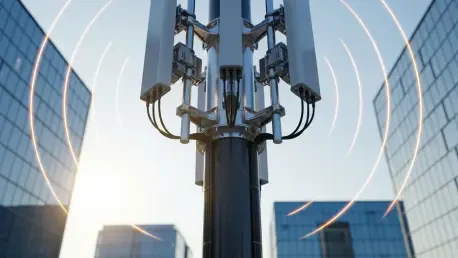

The telecommunications landscape is undergoing a radical transformation as T-Mobile US moves beyond the era of providing simple connectivity to become a central architect of intelligent infrastructure. During the recent proceedings at the 2026 Mobile World Congress, the company articulated a vision that moves past the incremental improvements of 5G-Advanced and instead focuses on the creation of a fully AI-native 6G framework. This strategic pivot signals a fundamental change in how networks are perceived, shifting from connectivity pipes that merely transport data to intelligent platforms that integrate sensing and high-performance computing directly into the radio fabric. By collaborating with key industry leaders, T-Mobile is laying the groundwork for a wireless ecosystem projected to reach commercial viability as early as 2029. This evolution represents a commitment to building a network that functions as a distributed brain, capable of perceiving its environment and processing massive datasets with unprecedented speed and precision while maintaining the highest standards of reliability.
Engineering an Intelligent Foundation with Strategic Alliances
A primary driver of this technological leap is the deep collaboration between T-Mobile and Qualcomm Technologies, which focuses on establishing a robust roadmap for the 6G era. This partnership is built upon three essential pillars: maximizing spectral efficiency to handle escalating data demands, pioneering wide-area sensing capabilities, and implementing energy-efficient computing models. Wide-area sensing stands out as a particularly transformative feature, as it enables the network’s radio waves to double as environmental sensors. This innovation allows the infrastructure to gather spatial data and provide situational awareness without the need for additional cameras or specialized hardware. Consequently, the network can generate high-fidelity digital twins of urban environments and offer real-time traffic insights that were previously impossible to achieve. By turning the radio environment into a source of contextual intelligence, T-Mobile is ensuring that the infrastructure provides value far beyond traditional voice and data services.
Parallel to these developments, T-Mobile is focusing on infrastructure flexibility by working closely with Ericsson and Nvidia to test the limits of Cloud Radio Access Network technology. A recent successful trial demonstrated a portable Cloud RAN stack that is entirely hardware-agnostic, successfully decoupling sophisticated network software from proprietary hardware components. This shift is critical for the AI-native future, as it allows T-Mobile to deploy high-performance network functions across a variety of off-the-shelf commercial systems, significantly improving scalability while managing operational costs. By embedding Nvidia’s specialized AI acceleration directly into the RAN, the company has created a platform that handles traditional communication tasks alongside intensive AI workloads. This dual-purpose architecture ensures that the network can support the heavy computational requirements of real-time machine learning without sacrificing the reliability or speed expected by modern consumers. This flexibility is the key to maintaining a competitive edge in a rapidly changing hardware landscape.
Integrating Physical Intelligence and Transatlantic Research
To maintain a leading edge in global research, T-Mobile established a Joint 6G Innovation Hub in partnership with Deutsche Telekom, linking major R&D centers in Washington and Germany. This transatlantic pipeline facilitates a constant exchange of technological breakthroughs, ensuring that American innovations remain perfectly aligned with international standards and European hardware developments. The hub’s primary focus is the integration of high-performance computing within the network to minimize latency for mission-critical applications. This collaborative effort is also driving the development of physical AI systems, which are designed to interpret and act upon real-world stimuli in real time. Rather than just predicting data trends, these systems enable the network to participate actively in autonomous environments. This global cooperation ensures that the 6G framework is built on a foundation of secure sensing and intelligent connectivity, providing a unified standard that can be deployed across different continents while addressing local regulatory and technical needs.
Central to the realization of physical AI is the introduction of kinetic tokens, a concept championed by T-Mobile’s leadership to describe data that carries both intent and precise timing for physical movements. Unlike the informational tokens used by current large language models to predict text or images, kinetic tokens are essential for triggering physical actions, such as an autonomous vehicle making a split-second turn or a robotic arm performing surgery. These applications require a level of deterministic performance that current 5G networks are only beginning to explore. To support these demands, the 6G architecture must provide ultra-low latency and perfect synchronization across the entire network fabric. By prioritizing these requirements, T-Mobile is positioning its infrastructure as the essential nervous system for the next generation of autonomous systems. This focus on deterministic performance ensures that the network can handle the high-stakes demands of a world where digital commands result in immediate and precise physical consequences without any room for error.
Reshaping the Telecom Identity Through Advanced Sensing
As the industry approaches the end of this decade, the distinction between a traditional telecommunications provider and a comprehensive AI service provider is becoming increasingly blurred. T-Mobile’s emphasis on the network as a sensor reflects a broader industry consensus that future wireless systems must offer more than just high-speed data transmission. By providing spatial and environmental awareness, the network serves as a foundational layer for global intelligence, enabling cities to become smarter and industries to operate with higher levels of autonomy. This shift toward integrated compute architectures and sensing capabilities marks the transition of the cellular network into a ubiquitous utility for machine intelligence. This transformation required a move away from static hardware toward software-defined environments that can adapt to the needs of different AI models. The result is an ecosystem where the network does not just connect devices but actively understands the context in which those devices operate, providing a much smarter experience.
In the pursuit of this 6G vision, T-Mobile successfully demonstrated that the path forward required deep cross-industry integration and a move away from proprietary silos. The strategy prioritized the development of open, hardware-agnostic platforms that allowed for the rapid deployment of AI-driven services across diverse geographical areas. Stakeholders recognized that preparing for 2029 necessitated immediate investments in edge computing and sensing technologies to ensure that the infrastructure remained relevant. The company focused on establishing clear protocols for kinetic tokens to guarantee the safety and reliability of autonomous systems in real-world scenarios. Future considerations involved refining the security protocols for wide-area sensing to protect user privacy while maximizing environmental intelligence. These steps ensured that the transition to 6G was not merely about faster speeds, but about creating a more capable and responsive digital world. By finalizing these architectural standards, the industry moved closer to a future where intelligence was embedded in every signal sent.