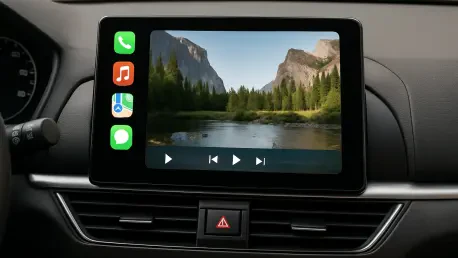

After more than a decade of meticulously curating the in-car experience to prioritize safety and minimize distraction, Apple is preparing to introduce a feature that was once considered unthinkable for its popular CarPlay platform: video playback. This significant evolution, anticipated to arrive with a future iOS update, signals a major shift in the philosophy behind the automotive interface, promising to transform periods of stationary waiting into opportunities for entertainment. However, this new capability is not an open invitation to stream content on the go; it is governed by a strict, non-negotiable rule that the vehicle must be safely in park. The announcement represents a delicate balancing act, attempting to satisfy a long-standing user desire for more robust media options while upholding the foundational safety principles that have defined CarPlay since its inception. While the prospect of watching a movie or TV show on a vehicle’s built-in display is undoubtedly compelling, the implementation is being approached with an abundance of caution, ensuring that this new form of in-car entertainment is reserved exclusively for moments of downtime, not for the open road.
A New Era for In-Car Entertainment
To fully grasp the significance of this development, it is essential to consider CarPlay’s transformative journey over the past 12 years. Since its introduction in 2014, the platform has fundamentally reshaped the automotive industry by providing a standardized, intuitive, and seamless extension of the iPhone on vehicle dashboards. It successfully brought the familiarity of the iOS ecosystem to a wide array of manufacturers, offering core applications like Maps, Music, and Messages in a driver-friendly format. Throughout this entire period, the conspicuous and deliberate omission of video playback has been a cornerstone of its design philosophy, a conscious decision made to prevent driver distraction and enhance road safety. The prospective introduction of video capabilities in a future iOS version is therefore not merely an incremental update but a landmark evolution. It addresses a feature that users have long desired, aiming to enhance the utility of the vehicle’s cabin during idle time while carefully navigating the inherent safety challenges that have historically made such a feature taboo for front-seat infotainment systems. This move indicates a maturation of the platform, recognizing that a vehicle serves multiple purposes beyond just transportation, including being a personal space for waiting.
The mechanism for delivering this new feature is as important as the feature itself, as it underscores Apple’s commitment to a controlled and secure experience. Rather than relying on native video applications running directly on the CarPlay interface, the functionality will be powered by Apple’s own robust and widely adopted AirPlay technology. This means users will stream content directly from their connected iPhone to the car’s display, leveraging an existing, stable protocol that is familiar to anyone within the Apple ecosystem. This strategic choice is critical for several reasons. It simplifies the user experience by mirroring the process of streaming to other AirPlay-enabled devices, and it gives Apple granular control over the feature’s operation. More importantly, it clarifies what this feature is not: it is not a system for watching streaming services while commuting. The distinction is crucial, as it immediately dispels the most significant safety concerns. The feature is explicitly designed to enrich the in-car experience during stationary periods, turning the vehicle into a temporary entertainment hub only when it is safe to do so.
The Rules of the Road Safety and Compatibility
The most critical regulation governing the use of this new video playback feature is the absolute requirement that the vehicle must be parked. This is not a suggestion or a guideline but a hard-coded, non-negotiable safety protocol designed to eliminate the risk of driver distraction. This limitation has historically been the sole reason for prohibiting video on front-seat infotainment screens, and its strict enforcement is central to the feature’s responsible implementation. The intended use cases are specific to periods of waiting, such as a parent waiting for a child’s karate class to end or a traveler sitting in an airport cell phone lot awaiting a pickup. In these common scenarios, the ability to watch a video on the larger, more comfortable CarPlay display presents a significant quality-of-life improvement over staring at a small phone screen. To ensure this rule is followed without fail, the system will integrate directly with the vehicle’s onboard data, using information from the gear selector’s position and wheel speed sensors to determine the “parked” state. The moment the vehicle is shifted out of park or begins to move, video playback will be automatically disabled, ensuring the driver’s full attention returns to the road.
Beyond the primary safety rule, a second, more complex set of challenges revolving around hardware and software compatibility presents a significant hurdle to widespread adoption. This hurdle is multifaceted, requiring active participation from both car manufacturers and application developers, which explains why access will be limited, at least initially. First, for the feature to function, a car’s infotainment system must be specifically designed or updated to support this video-over-AirPlay protocol. As of the current date, no automaker has announced any formal plans to support it. This is a major impediment, meaning that even after Apple releases the iOS update with this capability, the vast majority of existing and even newly manufactured CarPlay-enabled vehicles will be unable to use it until their manufacturers invest in the necessary hardware and software updates. Second, the compatibility issue extends to the applications themselves. Developers of popular streaming services will likely need to update their iOS apps to specifically permit this type of AirPlay session with a CarPlay unit. Without this explicit integration, apps may block streaming to the in-car display for technical or digital rights management reasons, adding another layer of uncertainty and a variable timeline to the feature’s availability for any given service.
Navigating the Hurdles to Your Dashboard
Ultimately, the announcement regarding in-car video playback served as a compelling preview of CarPlay’s future direction rather than a promise of an imminent feature release. While the technical framework was being developed by Apple, the path to a widespread rollout was understood to be contingent on a complex ecosystem of dependencies. The feature’s design, centered on a core principle of safety by strictly limiting its use to parked vehicles, was a sound approach to a long-standing challenge. However, its practical implementation was far from guaranteed, hinging on the active cooperation of both automakers and application developers. This created a narrative of promising technological advancement constrained by the practicalities of the automotive and software industries. The enticing prospect of streaming a favorite show while waiting for a child’s swim class to end represented the feature’s clear appeal, but it was tempered by the sober realization that such a convenience would have to wait. The final understanding was that the journey to watching videos in your car via CarPlay was a roadmap with multiple, unconfirmed checkpoints, making any timeline for its universal availability purely speculative at the time.