
The evolution of synthesized voices has rapidly progressed from the monotonous, robotic speech of early computing to a new frontier where artificial intelligence can convey genuine human emotion. A significant update to Google’s Gemini 2.5 Pro and Flash models introduced a groundbreaking Text-to-Speech (TTS) capability that moves beyond mere recitation. This advanced system generates audio that is not only context-aware and dynamically paced but also rich with emotional nuance, making it nearly indistinguishable from human speech. This development marks a pivotal moment in voice AI, unlocking new creative avenues while simultaneously presenting complex challenges related to security, industry disruption, and the very nature of human-computer interaction.
The Technology Behind the Voice
A New Era of Vocal Control
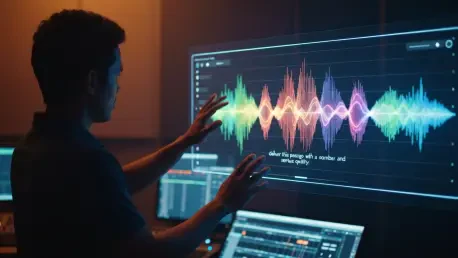
The core of this advancement is a paradigm shift away from complex technical manipulation toward intuitive, creative direction. Previously, adjusting a synthetic voice’s pitch, tone, or speed required developers to painstakingly modify numerical parameters, a process accessible only to those with specialized engineering skills. The Gemini 2.5 models, however, are designed to interpret natural language instructions. Developers can now issue simple, descriptive commands such as “generate this line with a cheerful and optimistic tone” or “deliver this passage with a somber and serious quality.” This innovation transforms the development process from a rigid programming task into an artistic one, more akin to directing a voice actor than configuring software. The AI can understand and execute complex emotional blends, like “nervous but hopeful,” by internally modulating dozens of vocal characteristics without any manual intervention, democratizing the creation of high-quality, emotionally resonant audio for a wider range of creators and applications.
Further enhancing its human-like quality, the system employs a sophisticated, Transformer-based architecture to achieve context-aware pacing. The AI does not simply read words; it analyzes the semantic meaning of the text to understand its purpose and emotional weight. This deep comprehension allows it to modulate its delivery in a remarkably natural manner. For instance, the model can automatically slow its cadence to add dramatic emphasis to a pivotal sentence in a narrative or increase its speed to efficiently move through boilerplate content like legal disclaimers. It intelligently identifies and stresses key terminology in technical explanations while maintaining a smooth, conversational flow through less critical passages. Early testers reported that the resulting audio felt “directed,” noting the presence of subtle yet impactful details like small, anticipatory breaths before an important line—a hallmark of professional human narration that adds a powerful layer of authenticity and realism to the synthesized speech.
Crafting Realistic Conversations
One of the most significant breakthroughs is the model’s ability to natively handle complex dialogue between multiple speakers. Legacy TTS systems have historically struggled with this task, often producing disjointed and robotic exchanges that require extensive post-processing to sound even remotely natural. The Gemini 2.5 TTS models overcome this challenge by processing an entire multi-speaker script as a single input. Developers can embed character labels directly within the text, and the AI generates a continuous, unbroken audio waveform that maintains distinct and consistent vocal identities for each character throughout extended scenes. This capability is particularly transformative for long-form content, where maintaining character consistency is paramount. It eliminates the artificial-sounding cuts and unnatural pauses that plagued previous multi-speaker audio synthesis, allowing for a seamless and immersive listening experience that mirrors the natural ebb and flow of human conversation.
This advanced dialogue handling promises to revolutionize the production of audiobooks, video games, and other narrative-driven media. A developer involved in early trials highlighted the AI’s capacity to sustain a single character’s unique voice—complete with subtle emotional shifts reflecting anger, calmness, or humor—across dozens of hours of gameplay, a feat of consistency that was previously unattainable with synthetic voices and often challenging even for human actors. Because the system generates a single, cohesive waveform, it can also render nuanced conversational interactions with incredible realism. For example, it can naturally produce a whispered aside from one character while another is speaking, or a slight, impatient interruption that feels organic rather than programmed. This allows for the creation of rich, dynamic soundscapes that were once the exclusive domain of expensive, full-cast audio productions, opening up new possibilities for storytelling and interactive entertainment.
Strategy and Societal Impact
Redefining Human-AI Interaction
Google’s overarching strategy involves deeply integrating this emotionally intelligent voice technology across its entire product ecosystem to create more natural and empathetic user experiences. In Android, accessibility services like TalkBack could offer more expressive and engaging narration for users with visual impairments, making digital content more accessible and enjoyable. Google Maps could adjust its navigational prompts to convey a sense of urgency based on real-time traffic conditions, providing clearer and more effective guidance. Within the Google Workspace suite, tools like Docs and Meet could provide contextual voice feedback, using an encouraging tone for suggesting draft revisions or a neutral, professional tone for summarizing meeting minutes. The low-latency Gemini 2.5 Flash model is specifically aimed at real-time applications like Live Translate, where capturing emotional nuance is critical for bridging cultural divides and preventing communication from feeling sterile and emotionally flat.
This approach strategically differentiates Google from its primary competitors in the AI assistant market. While Amazon’s Alexa and Apple’s Siri have historically focused on functional command-response interactions, and Microsoft’s Copilot has prioritized task completion, Google is pursuing what one industry consultant termed “affect, not just accuracy.” By developing a multimodal architecture that aims to both detect and mirror human emotion, Google is signaling its belief that the next frontier in human-AI interaction is not merely about what an assistant says, but how it says it. This focus on emotional intelligence aims to make technology feel less like a rigid tool and more like a helpful, intuitive partner, fundamentally reshaping user expectations for how they interact with their devices and the digital services they power.
A Double-Edged Sword for Society
Despite its immense potential, this powerful technology carried significant and immediate risks, with security experts warning that it presented a “gold mine for fraudsters.” The ability to generate flawless, emotionally convincing, multi-speaker audio conversations opened the door to highly sophisticated social engineering attacks. Malicious actors could stage entirely fake scenarios—such as a frantic argument between two people to create a sense of urgency, a reassuring call from a supposed family member in distress, or a fake escalation from a customer service agent to a “supervisor”—all within a single, seamlessly generated audio file. The verisimilitude of these audio deepfakes, particularly their ability to simulate empathy and other complex emotions, could bypass existing verification defenses that rely on detecting the unnatural or robotic speech patterns of older TTS systems. It was noted with concern that Google’s documentation lacked detailed information on crucial safeguards like audio watermarking or robust detection tools, leaving a potential vulnerability for exploitation.
Simultaneously, the technology was poised to have a dual and disruptive impact on the media and entertainment industries. For production houses, it offered a powerful tool for efficiency, enabling the rapid and cost-effective generation of high-quality narration for e-learning modules and corporate training videos, thereby reducing studio time and costs. However, this increased efficiency was expected to lead to a significant decline in demand for the mid-tier human voice talent who specialized in these areas. In contrast, a new opportunity arose for elite voice actors, whose role shifted from simply recording final audio to actively training AI models. In this new paradigm, actors licensed their vocal range and emotional versatility to “teach the product,” effectively selling their skill set as a training dataset rather than a finished performance. This represented a fundamental shift in the labor market for voice professionals and was viewed as a foundational prerequisite for the future of embodied AI, where robots and ambient computing systems would require voices that could adapt to their environment and enable natural, continuous emotional dialogue with humans.