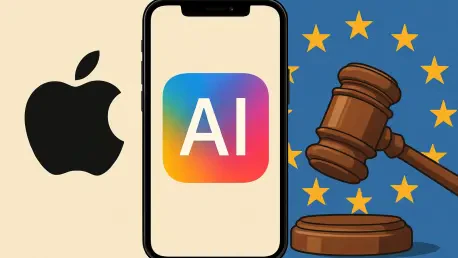

As the final trading days of 2025 unfold, Apple Inc. stands as a titan at a crossroads, navigating a complex environment where its present financial strength is pitted directly against profound future uncertainties. The company finds itself in a precarious balance, with the robust consumer appetite for its new iPhone 17 series serving as the primary bulwark against the mounting pressures of a delayed artificial intelligence strategy and an intensifying global regulatory assault on its lucrative App Store ecosystem. For investors, the narrative is sharply defined: a contest between the tangible, near-term momentum of its flagship hardware and the growing, long-term risks that threaten to reshape its most profitable business segments. This tension is palpable in its market position, where a staggering $4.05 trillion valuation is tempered by a slight pullback from recent highs, reflecting a market that is pricing in both immense stability and significant future challenges. The low-liquidity holiday trading period only serves to amplify this dynamic, creating a scenario where any new development could disproportionately influence sentiment and stock performance.
iPhone Demand The Engine Under Pressure
The most immediate and reassuring data point for Apple investors has emerged from China, a market whose performance has been a persistent source of concern throughout the year. Calculations based on official government data revealed a remarkable 128.4% year-over-year increase in shipments of foreign-branded phones in November, a figure widely interpreted as a powerful indicator of strong iPhone 17 demand. Given Apple’s overwhelming market share in the premium smartphone category in China, this surge provides a potent counter-narrative to fears of slowing consumer interest and escalating competition in the region. This positive signal from a critical international market reinforces earlier reports from the product launch cycle. Research from Counterpoint indicated that the iPhone 17 series initially outsold its predecessor by a healthy margin in key territories like the U.S. and China, suggesting that the new device’s feature set successfully captured the attention of both new buyers and those ready to upgrade. This combination of initial launch velocity and sustained momentum in a key growth market forms the bedrock of the bullish case for Apple’s holiday quarter performance, suggesting the iPhone remains a formidable and highly desirable product.
However, a more nuanced picture of consumer demand emerges upon closer inspection of the supply chain and sales channels as the launch cycle matures. A recent note from JPMorgan highlighted that lead times for various iPhone 17 models have moderated to an average of just three days, a level comparable to the same point in the iPhone 16 cycle. This normalization has become a focal point for a classic Wall Street debate. Optimists argue that the shorter wait times are a testament to Apple’s operational excellence, demonstrating its ability to ramp up production to meet persistently strong demand effectively. From this perspective, a balanced supply-demand dynamic is a sign of a healthy, well-managed product cycle. Conversely, bears interpret the easing lead times as a potential early warning sign that the initial surge of enthusiasm from early adopters is beginning to cool. Underpinning this entire debate is the high bar set by Apple’s own management. CEO Tim Cook’s forecast for double-digit year-over-year iPhone sales growth has baked significant optimism into the stock, creating a scenario where even a strong quarterly report could be perceived as a disappointment if it fails to exceed already lofty expectations.
The Artificial Intelligence Gamble
While the iPhone continues to drive current revenues, the investment community is increasingly fixated on artificial intelligence as the next transformative growth catalyst for the company. A strong consensus is forming among analysts that 2026 will be the year Apple finally makes its definitive entry into the generative AI era, with a heavily revamped “Siri 2.0” expected to be the centerpiece of this strategic push. Reports from multiple sources, including Bloomberg, have fueled speculation that Apple may leverage Google’s powerful Gemini models to power some of the new, more sophisticated capabilities, signaling a potential partnership that could accelerate its path to market with a competitive offering. The anticipation is that a truly intelligent and proactive Siri will not only enhance the user experience but also create a compelling reason for a massive wave of hardware upgrades, effectively supercharging the iPhone replacement cycle. This forward-looking AI narrative is a primary justification for Apple’s premium valuation, as investors are pricing in the immense potential for AI to unlock new monetization opportunities within both hardware and services.
This optimistic vision of an AI-powered future is tempered by significant execution risks and the stark reality of Apple’s current timeline. The company has publicly confirmed that certain planned AI enhancements, particularly those focused on deeper personalization and seamless cross-application functionality, have been delayed and will not launch until 2026. This postponement injects a considerable degree of uncertainty into the narrative and places an enormous burden on Apple to deliver a product that can meet the soaring expectations it has helped create. The critical question for investors has shifted from whether Apple will have AI features to whether it can successfully translate its AI strategy into concrete financial outcomes. This involves not only driving hardware sales but also creating new, high-margin revenue streams within its Services division, all while navigating the immense technical and ethical challenges of implementing powerful AI without compromising its long-standing and brand-defining commitment to user privacy. The delay gives competitors more time to establish their own AI ecosystems, raising the stakes for Apple’s eventual market entry.
A Global Squeeze on the App Store
If artificial intelligence represents the primary long-term opportunity for Apple, the most consistent and escalating threat comes from a global phalanx of regulators targeting its App Store. This month has seen a rapid succession of significant actions across multiple jurisdictions, each chipping away at the highly profitable, walled-garden ecosystem that underpins the company’s Services division. In Italy, the nation’s antitrust authority imposed a substantial fine of approximately $115 million, accusing Apple of abusing its dominant market position with its App Store policies, a ruling the company has vowed to appeal. This punitive measure was followed by a landmark settlement in Brazil, where Apple agreed with the country’s competition regulator to permit third-party app stores and alternative in-app payment systems on iOS. Similarly, in a proactive move to comply with new legislation in Japan, Apple announced it would introduce changes to allow for alternative app marketplaces and payment processing options, conceding to regulatory demands before a confrontation could escalate.
The regulatory pressure is not limited to international markets, as legal challenges continue to intensify within the United States. A U.S. judge recently ruled that Apple had violated a previous court order that was designed to foster greater competition for app downloads and payments, referring the matter to federal prosecutors for potential further action. The cumulative impact of these individual rulings creates a powerful and sustained headwind for Apple’s stock. Investors are increasingly concerned about a “domino effect,” whereby a legal defeat or a regulatory concession in one major country sets a precedent that is quickly emulated by others around the world. Each development threatens the foundational policies—such as the mandatory use of its in-app payment system and the 30% commission—that have made the App Store a phenomenally profitable enterprise. This global squeeze raises serious long-term questions about the potential for significant margin compression in the Services segment, which has been the company’s most important growth driver in recent years.
A Contest of Competing Forces
The convergence of these powerful but conflicting narratives led to a distinctly “barbelled” perspective on Wall Street heading into the end of the year. On the bullish end of the spectrum, analysts like Wedbush’s Daniel Ives raised their price targets significantly, arguing that strong iPhone 17 momentum would carry the company through the near term while the 2026 AI “revolution” would unlock a new era of growth. In a more moderately optimistic camp, others like Morgan Stanley’s Erik Woodring acknowledged the upside potential of the 2026 AI opportunity but also noted the near-term cost pressures and execution risks that could temper performance. This division was reflected in the broader consensus, which settled on a “Moderate Buy” rating, capturing the market’s collective uncertainty about how to weigh the immediate positives against the long-term threats. The stage was set for a classic confrontation between fundamentals and future risk.
Ultimately, the market’s direction in the final days of 2025 was defined by this tense equilibrium. The strong tailwinds provided by positive holiday consumer spending data and the impressive iPhone shipment figures from China offered clear support for the stock’s valuation. These factors underscored the enduring power of Apple’s brand and its unmatched ability to execute at scale. However, these present strengths were continuously weighed against the dark clouds gathering on the horizon. The accelerating regulatory pressure on the App Store represented a direct threat to a core profit center, while the execution risk tied to the company’s delayed AI timeline cast a long shadow of uncertainty over its future growth trajectory. Trading was thus driven by a delicate balance, where the stock’s path was ultimately determined by which of these powerful narratives—the certainty of today’s sales or the risk of tomorrow’s challenges—held greater sway over investor sentiment.