
When it comes to the intersection of hardware, software, and enterprise solutions, few have the depth of experience as Nia Christair. With a background spanning everything from mobile device design to large-scale app development, she brings a uniquely practical perspective to the burgeoning field of physical AI. Following a series of bullish predictions from tech leaders at the World Economic Forum, we sat down with Nia to cut through the hype and understand the real-world implications of giving intelligence a physical form.
Our conversation explored the nuanced reality of physical AI’s integration into the workforce, focusing on how it can augment human productivity rather than lead to mass job displacement. We delved into the critical role of human-in-the-loop systems, discussing the need for clear safety protocols and accountability when humans and robots collaborate. Nia also shed light on the foundational technologies, like IoT and emerging world models, that are paving the way for rapid enterprise adoption. Finally, we tackled the contrast between optimistic forecasts for humanoid robots and the significant technological hurdles that still stand in the way of their widespread deployment, examining why investors remain so enthusiastic about their long-term potential.
Jensen Huang framed physical AI as a way to enhance human productivity rather than replace jobs, citing how it could help address the nursing shortage. How does this vision translate into practice, and what are the first steps for industries to integrate AI without displacing their workforce?
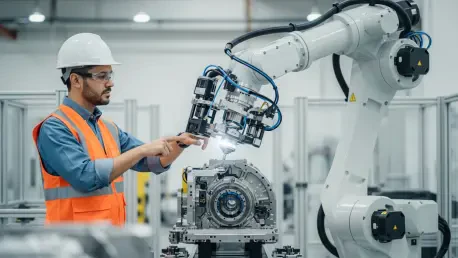
That’s the most critical question for any business leader right now. The vision translates into practice by focusing on augmentation, not automation of entire roles. Take the nursing example. We’re facing a shortage of five million nurses; the goal isn’t to replace the ones we have, but to make them superhuman. This means deploying physical AI to handle menial, repetitive tasks—like inventory management, patient transport, or data entry—freeing up a nurse’s time for critical thinking and patient care. The first practical step for any industry is to identify these low-value, high-repetition tasks. Start there. By offloading the grunt work, you not only make your existing team more productive but also improve their job satisfaction, which allows the organization to grow and, as Huang suggested, ultimately hire more people for higher-value roles.
We’re seeing systems where humans step in for robots during complex situations, like bad weather. Considering the need for clear boundaries for safety, what are the most effective “human-in-the-loop” models you’ve seen, and how do we establish rules to ensure accountability?
The most effective models are built on a principle of shared responsibility, where the robot has autonomy within a strictly defined operational space, but a human is always the ultimate failsafe. Think of the Venti Technologies example, where fleets of robots operate 24/7. They handle the predictable routes flawlessly, but when a sudden storm hits or an unexpected obstacle appears, a human driver takes remote control. To establish rules, you need to be brutally clear about those boundaries. For instance, if you give a robot a chainsaw, as Tianlan Shao proposed, the rule isn’t just “cut this tree.” It’s “cut this tree, within these coordinates, and cease all function if a human-shaped thermal signature enters a 20-foot radius.” Accountability is then baked into the system through immutable logs, tracking every decision made by both the AI and its human overseer.
With enterprise adoption of physical AI projected to reach 80% within two years, what role do foundational technologies like IoT play? How are new developments, such as world models, accelerating the transition from basic automation to true physical intelligence in the enterprise?
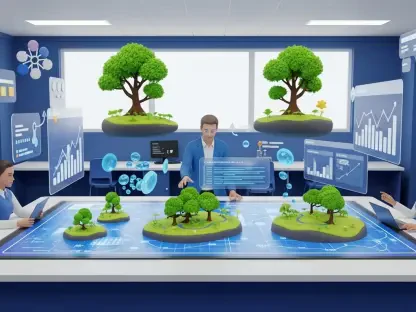
IoT is the nervous system of physical AI; it laid the groundwork for this entire revolution over the last decade. The sensors, the data streams, the interconnected devices—that’s the physical foundation that allows an AI to perceive and interact with the real world. What we’re seeing now, with this projected jump to 80% adoption, is the brain being layered on top of that nervous system. This is where world models come in. They are a game-changer because they allow an AI to simulate and understand cause and effect in a virtual environment before ever acting in the physical one. This accelerates everything. Instead of tediously programming a robot for one specific task, you can train a world model that aligns vision, motion, and reasoning, enabling the robot to adapt to a multitude of tasks far more quickly and safely.
Some leaders predict robots will soon saturate all human needs, while others recall past optimistic timelines that didn’t materialize. Where do you see the biggest gap between the current hype and the practical reality of deploying advanced robotics, especially humanoids, in the next five years?
The gap is between controlled environments and the chaotic, unpredictable real world. Elon Musk’s vision of robots saturating all human needs is a fantastic long-term goal, but we have to be realistic. Daniela Rus’s reminder about us not “falling asleep at the wheel” by 2019 is the perfect reality check. In the next five years, we will see incredible progress in structured settings like warehouses and factories, where the variables are limited. The biggest gap is in general-purpose deployment. A humanoid robot that can navigate a factory floor is one thing; a robot that can navigate a cluttered home, care for an elderly parent, and adapt to constantly changing social cues is an entirely different order of magnitude. The core challenges in dexterity, navigation in dynamic spaces, and true contextual reasoning are still monumental hurdles.
Humanoid robotics companies are attracting significant investment despite being far from widespread deployment. What specific capabilities are investors betting on, and what key technological hurdles in areas like navigation and dexterity must be overcome to justify these high valuations?
Investors are betting on the ultimate prize: a general-purpose machine. A humanoid robot isn’t just a tool; it’s a platform. It’s designed to operate in a world built for humans, using human tools and navigating human spaces. That versatility is the holy grail. The specific capability they’re funding is the potential to perform a vast range of tasks without needing to re-engineer the entire environment, which is what we do for most industrial robots today. To justify these valuations, the technology must overcome fundamental hurdles. Navigation needs to move beyond simple obstacle avoidance to predictive, intuitive movement through crowded and unpredictable spaces. Dexterity has to evolve from clumsy gripping to fine motor skills that can handle delicate or complex objects. And underlying all of it is reasoning—the ability to understand not just what to do, but why.
What is your forecast for physical AI?
My forecast is one of pragmatic acceleration. We won’t see humanoid butlers in every home within the next five years, but the enterprise adoption figures from Deloitte—jumping from 58% to 80% in two years—are very real. The immediate future belongs to specialized physical AI: autonomous vehicles in ports, collaborative robots on assembly lines, and intelligent monitoring systems in infrastructure. These applications will deliver tangible productivity gains and build the economic and technological foundation for the more ambitious humanoid robots to come. The hype is focused on the human-like form, but the real, near-term revolution is in making all our existing physical systems more intelligent, autonomous, and efficient.