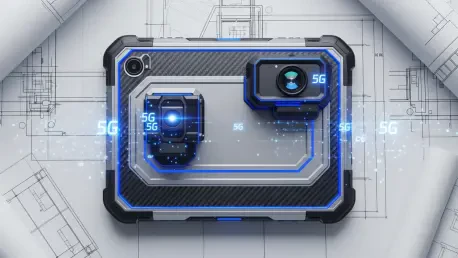

Modern industrial environments frequently demand that technicians carry an exhaustive array of specialized hardware ranging from laptops to laser measurers, often leading to significant logistical fatigue and reduced operational efficiency during remote site inspections. The 8849 Tank Pad Ultra addresses this specific pain point by consolidating these disparate tools into a single, high-performance Android ecosystem. Measuring 10.95 inches, this tablet moves beyond the traditional definition of a ruggedized slate by integrating professional-grade instrumentation directly into its chassis. It is not merely a screen protected by thick rubber; it serves as a central hub for field operations where durability is a baseline requirement rather than the primary selling point. This approach signifies a broader shift in the 2026 mobile market, where manufacturers prioritize the convergence of diverse hardware functions to streamline workflows for tradespeople and engineers who operate far from traditional office infrastructures. By fusing heavy-duty construction with high-end digital tools, the device attempts to redefine what a “rugged” device can actually accomplish during a standard workday.
Advanced Optical Engineering: The Integrated DLP Projector
The standout technical achievement of this device involves the inclusion of a high-definition DLP projector that significantly outperforms previous iterations of integrated mobile projection technology. While many older “pico projectors” suffered from poor resolution and dim outputs that rendered them nearly useless in anything but total darkness, this system delivers a 1080p native resolution with a brightness of 260 lumens. This leap in performance enables users to cast detailed schematics, instructional videos, or complex data charts directly onto flat surfaces without needing to tether the tablet to an external display unit. The inclusion of an intelligent auto-focus system ensures that the image remains sharp across its functional range of 0.5 to 4 meters, which is particularly beneficial when presenting findings in tight spaces like crawlspaces or industrial mechanical rooms. Although 260 lumens still requires some environmental light control, it provides a functional middle ground for professional use where portability is the ultimate priority.
Beyond basic media consumption, this projection capability introduces a collaborative layer to field work that was previously restricted to office environments. Instead of multiple technicians crowding around a single ten-inch screen to view a technical drawing, a project lead can project the blueprints onto a wall at a larger scale for group analysis. This functionality effectively turns any shaded area into a mobile briefing room, allowing for immediate feedback and collective decision-making. The software management for the projector is integrated directly into the operating system, allowing for rapid toggling between the tablet display and the projected image. This seamless transition is crucial for professionals who need to maintain a steady flow of information without fumbling through complex menus or hardware connections. The result is a specialized tool that enhances communication in rugged environments, proving that the device is built for much more than just simple durability, acting as a versatile communication engine for on-site teams.
Sustained Performance: Processing Power and Battery Management
Supporting the high power draw of a DLP projector and professional sensors requires a robust internal architecture, which is anchored by the MediaTek Dimensity 8200 chipset. This silicon provides the necessary computational overhead to manage 5G connectivity and Wi-Fi 6 data streams while simultaneously running intensive measurement or projection software without thermal throttling. With storage options reaching up to 512 GB, the device ensures that large technical files, high-resolution site photos, and extensive databases remain accessible even in areas with limited cloud connectivity. This level of processing power places the tablet firmly in the mid-to-high performance tier of modern mobile devices, ensuring that the specialized tools are not hindered by slow interface responses or app crashes. The integration of 5G is particularly relevant for 2026 standards, where real-time data transmission from remote sites to central management servers has become a standard operational requirement for large-scale engineering projects and infrastructure maintenance.
To manage the substantial energy requirements of its unique feature set, the tablet is equipped with a massive 23,400-mAh battery, which provides several times the capacity of a standard consumer-grade tablet. This energy reservoir is essential for a device designed to power a projector for hours or utilize a laser rangefinder throughout a full shift. Charging this massive cell is facilitated by a 66-W fast-charging system, which minimizes downtime when the device finally needs to be replenished. Furthermore, the hardware is shielded by IP68 and IP69K ratings, providing protection against high-pressure water jets, dust ingress, and submersion. This level of environmental resilience ensures that the internal electronics remain operational despite the physical stresses of construction sites, agricultural fields, or rainy outdoor conditions. The trade-off for this endurance is a total weight of approximately 2.8 pounds, a physical reality that users must accept in exchange for a device that effectively replaces several other heavy tools.
Professional Measurement: Integration of Site-Specific Sensors
The utility of the device is further extended through the inclusion of a built-in laser rangefinder, a tool that effectively eliminates the need for technicians to carry separate measuring devices for basic site surveys. This sensor is capable of measuring distances up to 13 feet and includes integrated software for calculating area and volume on the fly, which is invaluable for estimators and architects working on-site. When combined with the 50-megapixel main camera and a specialized 64-megapixel night-vision sensor, the tablet becomes a comprehensive documentation tool capable of capturing high-detail imagery in nearly any lighting condition. The night-vision capability is especially critical for inspections in unlit basements, tunnels, or nighttime emergency repairs, allowing for clear visual recording where standard flash photography might fail to capture the necessary nuance. This combination of distance measurement and specialized imaging creates a unified platform for creating accurate digital twins or site reports without external peripherals.
Strategic adoption of this technology required organizations to weigh the initial investment of approximately $599 against the long-term gains in efficiency and reduced hardware overhead. By integrating a projector, a rangefinder, and night vision into a single ruggedized frame, the tablet challenged the high-cost barriers traditionally associated with niche industrial equipment. Organizations looking to optimize their field operations should have evaluated how these integrated features could reduce the weight of a standard gear bag while increasing the accuracy of field data collection. In practice, the successful deployment of this hardware depended on training personnel to utilize the full breadth of the sensor suite and the projection system. Looking forward, the focus remained on the reliability of these consolidated sensors over years of heavy use, suggesting that future developments would likely emphasize even higher lumen counts for projectors and expanded range for laser measurement to further solidify the tablet’s role as a true multi-tool.