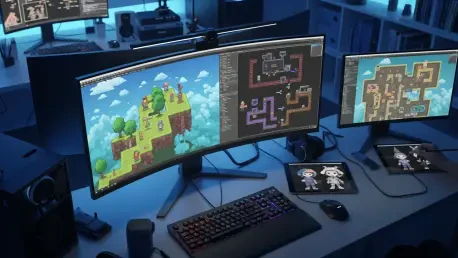

The sudden rise of a small South Korean development team to international prominence at the Taipei Game Show 2026 signals a transformative moment for the indie gaming industry at large. Concode, a studio founded by Myeongjin Shin and Seonhyang Kim, recently captured the prestigious Best Mobile Game award for their upcoming title, which represents a bold leap forward from their previous success with over three million downloads. This achievement highlights a growing demand for premium experiences on mobile devices that challenge the dominance of short-form, casual entertainment. By blending intricate narrative design with high-quality animation, the duo established a new benchmark for what independent creators can accomplish with limited resources and immense technical focus. The recognition served as a testament to their ability to bridge the gap between niche artistic expression and mainstream appeal, setting the stage for a project that aims to redefine the very essence of the puzzle-adventure genre through its unique 2.5D aesthetic and deep world-building.
Integrating Classic Inspiration With Modern Visual Depth
The creative philosophy behind this new project draws heavily from the golden age of top-down adventures, specifically echoing the intricate charm found in titles like the classic handheld entries of the Zelda series. However, rather than merely replicating the flat pixel art of the past, the developers integrated a 3D perspective that provides a sense of physical weight and environmental depth rarely seen in mobile titles. This hybrid visual style allows players to navigate a world that feels vast and multilayered, where shadows and lighting play a critical role in solving environmental challenges. By prioritizing a modernized sense of nostalgia, the team ensured that seasoned players feel an immediate sense of familiarity while simultaneously introducing younger audiences to a more sophisticated visual language. This evolution of the pixel-art medium demonstrates how modern rendering techniques can enhance traditional aesthetics without losing the pixelated soul that defines the indie spirit, effectively bridging generational gaps in gaming.
Beyond the visual allure, the shift toward a “complete adventure” format marks a departure from the industry trend of fragmented, microtransaction-heavy mobile games that often prioritize retention over quality. The developers intentionally crafted a cohesive journey that rewards exploration and curiosity, moving away from the linear simplicity that frequently characterizes the mobile market. This approach emphasizes a rich narrative structure where every dungeon and interaction contributes to a larger overarching story, fostering a sense of immersion that is often reserved for console or PC platforms. By focusing on a self-contained experience, the studio challenged the notion that mobile gaming must be inherently casual or ephemeral. This commitment to depth ensured that the player’s journey through the game’s diverse biomes felt substantial, offering a level of intellectual engagement that respects the player’s time and intelligence. Consequently, the project emerged as a symbol of the potential for mobile platforms to host truly epic and meaningful adventures.
Engineering Accessibility Through Intuitive Gameplay Mechanics
One of the primary technical hurdles for any mobile adventure is the inherent limitation of touchscreen controls, which can often feel clunky or imprecise compared to traditional physical inputs. To address this, the development team engineered a streamlined control scheme that utilizes intelligent auto-targeting and a simplified button layout without sacrificing the complexity of the combat or puzzles. This refined interface allowed for fluid movement and interaction, ensuring that the physical act of playing never interfered with the mental challenge of solving riddles. By reducing the friction between the player and the game world, the studio created an environment where precision is achieved through smart design rather than frantic tapping. Such innovations are crucial for expanding the reach of the puzzle-adventure genre, as they make sophisticated mechanics accessible to a broader demographic that might otherwise be intimidated by complex control requirements. This focus on ergonomic software design reflects a deep understanding of the mobile user’s physical interaction with their device.
Player agency remains a cornerstone of the design, with puzzles intentionally built to support multiple solutions rather than a single, rigid path to progress. This flexibility encourages creative thinking and allows individuals to leverage different mechanics depending on their personal playstyle, which significantly enhances the sense of personal accomplishment upon success. Furthermore, the inclusion of a flexible save system acknowledges the realities of daily life, allowing players to dive into the world for brief moments or long sessions without the fear of losing progress. This design choice effectively balances the immersive nature of a deep adventure with the portable convenience of the hardware. The developers aimed to foster a genuine sense of intellectual achievement, where the satisfaction comes from understanding the internal logic of the world rather than simply following a guide. By empowering players to experiment and find their own way through the game’s many trials, the studio reinforced the idea that the best puzzle adventures are those that act as a collaborative dialogue between the creator and the player.
Navigating the Path Toward Multi-Platform Success
The transition toward a full release was characterized by a clear vision for expansion that looked beyond the confines of the mobile ecosystem. Developers focused on refining the intricate dungeon designs and expanding the story branching to ensure that the final product offered a robust experience on all planned platforms. This strategic shift paved the way for the title to reach PC, Xbox, and Nintendo Switch by the second quarter of 2027, marking the studio’s evolution into a multi-platform powerhouse. By prioritizing cross-platform compatibility from an early stage, the team secured a future where their artistic vision was not restricted by specific hardware limitations. This move provided a blueprint for other indie developers seeking to scale their projects without compromising on their original creative intent. The successful integration of sophisticated design with accessible mechanics ultimately proved that the boundaries between mobile and traditional gaming are increasingly porous. As the industry looked forward, the focus shifted toward maintaining this balance of depth and accessibility to reach a truly global and diverse audience of gamers.