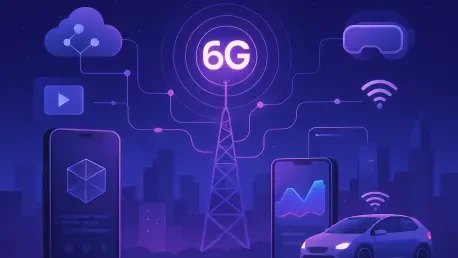

The rapid advancement of wireless infrastructure suggests that the transition to sixth-generation (6G) technology, projected for commercial release around 2030, will represent the most significant leap in digital connectivity since the inception of the smartphone. While previous generations focused on the incremental expansion of bandwidth and the stabilization of 4G and 5G signals, 6G is architecturally designed to serve as a bridge between the physical and digital worlds through human-centric engineering. For mobile app developers and tech stakeholders operating in the current 2026 landscape, this shift necessitates a proactive pivot in strategy to accommodate a new era of instantaneous, high-performance computing. The upcoming standard promises to move beyond simple data transmission, integrating complex network intelligence that supports sophisticated ecosystems and immersive experiences. Preparing for this evolution requires a total reimagining of how data is processed, how users interact with hardware, and how mobile software can scale to meet the demands of a hyper-connected global population that expects nothing less than total reliability and zero lag.
From Real-Time Lag to Instantaneous Digital Interaction
The most striking feature of the 6G era is the anticipated achievement of near-zero latency, which effectively eliminates the perceptible delay between a user’s input and a digital response. This technical leap is the foundational requirement for the “Internet of Senses,” a concept where applications transmit not just sight and sound, but complex tactile and haptic data. For developers, this means building interfaces that allow users to virtually “feel” digital objects or perform high-precision remote tasks with the same dexterity as physical touch. In fields such as remote robotic surgery or hazardous material handling, the absence of lag ensures that every movement is reflected in the digital twin or remote hardware without dangerous hesitation. This level of synchronization transforms the mobile device from a simple viewing portal into a sophisticated control center capable of managing intricate physical operations across vast distances.
Beyond industrial and medical applications, the removal of latency creates a paradigm shift in competitive digital environments like professional gaming and high-frequency financial trading. In the current 2026 market, mobile devices often struggle to compete with fixed-line fiber optics due to the inherent jitter of wireless signals, but 6G promises to equalize this landscape by matching the performance of high-end desktop workstations. Financial applications will benefit from micro-second responsiveness, allowing traders to execute orders based on real-time market fluctuations regardless of their proximity to a physical stock exchange. This democratization of high-performance connectivity means that the geographical disadvantages previously associated with mobile usage will vanish, forcing developers to optimize their software for a world where the bottleneck is no longer the network speed, but rather the biological reaction time of the human user.
The Shift Toward Edge Intelligence and Network Slicing
Architecturally, 6G is designed to move heavy artificial intelligence processing from centralized, distant cloud servers directly to the “edge” of the network, closer to the end-user. By performing AI inference on-device or at local cellular nodes situated just meters away from the user, developers can create highly responsive applications capable of complex generative tasks without the traditional data transmission bottleneck. This localized processing is essential for applications that require constant environmental scanning, such as autonomous drone navigation or real-time language translation in crowded spaces. As a result, the next generation of mobile development will focus less on cloud-dependent architectures and more on building robust, intelligent local systems that can operate with high autonomy while maintaining a lightweight footprint on the central network infrastructure.
Another transformative element of this new landscape is the maturation of sophisticated network slicing, which allows an application to dynamically request specific network properties based on its immediate needs. Instead of all applications sharing a single, generic data pipe, a 6G-enabled app can negotiate for a high-priority, ultra-reliable “slice” for a critical task, such as a telehealth consultation, while using a standard high-bandwidth slice for non-essential background updates. Developers must master these new network APIs to ensure their software can intelligently advocate for the resources required to maintain peak performance under varying conditions. This flexibility ensures that critical services remain uninterrupted even during periods of heavy network congestion, providing a level of service reliability that was previously impossible to guarantee on older, less flexible mobile networks.
Spatial Computing and the End of the Flat Screen
Mobile user experiences are currently on a trajectory toward a radical transformation as 6G facilitates volumetric streaming, which moves interfaces beyond two-dimensional glass screens into three-dimensional spaces. This shift toward Extended Reality (XR) allows for the seamless fusion of digital entities with the physical world through high-fidelity holographic environments that do not suffer from the pixelation or lag found in current 2026 AR/VR implementations. For app designers, this means rethinking user interface (UI) principles entirely, moving away from buttons and menus toward spatial gestures and depth-based interactions. The ability to stream massive amounts of 3D data in real-time allows for the creation of virtual meeting spaces where participants appear as lifelike holograms, making remote collaboration indistinguishable from a physical gathering in a shared office or laboratory.
As 6G enables the instant streaming of heavy, complex software directly through browsers and thin-client interfaces, the traditional “download and install” model of the app store may soon be viewed as an outdated relic. We are entering a post-app store era where immersive experiences are accessed instantly without the need for significant local storage or lengthy installation processes. This change will force developers to focus on progressive web technologies and cloud-native execution models that prioritize accessibility and immediate engagement. By removing the friction of the installation cycle, 6G allows for a more fluid discovery process, where users can jump between different digital environments as easily as they currently navigate between websites, leading to a more interconnected and dynamic ecosystem of streamable mobile software.
Universal Connectivity Through Integrated Satellite Networks
To achieve truly ubiquitous coverage, 6G integrates traditional terrestrial towers with non-terrestrial networks, including massive satellite constellations and high-altitude platform stations. This hybrid approach ensures that high-speed connectivity is no longer a luxury limited to major urban centers but is available even in the most remote regional territories or over open oceans. For mobile app developers, this provides a mandate to build resilient software that can transition smoothly between land-based and satellite connections without any interruption to the user experience. Applications designed for logistics, outdoor exploration, or global shipping will benefit from a constant data link, enabling real-time tracking and communication in areas that were once considered digital dead zones due to a lack of physical infrastructure.
The impact of this universal connectivity extends to the socio-economic level, as it bridges the digital divide for millions of people in underserved regions who will gain access to high-performance tools for education and commerce. Developers must consider the diverse environments in which their apps will be used, ensuring that security and data integrity are maintained as the device switches between different types of network hardware. This “always-on” global network requires a shift in how applications manage data synchronization and offline modes, as the very concept of being “offline” will become increasingly rare. By leveraging this integrated network fabric, software creators can deploy solutions that are truly global from day one, reaching users in the most isolated corners of the earth with the same quality of service found in a smart city.
Hardware Evolution and the Zero-Trust Security Model
Operating within the Terahertz spectrum requires a complete rethink of mobile hardware, particularly regarding antenna design and energy efficiency to manage the significantly increased computational demands of 6G. Devices will need to incorporate new materials and cooling solutions to handle the heat generated by processing terabits of data per second, which in turn influences how apps are coded to minimize battery drain. Developers will need to work more closely with hardware specifications, optimizing their code to take advantage of new specialized chips designed specifically for 6G signal processing and AI acceleration. This hardware-software synergy will be the defining characteristic of high-end mobile devices as we approach 2030, ensuring that the physical limits of the device do not hinder the vast potential of the network it connects to.
In this hyper-connected environment, the security risks are magnified, necessitating a definitive move toward “zero-trust” architectures where encryption and authentication are baked into the core fabric of every application. Because 6G networks will connect billions of sensors, vehicles, and personal devices, the potential attack surface for cyber threats is unprecedented, making traditional perimeter-based security obsolete. Developers must implement rigorous security protocols that verify every data packet and user interaction in real-time, ensuring that privacy is maintained in an era of constant data exchange. As we look toward the future, the success of mobile development will depend on how well creators integrate these hardware considerations and security protocols into their long-term digital strategies, creating a foundation of trust that allows the full potential of 6G technology to be realized by society.
Strategic Adaptation for the Next Technological Era
The transition toward a 6G-dominated world was characterized by a fundamental shift in how developers approached the relationship between software and the physical environment. Organizations that flourished during this period were those that moved away from the constraints of 4G and 5G thinking, embracing the possibilities of instantaneous data and spatial interfaces. By prioritizing edge intelligence and network slicing early in the design phase, these pioneers ensured that their applications remained functional and responsive even as user expectations for performance reached new heights. The industry learned that success was not merely about speed, but about the intelligent application of bandwidth to create meaningful, sensory-rich experiences that enhanced the way people lived, worked, and communicated.
Looking ahead, the primary takeaway for the mobile industry is the necessity of building for a decentralized and immersive digital landscape. Developers should focus on mastering volumetric data handling and zero-trust security frameworks to remain competitive as 6G hardware becomes the standard for global communication. Future-proofing mobile applications involves more than just updating libraries; it requires a deep understanding of how satellite integration and terahertz frequencies will change the very nature of connectivity. By adopting a forward-thinking perspective on hardware optimization and universal access, tech leaders can ensure that their products are ready to lead the next decade of innovation. The evolution from flat screens to holographic spaces and from cloud-latency to edge-immediacy marks the beginning of a truly boundless era for mobile app development.