
With a rich background spanning mobile gaming, app development, and hardware design, Nia Christair has a unique perspective on the intersection of personal technology and daily life. At this year’s CES, the smart lock market exploded with innovation, and we sat down with Nia to make sense of it all. Our conversation explores the growing divide between user-friendly simplicity and high-tech convenience, the competing technologies behind touchless entry, the real-world challenges of installation and power, and how the Matter standard is finally unifying the smart home.
We’re seeing a fascinating split in the market. On one hand, Yale’s Linus L2 Lite is all about beginner-friendly use, while on the other, Desloc’s models are packing in AI and palm recognition. Can you elaborate on this market divergence? For a typical family, what are the step-by-step benefits of Yale’s simplicity versus the high-tech features from Desloc?
That’s a perfect observation of the two main currents in the smart lock space right now. It’s really about two different philosophies of convenience. For a family considering the Yale Linus L2 Lite, the benefits are all about predictable, stress-free access. Step one is the immediate peace of mind you get from receiving a notification the moment your child gets home from school and uses their passcode. Step two is the sheer simplicity for guests; you can grant a temporary code without handing over a physical key or a complicated app tutorial. And step three is the subtle but brilliant automation—the door locking itself after a set time as you leave, or unlocking automatically based on your phone’s location when you pull into the driveway with arms full of groceries. It’s about removing small, daily frictions in a reliable way.
Now, with a brand like Desloc, you’re buying into a vision of the future. The first benefit is a truly seamless, hands-free experience. Imagine walking up to your door and the S150 Max recognizes your face and unlocks in just 1.5 seconds—it’s a powerful, almost magical feeling. The second benefit is the proactive intelligence; its AI can differentiate between a family member and a delivery person, sending you a specific, useful alert instead of a generic motion notification. Finally, the third benefit is the unique security of biometrics like palm vein recognition. It’s a very personal and secure method that feels incredibly advanced. So, one path offers straightforward, app-and-code-based reliability, while the other offers a sophisticated, AI-driven, and biometric-based ecosystem.
The Aqara U400 uses UWB for precise location to prevent accidental unlocks, whereas the Desloc S150 Max uses 3D facial recognition. Could you compare the real-world reliability and speed of these two approaches, especially in challenging conditions like bad weather or low light?
This gets to the heart of what makes a touchless system truly smart. They’re both impressive, but they solve the problem from different angles. Aqara’s UWB approach in the U400 is about spatial awareness. Think of it as a hyper-accurate indoor GPS. Its strength is precision—it knows your location down to a centimeter, including your angle of approach. This is brilliant for reliability because it solves the classic “drive-by unlocking” problem where a lock might trigger if you just walk past your front door to take out the trash. It also knows which side of thedoor you’re on, so it won’t accidentally unlock when you’re already safely inside. In bad weather, UWB, being a radio-based technology, should be completely unbothered by rain, fog, or snow. Its performance is tied to your phone, not environmental conditions.
The Desloc S150 Max with 3D facial recognition is focused on identity verification. It’s incredibly fast at 1.5 seconds and feels very personal. However, its reliability in challenging conditions is where questions can arise. Heavy rain obscuring the camera lens, a face partially covered by a winter scarf and hat, or very low light at night could potentially slow it down or cause a failed recognition. While modern 3D systems are much better than older tech, they are still fundamentally optical. UWB’s reliability is based on pure physics and location data, which might give it an edge in tricky environmental situations, whereas 3D facial recognition’s speed and convenience are undeniable when conditions are ideal.
The Kwikset Aura Reach promises a simple installation with just a screwdriver. How does this guided process technically differ from fitting a more complex, all-in-one unit like the Lockly Affirm Series? Please walk us through the key installation steps a renter might face with each.
The difference is night and day, especially for a renter. With the Kwikset Aura Reach, the entire process is designed to be non-intimidating. A renter would start by unscrewing their existing deadbolt thumb-turn on the inside of the door. That’s it. The Aura Reach is likely designed to mount directly over the existing hardware using the same screw holes. The app then provides an interactive, step-by-step guide on their phone, telling them exactly what to do next—it’s like having an expert looking over your shoulder. The final step is connecting it to Wi-Fi via Matter over Thread, which the app also guides them through. The key here is that they are not replacing the core locking mechanism, making it a simple, reversible upgrade that a landlord would likely approve of.
Now, consider an all-in-one unit like the Lockly Affirm Series. This is a full hardware replacement. A renter’s first step would be getting permission, as this is a much more involved installation. They would have to remove the entire old lockset—both the interior and exterior components, including the latch and strike plate. Then, they would need to install the new Lockly unit, which includes a lever handle, the keypad, and an integrated video doorbell. This means carefully aligning all the pieces through the door, potentially wiring the doorbell component, and ensuring the new latch mechanism works smoothly. It’s a much more technical process that, while manageable for a homeowner, could be a daunting and potentially lease-violating project for a renter.
We’re seeing innovative power solutions like the Desloc K140 Plus with its solar panel and the Lockin V7 Max with its AuraCharge wireless system. Based on your experience, what are the practical pros and cons of each, and how much daily sunlight or proximity is truly needed?
These new power solutions are tackling one of the biggest pain points of smart locks: the dreaded dead battery. The Desloc K140 Plus and its solar panel represent a wonderfully practical, eco-friendly approach. The biggest pro is the potential for near-zero maintenance. The small panel constantly trickles charge to the battery, meaning you may never have to think about it again after installation. However, the major con is its dependence on the environment. A door that’s under a deep porch or facing north might not get enough direct sunlight to keep the battery sufficiently topped up, especially during cloudy winter months. While it doesn’t need a full day of bright sun, consistent ambient light is key.
The Lockin V7 Max with AuraCharge is on the other end of the spectrum—it’s a high-tech, brute-force solution. The pro is its sheer power and convenience; it delivers true wireless charging from up to four meters away, completely eliminating the concept of batteries for the lock. It’s a game-changer. The cons, however, are related to its infrastructure. You need a dedicated transmitter plugged into an outlet within that four-meter range, which might not be practical for every entryway. There’s also the question of what happens during a power outage. While the lock almost certainly has a backup battery, its primary power source would be cut off, unlike the solar panel which would keep working as long as the sun is out.
The article highlights that nearly all new locks are Matter-certified. Can you explain with a specific example how Matter support on a lock like the Aqara U400 simplifies its integration into a smart home with existing Alexa or Google devices, compared to a non-Matter lock?
Matter is the universal translator the smart home has been desperate for, and its impact on a device like a lock is profound. Let’s take the Aqara U400 as a specific example. When you install it, because it supports Matter over Thread, your existing Amazon Echo or Google Nest Hub that acts as a Matter controller will see it on the network almost instantly. You’ll likely just open your Alexa app, see a pop-up saying “New device found,” tap “Connect,” and you’re done. From that moment on, you can say, “Alexa, lock the front door,” and it just works. You can also seamlessly build it into routines. For instance, you could create an Alexa routine called “Goodnight” that, with one command, turns off all your smart lights, adjusts the thermostat, and locks the Aqara U400.
Now, contrast that with a non-Matter lock from a few years ago. First, you’d have to see if it even had a “skill” for Alexa or an “action” for Google. If it did, you would have to install its proprietary app, create an account, connect the lock to your Wi-Fi through that app, then go into the Alexa app, find and enable the specific brand’s skill, and then link your two accounts by logging in again. It was a clunky, multi-step process that often resulted in limited functionality. Matter eliminates all of that friction. It turns a ten-minute, five-step, account-linking headache into a thirty-second, two-tap process.
What is your forecast for the smart lock market? Based on the trends from CES, like integrated video and wireless charging, which features do you expect to become standard in the next five years, and which might prove to be just a gimmick?
Based on what we’re seeing, I am confident that integrated video doorbells will become a standard feature on mid-to-high-end smart locks within the next five years. The synergy is just too strong. It consolidates two of the most critical front-door smart devices into a single, more elegant piece of hardware, which is a powerful proposition for consumers. Similarly, I expect advanced biometric options, like the reliable fingerprint sensors we see today and emerging tech like palm vein recognition, to become the default unlocking method, pushing passcodes into a secondary, backup role.
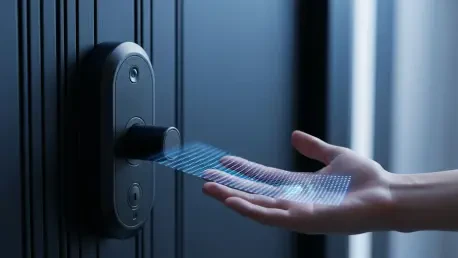
As for what might be a gimmick, I’m a bit skeptical about gesture unlocking. While it sounds futuristic, it feels less secure and more prone to false positives than a definitive biometric scan like a fingerprint or face. I could see it causing more frustration than convenience. True wireless charging like AuraCharge is an incredible innovation, but I suspect it will remain a premium, niche feature for a while. The infrastructure requirement of a nearby power transmitter makes it a less universal solution than something like a small, integrated solar panel, which I believe has a much higher chance of becoming a widespread, practical feature for extending battery life across all price points.