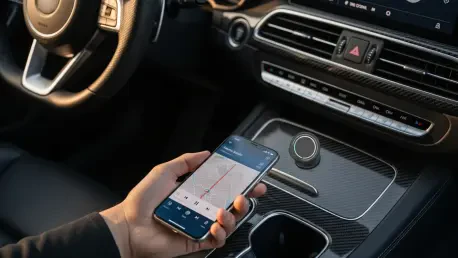

The daily ritual of entering a vehicle often involves a series of repetitive manual interactions with a smartphone that can detract from situational awareness before the tires even touch the pavement. While smart home enthusiasts frequently deploy Near Field Communication (NFC) tags to trigger lighting scenes or adjust thermostats, these indoor applications typically address minor inconveniences rather than significant safety or operational hurdles. In the context of a modern commute, however, the stakes are considerably higher because the transition from a stationary state to active driving requires a sudden shift in cognitive load and physical coordination. Fumbling with various applications to initiate a GPS route, select a podcast, or silence incoming notifications creates a window of distraction that is both unnecessary and potentially hazardous. By moving the automation focus from the living room to the center console, drivers can utilize a single, physical trigger to synchronize their digital environment with their physical journey instantly.
1. Enhancing Safety and Commuter Efficiency
The primary benefit of integrating an NFC tag into a vehicle’s interior lies in the immediate reduction of cognitive friction that occurs during the initial moments of a trip. When a driver attempts to launch multiple applications manually, they are forced to navigate through various menus, type in search bars, or scroll through playlists, all of which require precise motor skills and visual focus. This manual overhead often persists even after the vehicle is in motion, leading to a dangerous period where the driver is multitasking between the road and a glowing screen. Implementing a dedicated NFC trigger allows the user to replace these disparate actions with a single, deliberate physical gesture that requires no visual confirmation or complex dexterity. As the phone makes contact with the tag, the device automatically executes a pre-defined sequence of commands, ensuring that the necessary tools for the drive are ready before the vehicle even leaves the parking space or driveway.
Beyond the immediate safety implications, the efficiency gains provided by a streamlined driving routine contribute to a more composed and focused transition into the traffic flow. Many commuters find themselves performing the same five or six digital tasks every time they enter their car, such as toggling Wi-Fi settings to maintain a stable connection or activating a specific driving focus mode to filter out non-essential alerts. Automating these steps ensures that nothing is forgotten in a morning rush, such as failing to turn on an auto-reply feature for incoming text messages. This systemic approach transforms the smartphone from a source of distraction into a functional component of the vehicle’s cockpit, operating in the background without requiring constant monitoring. The result is a more professional and disciplined approach to modern transit, where technology serves the driver’s needs rather than demanding their attention at the most inopportune moments of the daily commute.
2. Reliability and Technical Superiority Over Alternatives
Comparing NFC-based triggers to other common automation methods, such as location-based geofencing or voice-activated commands, reveals a significant advantage in terms of reliability and execution speed. Geofencing often suffers from accuracy issues caused by GPS signal drift or atmospheric interference, leading to situations where a routine might trigger too early or fail to activate entirely because the device did not precisely cross a digital boundary. In contrast, an NFC tag provides a hardware-level handshake that is entirely independent of satellite signals or cellular data availability, functioning perfectly in underground parking garages or remote areas. Because the interaction is physical and intentional, there is no ambiguity regarding when the automation should begin, providing a level of deterministic behavior that software-only solutions simply cannot match. This eliminates the frustration of waiting for a slow location update to fire or dealing with the inconsistent performance of cloud-dependent triggers.
Voice assistants present their own set of challenges, often requiring an active internet connection to process complex multi-step commands and occasionally misinterpreting spoken instructions due to background noise or road hum. A driver might find themselves repeating a request to launch a specific navigation route several times, which only adds to the stress of the environment and increases the time spent looking away from the road. NFC technology bypasses these linguistic and acoustic hurdles by utilizing a unique identifier stored on a passive chip that the smartphone reads instantly upon proximity. Furthermore, this solution is remarkably cost-effective, as high-quality NFC stickers can be purchased for a negligible price and require no batteries or maintenance. This makes it an accessible upgrade for any vehicle, regardless of whether the car features the latest integrated infotainment systems or older hardware that lacks wireless connectivity options like CarPlay or Android Auto.
3. Execution of the Automation Configuration
The process of configuring a personalized driving routine begins with the native automation tools available on modern mobile operating systems, such as the Shortcuts application. To initiate the setup, one must launch the application and navigate to the automation section to create a new personal trigger based on an NFC scan. The device will then prompt the user to bring the phone near the physical tag to register its unique identification code, effectively linking that specific sticker to the upcoming set of instructions. It is important to note that the automation logic is stored on the phone itself, while the tag serves merely as a passive key that tells the device when to execute the stored script. Once the tag is successfully identified and labeled with a descriptive name like “Vehicle Hub,” the user can proceed to add specific actions such as opening Spotify, setting the volume to a specific level, and launching a preferred maps application with a pre-set destination.
Refining the sequence involves selecting precise parameters for each task to ensure the automation runs smoothly without requiring any further user input or confirmation prompts. For instance, the user should toggle off the “Ask Before Running” option to ensure the sequence fires immediately upon contact, creating a truly hands-free experience after the initial tap. Additional steps might include enabling a “Do Not Disturb” or “Driving Focus” filter and sending a standard arrival time update to a family member or colleague. After saving the automation, the physical tag can be permanently adhered to a convenient location within the car, such as the dashboard or the phone mount, where it is easily accessible but does not interfere with the vehicle’s controls. This straightforward technical intervention provides a customized technological ecosystem that adapts to the driver’s specific needs every time they enter the cabin, representing a significant return on a very minimal investment of time and resources.
The implementation of NFC technology within the automotive space demonstrated that the most effective digital solutions were often those that bridged the gap between physical intent and software execution. By prioritizing safety and eliminating the friction associated with manual device handling, this setup provided a blueprint for how personal technology could be better integrated into high-stakes environments. Users who adopted this approach discovered that the small investment in hardware and a few minutes of configuration yielded consistent daily dividends in terms of reduced stress and improved focus. Moving forward, the focus should remain on identifying other high-friction transitions in daily life where a simple physical trigger could replace a series of complex digital interactions. Exploring the potential for multi-tag setups or more sophisticated conditional logic could further enhance this experience as mobile operating systems continue to expand their automation capabilities. The success of the in-car NFC routine served as a definitive proof of concept for practical automation.