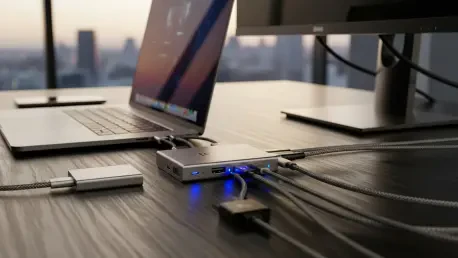

thoughtful 1984 tokens assistant The following discussion explores the technical nuances of peripheral management, focusing on the critical importance of power limit monitoring and data integrity during multi-device usage. Christair provides detailed insights into the mechanics of high-speed data transfer, the ergonomic benefits of secondary displays, and the often-overlooked necessity of hardware-level privacy and cooling. By examining specific wattage requirements, file system configurations, and thermal management strategies, she offers a masterclass in building a resilient and efficient mobile workstation. When connecting multiple high-draw devices like cooling pads or external drives, how do you monitor power limits to avoid permanent port damage? What specific system warnings or hardware behaviors should a user look for to identify a potential power surge before it occurs? Safeguarding your hardware begins with a fundamental understanding of your port’s maximum capacity, as exceeding these limits can lead to irreversible electrical damage. In many modern systems, the first line of defense is an automated safety shutdown where the OS will trigger a “Power Surge on the USB Port” error message to alert you that the connected accessory is drawing too much current. To prevent reaching this critical state, you should keep a close eye on any erratic behavior, such as a connected mouse stuttering or an external drive disconnecting unexpectedly, which often indicates the port is struggling to provide consistent voltage. I always recommend checking the manufacturer’s specifications for each device; for instance, if you are stacking a three-fan cooling pad and a high-speed external drive on a single bus, you are likely pushing the $500\text{–}900\text{ mA}$ limit of a standard USB-A port. If your laptop doesn’t provide a specific software-level wattage readout, the physical heat radiating from the port area is a clear sensory warning that you should disconnect non-essential peripherals immediately. Using a 4-port hub can expand a laptop’s utility, but data speeds often drop when all ports are occupied. How do independent chips within a hub maintain a stable 5 Gbps transfer rate, and what physical arrangement of cables prevents interference during heavy file sharing? Maintaining a stable 5 Gbps transfer rate across multiple occupied ports requires a hub equipped with dedicated internal logic, such as the independent chips found in high-quality units like the Vienon model. These chips act as traffic controllers, ensuring that data packets from a 4 GB movie transfer do not collide with the signals from a connected keyboard or mouse, effectively preventing the “bottleneck” effect. To further ensure stability, the physical spacing of the ports is vital; you want a design where the ports are sufficiently distanced to allow for the heat dissipation of the connectors themselves. When arranging your cables, try to avoid overlapping them in a tight bundle, as this can lead to electromagnetic interference that degrades the 5 Gbps signaling. By utilizing a hub that uses blue LED indicators to show active connections, you can visually verify that each branch of the hub is receiving the necessary bandwidth for uninterrupted performance. Adding a secondary 15.6-inch portable monitor can significantly boost productivity for video editors and coders. What are the best ways to configure these dual-screen setups to minimize eye strain, and how do you manage the additional battery drain when working away from a wall outlet? For professionals like coders or editors, a 15.6-inch 1080p portable monitor is a game-changer, but it must be configured correctly to protect your vision. I recommend utilizing features like low blue light modes and eye protection settings, while positioning the screen at a 178-degree angle to ensure colors remain consistent without you having to crane your neck. Regarding power management, these screens are often powered directly via a USB-C cable from the laptop, which can deplete your internal battery rapidly during a long session. To mitigate this, I suggest lowering the brightness of the portable monitor to about 50% when on battery power and closing any background applications that are unnecessarily taxing the GPU. If you are working remotely, having a dedicated power bank capable of 65W output can serve as a bridge, allowing the monitor to run without tethering your laptop to a wall outlet for every single task. External 1080p webcams often outperform built-in laptop cameras in dim environments. How does automatic low-light correction technology physically adjust to capture sharp images, and why remains a physical privacy cover a vital security step even if the camera is unplugged after use? The superiority of external 1080p webcams, such as those from Emeet, lies in their ability to use automatic low-light correction to digitally amplify the available light signals without introducing excessive “noise” or graininess. This technology works in tandem with an adjustable base and a 90-degree field of view to ensure that even if you are in a poorly lit room, the sensor captures enough data to keep the image sharp for your colleagues. While software controls like EmeetLink allow you to fine-tune exposure and color, the physical privacy cover remains the only foolproof method of security. Even if you intend to unplug the device, a physical shutter provides a sensory “peace of mind” that no software hack can bypass, ensuring your private space remains private. It’s a simple, mechanical solution to a complex digital problem, and it’s something I insist on for every professional setup I design. High-capacity 20,000 mAh power banks are now essential for professionals working in-flight. What specific wattage requirements should a user check to ensure their laptop receives a fast charge, and how can a digital display help in estimating remaining runtime during long trips? When you’re at 30,000 feet, a 20,000 mAh power bank is your lifeline, but you must ensure it outputs at least 65W through its USB-C ports to successfully charge a modern laptop. Many users make the mistake of using a standard phone power bank, which might only output 10W or 15W, resulting in a “plugged in, not charging” status because the laptop is consuming power faster than the bank can supply it. A built-in digital display is an invaluable feature here, as it provides a real-time percentage of the bank’s capacity and an estimate of the remaining runtime based on the current draw. For instance, if you see the display dropping rapidly while editing video, you know to switch to less intensive tasks like document review to stretch that 20,000 mAh across the entire flight. This visibility allows for proactive power management rather than just reacting when the screen finally goes dark. High-speed flash drives are still a primary tool for transferring large 4 GB files without internet access. Why is reformatting a drive to exFAT or NTFS necessary for large data packets, and what are the trade-offs between using a retractable design versus a fixed-cap USB? Many high-capacity flash drives, like the 256 GB Amazon Basics model, come pre-formatted in FAT32, which has a hard architectural limit that prevents any single file larger than 4 GB from being saved. Reformatting the drive to exFAT or NTFS is essential because these modern file systems remove that limitation, allowing you to move massive 4K video files or database exports with a read speed of up to 130 MB/s. When choosing the physical chassis, a retractable design offers the convenience of portability without the risk of losing a separate cap in your laptop bag. However, fixed-cap designs often provide a tighter seal against dust and pocket lint, which can accumulate in the connector and interfere with the 30 MB/s write speeds over time. For most users, the retractable mechanism is the superior “on-the-go” choice, provided they keep their gear in a clean tech pouch. Heat is a major factor in the premature decline of laptop batteries, particularly during resource-intensive tasks. How do multi-fan cooling pads improve long-term hardware health, and what ergonomic adjustments should be made to the pad’s height to ensure maximum airflow to the laptop’s base? Thermal management is the single most important factor in extending the lifespan of your laptop’s internal battery and processor. Multi-fan cooling pads, such as the three-fan Havit model, work by continuously pushing ambient air against the laptop’s chassis, which dissipates the concentrated heat generated by the GPU and CPU during tasks like gaming. To maximize this effect, you should use the pad’s adjustable height settings to create a slight incline; this elevation creates a larger “plenum” or space for the fans to draw in cool air and exhaust the hot air more efficiently. Physically lifting the base even just an inch or two off a flat desk surface can drop internal temperatures by several degrees, preventing the thermal throttling that slows down your work. It’s an ergonomic double-win: you get a better typing angle while ensuring your $1,500 investment doesn’t cook itself from the inside out. For laptops without backlit keyboards, gooseneck USB lights offer a targeted solution for typing in the dark. How do you determine the best color temperature for late-night focus, and what steps can be taken to position the light so it illuminates the keys without causing screen glare? When you’re working late into the night, the color temperature of your light source significantly impacts your focus and circadian rhythm. I recommend selecting a “warm” or “warm white” setting—typically around 3000K—to reduce the amount of blue light exposure before sleep, which is much easier on the eyes than a stark 6000K “cool white” light. To avoid the frustrating “hot spot” glare on your laptop screen, utilize the 360-degree flexible gooseneck to position the light head directly over the center of the keyboard, angled slightly away from the display. You want the light to wash over the keys from a height of about 4 to 6 inches, which provides enough illumination for the three brightness levels to be effective without bouncing harsh reflections back into your eyes. This targeted lighting allows you to remain productive in a dark room without disturbing others or straining your own vision. What is your forecast for the future of laptop peripherals and the “mobile office” setup? I believe we are moving toward a “single-cable ecosystem” where the distinction between mobile and desktop setups becomes virtually invisible. Over the next few years, we will see even more power-efficient accessories, like portable monitors that consume 30% less energy and power banks that can fully recharge a laptop in under 45 minutes using Gallium Nitride (GaN) technology. As laptops become thinner and shed more ports, the quality of your USB-C hub and your ability to manage power distribution will become the most critical skills for any professional. We’ll also see a greater integration of AI in peripherals—think webcams that automatically crop and color-correct based on your skin tone and environment without needing manual software adjustments. My advice to users is to invest in high-quality, high-wattage accessories now, as the hardware demands of our software will only continue to grow.