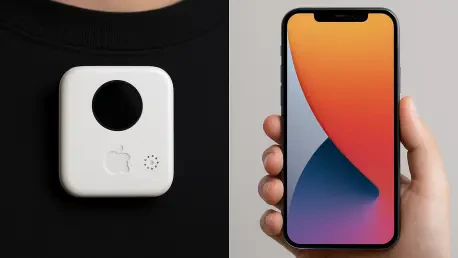

The familiar glow of the smartphone screen, a constant companion for nearly two decades, may soon be eclipsed by a new form of technology designed to integrate seamlessly into the fabric of daily life rather than demand our constant attention. Reports of Apple’s ambitious new project, an “AI Pin” slated for a potential 2027 launch, suggest the company is preparing to pioneer this next great shift in personal computing. This wearable device is not envisioned as another accessory but as a potential successor to the very device that cemented Apple’s dominance. By moving beyond traditional screens and embracing an interface driven by artificial intelligence, voice commands, and contextual awareness, Apple is betting on a future where technology becomes an ambient, almost invisible, assistant. This strategic pivot aims to redefine user interaction, moving away from taps and swipes toward a more natural, conversational relationship with our digital tools, potentially setting a new standard for the entire consumer electronics industry.
A New Paradigm in Wearable Technology
The foundational principle of the AI Pin is its revolutionary screenless interface, a deliberate design choice intended to liberate users from the constant need to look down at a device. This approach signals a significant departure from the current smartphone-centric model, fostering more present and natural interactions with both the digital world and the physical environment. The device’s design is expected to reflect Apple’s signature minimalist aesthetic, featuring a compact and premium build crafted from high-quality aluminum and glass. Engineered to be worn discreetly by clipping onto clothing, its form factor emphasizes simplicity and ease of use. A single physical button for essential functions further underscores this philosophy, stripping away complexity to deliver a user-friendly experience. This focus on unobtrusive hardware is central to its purpose: to provide instant access to powerful AI capabilities without the intermediary of a screen, making technology a helpful partner rather than a demanding focal point of daily existence.
Central to the AI Pin’s advanced functionality is its sophisticated hardware suite, meticulously engineered to support its ambitious AI-driven vision. The device will reportedly be equipped with dual cameras, one standard and one wide-angle, which will serve as its “eyes” on the world. This configuration will enable a host of real-time visual AI applications, from object recognition and on-the-fly language translation to immersive augmented reality experiences that overlay digital information onto the user’s surroundings. For audio, a high-fidelity speaker and a three-microphone array are integrated to facilitate crystal-clear voice commands and superior sound capture, even in noisy environments. This advanced audio system is crucial for enabling the sophisticated, nuanced voice interactions that will form the core of the user experience. Together, these components create a powerful sensory platform, allowing the AI Pin to see, hear, and understand the user’s context, providing intelligent and timely assistance in a truly proactive manner.
The Intelligence Powering the Pin
At its core, the AI Pin represents Apple’s strategic push to create a deeply integrated and powerful conversational assistant that lives at the heart of its ecosystem. The device is positioned as a key component in the broader industry shift toward ambient computing, a paradigm where intelligence is embedded into the environment and accessible on demand. This move places Apple in direct competition with other major innovators in the AI space, including OpenAI, as the race to define the next generation of human-computer interaction intensifies. By entering this landscape, Apple is leveraging its extensive experience in hardware design, software integration, and user experience to build a product that is not just a standalone gadget but a vital node in a larger network of intelligent services. The company’s approach involves learning from past projects to ensure a polished and robust user experience, combining sophisticated AI with its renowned focus on high-quality, intuitive design to create a new category of wearable technology.
A crucial element of the AI Pin’s potential is the rumored collaboration with Google to integrate its powerful Gemini model directly into an enhanced version of Siri. This strategic partnership would dramatically elevate the capabilities of Apple’s virtual assistant, transforming it from a tool for simple commands into a truly dynamic and context-aware conversational AI. By leveraging Gemini’s advanced natural language processing and reasoning abilities, the AI Pin could handle complex, multi-step queries, understand nuanced requests, and provide highly personalized and relevant information in real time. This move suggests that Apple is willing to look beyond its own walls to incorporate best-in-class technology, ensuring its AI offerings remain competitive at the cutting edge. Such a collaboration would not only supercharge the AI Pin but also signal a new era for Siri across all Apple devices, making the assistant more capable, reliable, and central to the user experience than ever before.
A Glimpse into a Screenless Future
The announcement of Apple’s AI Pin initiative ultimately marked a pivotal moment in consumer technology, signaling a deliberate and strategic departure from the screen-centric paradigm that had defined the previous era. This development was not merely about a new product; it represented a fundamental reimagining of how humans interact with digital information. By championing a screenless, voice-first approach, Apple validated the growing movement toward ambient computing and set a new trajectory for the entire industry. The device’s focus on seamless integration, contextual awareness, and proactive assistance suggested a future where technology would recede into the background, serving as an intuitive and ever-present partner rather than a constant source of distraction. The project challenged long-held assumptions about personal devices and forced competitors to reconsider their own roadmaps, accelerating innovation in wearable AI and natural language interfaces for years to come.