
Nia Christair is a leading voice in the mobile technology sector, bringing a wealth of expertise that spans hardware design, mobile gaming, and complex enterprise solutions. With a career dedicated to refining how we interact with digital interfaces, she has witnessed the evolution of mobile devices from simple communication tools to the sophisticated, integrated systems we use today. Her deep understanding of both the technical constraints of hardware and the shifting demands of the consumer market makes her an essential perspective on the future of wearable tech.
The following discussion explores the rapid rise of smart glasses, examining the tension between high-end AR headsets and stylish, daily-wear frames. We delve into the impressive productivity gains seen in industrial settings, the engineering hurdles of battery life and weight, and the social evolution required for these devices to truly move from a smartphone accessory to a standalone necessity.
Recent sales for stylish smart glasses have crossed the million-unit mark, while high-end AR headsets remain a premium entry point. How do these different hardware approaches impact broader market adoption, and what specific design changes are needed to transition from a smartphone accessory to a primary device?
The market is currently split between “lite” wearable tech, like the Ray-Ban Meta glasses which have already moved over 1 million units, and heavy-duty spatial computers like the Apple Vision Pro. This split tells us that consumers prioritize social acceptability and comfort for daily use, while the high-end gear proves what is technically possible in terms of immersive resolution. For smart glasses to become a primary device, we need to see a massive shift in how we handle data processing; right now, these frames are mostly “viewers” for our phones. We need to move toward a 15% capture of smartphone accessory revenue by 2030, which requires integrating more on-device AI to handle voice tasks and notifications locally. The goal is to move away from the “tether” and ensure the frames provide enough utility—like real-time translation and navigation—that the user feels a tangible loss when they aren’t wearing them.
Logistics companies report 35% faster picking times using hands-free displays, and surgeons are now using them to view data mid-procedure. Beyond these specialized environments, what everyday workflows can benefit most from AR, and what steps should companies take to integrate this technology without disrupting current operations?
The beauty of AR is that it shines whenever your hands are busy but your brain needs information, such as during complex cooking, home repairs, or even intensive fitness training. Imagine a mechanic accessing a 3D repair manual in their direct line of sight or a cyclist seeing their heart rate and route without glancing down at a handlebar mount. To integrate this without chaos, companies and developers must focus on “glanceable” UI—information that appears only when relevant and doesn’t obstruct the central field of vision. It’s about creating a hybrid ecosystem where the glasses handle the “quick-hit” tasks like media control and alerts, while the phone stays in the pocket for heavy storage and deep computing. This gradual transition ensures the user isn’t overwhelmed by a digital overlay while trying to navigate the physical world.
Wearable hardware is expected to shrink from 300 grams to nearly 50 grams by 2028, yet battery life currently caps at about eight hours. How will manufacturers balance the demand for lighter frames with the power needs of AI, and what role will solid-state batteries play in this evolution?
Reducing the weight from 300g to a featherweight 50g is the “holy grail” of wearable design, as it moves the device from a “headset” to “eyewear” that can be worn all day. However, the current 4-to-8-hour battery life is a significant bottleneck for anyone wanting to replace their phone for a full workday. This is where solid-state batteries become the game-changer; we are looking at a roadmap where these could extend usage to a full 24 hours by 2029. By using higher energy density materials, we can keep the frames slim—like the titanium models we see emerging—while powering the hungry sensors required for AR lag reduction and AI assistants. Without this battery breakthrough, manufacturers are forced to make a “weight-for-power” trade-off that usually results in a device that is either too heavy to be comfortable or too short-lived to be useful.
Moving from bulky headsets to lightweight titanium frames and recognizable fashion brands has helped lower the social stigma of wearable cameras. How do you address the remaining privacy concerns from the public, and what design elements are most critical for making smart glasses indistinguishable from traditional eyewear?
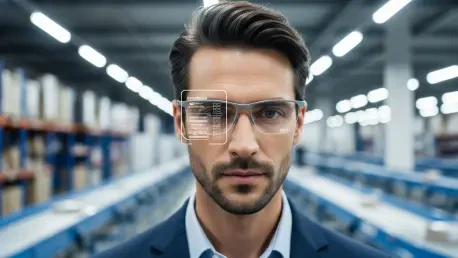
Privacy is the most delicate hurdle, and the industry is currently leaning on visible cues, such as LED privacy indicators that light up when a 12MP camera is recording. However, the real key to mainstreaming these devices is “invisible tech”—collaborations with heritage brands like Oakley or Ray-Ban ensure the frames look like something you’d choose for style, not just for a gadget. We have to be very transparent with the public about where data is stored and how these “always-on” microphones function. Design-wise, the electronics must be tucked into the temples without creating that tell-tale “bulky” look that screams “camera glasses.” When the technology becomes an integrated part of the aesthetic rather than an appendage, the social friction begins to dissolve because the device is seen as apparel first.
Most current smart glasses still rely on smartphones for processing power and cellular connectivity. In a future hybrid ecosystem, which specific tasks will migrate to the glasses first, and what technical milestones must be met before a user can comfortably leave their phone at home?
The first things to migrate are what I call “micro-interactions”: checking a text, following a 50-meter walking turn, or toggling a music track. These are the “pull-out-the-phone-for-five-seconds” tasks that currently fragment our attention spans. To truly leave the phone at home, we need two major technical milestones: independent 5G/6G connectivity within the frame and a leap in on-device AI processing that doesn’t cause the hardware to overheat against the user’s temples. We are seeing progress with Viture Pro XR’s 1,920×1,080 resolution per eye, which proves we can handle the visual output. Once the processing “brain” of the device can manage complex app ecosystems without a pocket-bound companion, the smartphone will officially move from the center of our digital lives to a secondary storage hub.
What is your forecast for smart glasses?
I anticipate that the smart glasses market will reach a valuation of $8.2 billion by 2028, driven by a 28% compound annual growth rate as fashion and function finally align. We are moving toward a world where “screen time” isn’t something we do by looking down at a piece of glass in our hands, but something that happens naturally within our environment. By 2030, expect a significant portion of the population to view their glasses as their primary interface for navigation, communication, and augmented productivity. The shift will be subtle at first—more people wearing titanium frames with hidden sensors—but eventually, the sight of someone staring down at a handheld rectangular slab will seem as antiquated as a rotary phone.