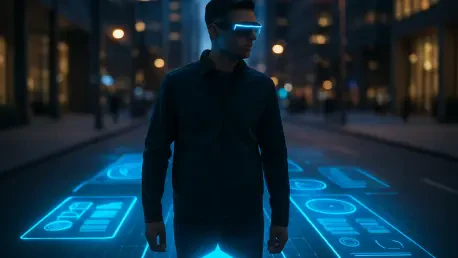

Nia Christair is a leading authority in the mobile and augmented reality sectors, bringing a wealth of experience from the front lines of mobile gaming, hardware design, and enterprise-scale solutions. Her work has consistently pushed the boundaries of how we interact with digital layers in physical spaces, making her one of the most sought-after voices in the industry. As we move toward a world where city streets are becoming interactive canvases, Nia’s insights help bridge the gap between complex hardware engineering and the lived experience of the user. This conversation explores the evolution of wearable technology, the technical hurdles of outdoor spatial mapping, and how high-fidelity visuals are transforming urban environments into dynamic, multiplayer battlegrounds.
The Snap Spectacles offer a 45° field of view and 120Hz visuals, while the Xreal Air 2 Ultra emphasizes spatial tracking. How do these hardware differences affect the precision of holographic object placement, and what specific metrics ensure that digital overlays remain stable when a player is running through a city?
The distinction between these two devices highlights a fundamental trade-off in current AR gaming tech: fluid motion versus spatial anchoring. The 120Hz refresh rate on the Snap Spectacles is vital for reducing motion blur, which ensures that when a player turns their head quickly at a street corner, the digital overlay doesn’t ghost or lag behind. However, the Xreal Air 2 Ultra focuses on the spatial tracking side, using dedicated sensors to maintain the “persistence” of an object, so a virtual shield remains exactly where you left it on a physical sidewalk. To ensure these overlays stay stable while running, we look at low-latency synchronization and high-frequency sensor polling to keep the drift to a minimum. When these metrics are optimized, the virtual content feels anchored to the concrete with a sense of weight and physical presence that survives fast-paced movement.
Environmental mapping allows sensors to anchor virtual elements to buildings and sidewalks. Can you explain the step-by-step process of how hand-tracking integration replaces traditional controllers, and what challenges developers face when maintaining responsive controls in unpredictable outdoor lighting conditions?
Transitioning away from controllers involves a sophisticated chain where the glasses first use depth sensors and cameras to create a mesh of the environment, identifying surfaces like brick walls or park benches. Once the environment is mapped, hand-tracking integration kicks in by using computer vision to identify 21 key points on a user’s hand, allowing gestures like a “pinch” or a “swipe” to act as a trigger for swinging a virtual weapon. The biggest hurdle in a city is the variable lighting, such as the harsh glare of the midday sun or the flickering of neon signs, which can wash out the sensors’ ability to see the hands clearly. Developers have to implement robust algorithms that can filter out this visual noise to ensure that a player’s command is registered the millisecond it happens, maintaining that critical sense of immersion.
The Swave HXR prototype features an ultra-high 64 gigapixel resolution for extreme visual realism. How does such high resolution compare to the dimming technology used in devices like the Viture Pro XR, and what are the trade-offs between visual fidelity and battery life during long-range street gameplay?
The Swave HXR is pushing for a level of detail where digital objects are indistinguishable from reality, but that 64 gigapixel resolution demands an incredible amount of processing power and power consumption. In contrast, the Viture Pro XR uses clever dimming technology to make the virtual screen pop by darkening the lenses, which is a much more power-efficient way to handle bright outdoor environments. The trade-off is quite stark: while a high-fidelity prototype provides a breathtaking sci-fi experience, it might only last a fraction of the time that a more optimized device would. For long-range street gameplay, players often prefer a balance where the device can last for a two-hour session without overheating or requiring a bulky external battery pack.
Large-scale multiplayer sessions require low-latency synchronization and spatial audio to blend digital sounds with the physical environment. What infrastructure is necessary to support these real-time urban interactions, and how do wearable devices ensure players stay aware of real-world obstacles during intense, fast-paced team challenges?
To make a city-wide battle feel real, we rely on a backbone of high-speed connectivity and edge computing to synchronize the movements of dozens of players simultaneously. Spatial audio is the “secret sauce” here; it processes sound so that a virtual explosion blocks away sounds distant, while a teammate’s voice feels like it’s coming from right next to you. However, safety is a massive priority, so these wearable devices use “environmental awareness” features that can highlight real-world hazards like moving cars or uneven pavement within the user’s peripheral vision. This ensures that even during a frantic team challenge, the player is never truly “blind” to the physical risks of the urban landscape.
Lightweight wearables like the Ray-Ban Meta prioritize accessibility through voice controls and extended battery. As AR gaming tech becomes more mainstream, how will the blend of navigation, social tools, and interactive gaming redefine how people perceive urban spaces, and what indicators show that users are ready for this transition?
We are moving toward a reality where the “map” is no longer something you look down at on a phone, but something you live inside of as you walk through downtown. When navigation markers, social notifications, and gaming elements are all blended into one lightweight pair of glasses, the city becomes a much more interactive and legible space. We see indicators of readiness in the way people are already embracing voice-activated AI and wearable tech that feels like traditional fashion. The transition happens when the technology becomes “invisible,” allowing a user to check a bus schedule or join a quick AR skirmish without ever breaking their stride or feeling like they are wearing a heavy piece of laboratory equipment.
What is your forecast for augmented reality streets?
I believe that by the end of this decade, the distinction between “online” and “offline” in a city will almost entirely disappear as AR becomes a standard layer of urban infrastructure. We will see “digital twins” of entire city blocks where the history of a building is projected onto its facade, and localized gaming events will draw thousands of people to physical parks to compete in invisible, holographic tournaments. This shift will require even more advancements in battery density and light-weight optics, but the momentum is undeniable as more people seek to reclaim the physical world through a digital lens. Ultimately, the city will cease to be just a place to commute through and will become a living, breathing interface for play, work, and social connection.