
The successful integration of Augmented Reality (AR) and Virtual Reality (VR) into K–12 education requires a fundamental shift from focusing on hardware to prioritizing long-term pedagogical strategy. Rather than viewing these tools as high-tech novelties, school districts must establish a comprehensive framework that moves beyond isolated pilot programs. This transition involves creating cross-functional teams where educators from various disciplines collaborate to weave immersive technology into the broader curriculum. By avoiding a siloed approach, schools ensure that these tools enhance core subjects like science and literacy across all grade levels, making the technology a versatile asset for the entire institution. To make the most of immersive tech, educators must establish clear, goal-oriented intentions that align with existing curricular standards. VR should never be treated as a passive entertainment medium; instead, it should serve as a catalyst for project-based learning and design thinking. When teachers set specific educational objectives before students ever put on a headset, the technology becomes a purposeful tool for inquiry rather than a temporary classroom distraction. This intentionality ensures that every virtual experience adds measurable depth to the student’s understanding of the subject matter, transforming the classroom into a space of active exploration.
Empowering Students Through Digital Creation
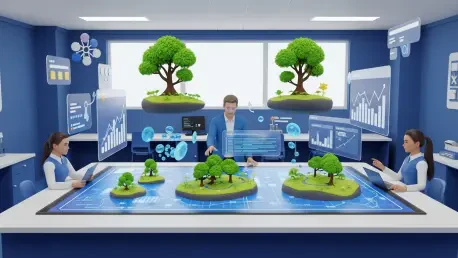
A significant evolution in the modern classroom is the transition of students from passive consumers of content to active digital creators. Instead of merely touring pre-made virtual environments, students are now using sophisticated platforms to build their own historical sites or scientific models. By synthesizing tools like AI generation and green screens, learners can translate abstract concepts into three-dimensional spaces they can actually navigate. This shift fosters a sense of ownership over their education, replacing traditional projects like dioramas with immersive digital storytelling that reflects a deeper mastery of the material. When a student builds a replica of a biological cell or a Roman forum, they are not just memorizing facts; they are engineering an experience. This process requires a synthesis of research, spatial reasoning, and technical skill, ensuring that the technology serves the learning objective rather than overshadowing it. Consequently, the classroom becomes a laboratory where students take the lead in their own intellectual development through trial and error.
As students build their own virtual worlds, they develop a unique set of skills that go beyond traditional rote memorization. The process of spatial design requires them to visualize complex information and present it in a way that others can experience. This hands-on approach transforms the learning environment into a center of innovation, where the act of creation is just as important as the final product. By engaging in this level of high-order thinking, students become more invested in the learning process, resulting in a more profound and lasting educational impact. This methodology encourages students to ask “what if” and “how,” leading to a more curious and engaged student body. Moreover, the ability to manipulate digital environments gives students a sense of agency that is often lacking in traditional lecture-based settings. By the time they complete a project, they have not only learned the subject matter but have also mastered a suite of digital tools that are increasingly relevant in the modern workforce. This dual benefit reinforces the value of XR as a core component of a contemporary, comprehensive education.
Overcoming Barriers to Implementation
One of the primary hurdles to adopting immersive technology is teacher reluctance, often fueled by a lack of time or the intimidation of mastering new hardware. To address this, experts suggest a hands-off initial approach where hesitant teachers focus on observing student engagement rather than worrying about the technical nuances of the devices. The visible excitement and audible reactions from students often serve as the most compelling evidence for the technology’s value. Furthermore, teachers should be encouraged to learn alongside their students, modeling a growth mindset that embraces the inherent messiness of exploring new digital frontiers. This collaborative learning model reduces the pressure on educators to be instant experts and instead positions them as facilitators of discovery. When teachers see that they do not need to have every answer before starting, the psychological barrier to entry drops significantly. This shift in perspective allows for a more organic integration of AR and VR into daily lessons, as the focus remains on the pedagogical outcome rather than the technical execution of the software itself.
Building a sustainable support system is equally critical for ensuring that XR tools do not end up gathering dust in a storage closet. Schools that succeed in this area often designate “tech champions” or peer mentors who provide on-demand assistance to their colleagues. This peer-to-peer support network is far more effective than a single annual professional development session, as it allows for continuous, context-specific troubleshooting. Additionally, integrating AR and VR into existing lesson plans as station-based activities, rather than total classroom overhauls, makes the transition feel manageable. By starting small, teachers can build confidence and gradually expand their use of immersive tools without feeling overwhelmed by a massive shift in their teaching style. This incremental approach also allows school districts to gather data on what works best for their specific student populations, enabling them to refine their strategies over time. Ultimately, the goal is to normalize the presence of immersive technology until it becomes just another standard tool in the educator’s toolkit, much like the laptop or the whiteboard.
Measuring Success Beyond Test Scores
Determining the return on investment for AR and VR programs requires looking past traditional metrics like standardized test scores to focus on future-ready competencies. Educators find the true value of these tools in the high levels of student engagement and the development of essential soft skills. Immersive projects naturally encourage collaboration and problem-solving, as students must work together to navigate the frustrations and triumphs of digital construction. Success is therefore measured by the quality of the collaborative process and the students’ ability to think critically within a spatial environment. When students are tasked with building a virtual ecosystem, they must negotiate roles, share resources, and troubleshoot technical glitches as a team. These interactions provide invaluable lessons in teamwork and communication that are difficult to replicate through traditional assignments. By prioritizing these competencies, schools are better preparing students for the complexities of a professional landscape that values adaptability and collaborative innovation over simple fact retention.
The ultimate goal of integrating these technologies is to create a classroom where the hardware becomes an invisible bridge to deeper understanding. When schools prioritize the journey of exploration and trial-and-error over the final visual output, they prepare students for a technologically integrated reality. By focusing on engagement as a primary success metric, schools can move past the initial novelty of VR and AR, creating a dynamic environment where students can interact with the world in ways that were previously unimaginable. To move forward, administrators should focus on qualitative assessments, such as student portfolios and reflective journals, which capture the nuances of the learning journey. These methods provide a more comprehensive view of how immersive tech influences student growth and intellectual curiosity. Moving into the next phase of digital adoption, the focus should remain on scaling these successes by documenting best practices and sharing them across district lines. This collective knowledge will ensure that the benefits of AR and VR are not limited to a few elite classrooms but are accessible to every student, regardless of their background or location.