
In a decisive move that reverberates through the extended reality (XR) industry, Asus has fundamentally altered its course, trading its virtual reality aspirations for a focused pursuit of augmented reality’s potential in the gaming sector. The company’s recent cancellation of a planned Meta Quest-style VR headset, which was set to run on Meta’s Horizon OS, signals a significant strategic realignment. This pivot is not a retreat but a calculated maneuver into a more specialized and potentially more defensible market niche. By partnering with AR specialist XREAL, Asus is now channeling its considerable resources and its formidable Republic of Gamers (ROG) brand into a new device: the ROG XREAL R1. This pair of AR glasses is not designed to compete in the all-encompassing mixed-reality space dominated by giants like Meta and Apple. Instead, it aims to perfect a single, crucial experience for a demanding audience: providing high-performance traditional gamers with a massive, private, and exceptionally fluid virtual display for their existing PC and console titles. This shift reflects a keen understanding of the current market’s complexities and a bold bet that the immediate future of gaming enhancement lies not in creating new worlds, but in transforming how we view the ones we already love.
A Strategic Shift in a Crowded Market
The Unwinnable VR Battle
The decision by Asus to abandon its previously announced VR headset venture, first revealed in 2024, underscores the immense challenge of competing in a market so thoroughly dominated by a single player. The plan to build a device on Meta’s Horizon OS initially seemed like a logical step, leveraging an established software ecosystem to enter the VR space. However, the economic realities of the industry presented a nearly insurmountable obstacle. Meta employs a strategy of heavily subsidizing its Quest hardware, often selling the devices at or below cost to drive platform adoption and build a massive user base for its software and services. For a hardware partner like Asus, this creates a difficult competitive landscape. Without the ability to modify core components, such as the chipset, or influence the fundamental software experience, any Asus-branded headset would have struggled to differentiate itself meaningfully from Meta’s own offerings. The most likely outcome would have been a device functionally similar to the Quest 3 but at a higher price point to ensure profitability, a proposition few consumers would find compelling. This economic vise forces partners into a corner, making it nearly impossible to innovate on hardware or compete on price, effectively turning them into assemblers for the platform holder.
Asus’s withdrawal from the Horizon OS partnership is more than a single product cancellation; it serves as a potent case study on the limitations of the so-called “open” XR ecosystem model as it currently exists. While Meta has positioned Horizon OS as the accessible alternative to Apple’s tightly controlled visionOS, the power dynamic remains heavily skewed in favor of the platform owner. When the company that controls the operating system is also the leading hardware manufacturer and subsidizes its products, the “openness” for other hardware makers becomes largely theoretical. This situation highlights a critical challenge for the industry: for a truly diverse and competitive hardware market to flourish, there must be a clearer separation between the platform and the hardware, or a model that allows partners to add significant value and differentiate their products in a way that justifies a premium. Asus’s pivot suggests a conclusion that many in the industry have quietly acknowledged: directly challenging Meta on its home turf with similar hardware is a strategy fraught with financial risk and limited potential for brand distinction, prompting a search for alternative paths to success in the broader XR landscape.
Forging a New Path with XREAL
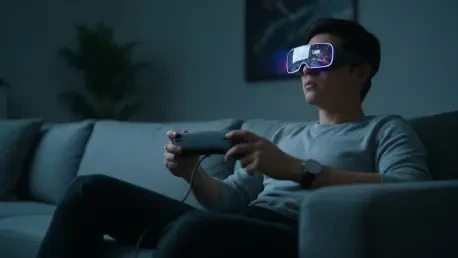
In place of a direct confrontation in the VR arena, Asus has opted for a more agile and targeted approach through its collaboration with AR specialist XREAL. This partnership has culminated in the announcement of the Asus Republic of Gamers (ROG) XREAL R1, a device that sidesteps the VR platform wars entirely. Rather than attempting to build a new immersive world, the R1 is designed as a premium peripheral for the massive, existing ecosystem of PC and console gaming. Its core function is to act as a high-performance virtual monitor, simulating the experience of viewing a colossal 171-inch screen from a comfortable distance. This strategic positioning is brilliant in its simplicity. It lowers the barrier to entry for consumers, who do not need to invest in a new library of games or learn a new operating system. Instead, they can enhance the games they already own and play. By focusing on a specific use case for a dedicated audience—the serious gamer who values visual fidelity and performance above all else—Asus is carving out a niche where its ROG brand equity and technical expertise can shine, avoiding the commoditized, price-driven battleground of mainstream VR headsets.
The collaboration between Asus and XREAL represents a powerful synergistic model that could become a blueprint for other companies looking to enter the XR market. XREAL contributes its deep, specialized expertise in AR optics and hardware miniaturization, a field that requires years of dedicated research and development. Asus, in turn, brings its globally recognized ROG brand, a powerful marketing apparatus, established distribution channels, and an intimate understanding of the PC gaming community’s desires and demands. This division of labor allows each company to focus on its core competencies, dramatically reducing the time, cost, and risk associated with developing an XR product from the ground up. For Asus, it provides a fast track into a promising market segment without the multi-billion dollar investment required to build a new platform. For XREAL, it offers access to a massive and influential audience through a trusted brand. This partnership-driven approach demonstrates a pragmatic understanding that in the current XR climate, success may not come from monolithic, vertically integrated giants alone, but also from clever alliances that combine specialized innovation with market-leading brand power.
The Technology Behind the Vision
Pushing the Boundaries of Visual Fidelity
The true distinction of the ROG XREAL R1 lies in its uncompromising focus on visual performance, headlined by technical specifications designed to appeal directly to the most discerning gamers. At the heart of the device are dual 1,920 x 1,080 Sony micro-OLED displays, which promise deep blacks, vibrant colors, and exceptional clarity. However, the standout feature that sets the R1 apart from nearly every other consumer display device is its astonishingly high 240Hz refresh rate. This figure is double that of comparable high-end AR glasses, such as the XREAL One Pro, and it represents a significant leap forward for visual fluidity in a wearable form factor. For gamers, particularly those engaged in fast-paced competitive titles, a higher refresh rate translates directly into a tangible advantage. It drastically reduces motion blur, improves tracking of fast-moving targets, and creates a sense of immediacy and responsiveness that can be the difference between victory and defeat. This commitment to a pro-grade refresh rate firmly positions the R1 not as a casual media viewer, but as a serious piece of gaming hardware designed for peak performance. Combined with a 57° field of view, the glasses create an immersive sense of scale, effectively replicating a large-format monitor without the physical space requirements.
Beyond the headline-grabbing refresh rate, the ROG XREAL R1 incorporates a suite of features that demonstrate a thoughtful approach to the complete user experience. One of the most practical innovations is the 3-level electrochromic tinting. This technology allows the user to electronically adjust the transparency of the lenses, making it possible to adapt to various environments on the fly. A user could opt for a nearly opaque setting to block out all distractions during an intense tournament match or switch to a more transparent mode to maintain awareness of their physical surroundings while gaming at home. This versatility is complemented by an integrated “Sound by Bose” audio system, ensuring a high-quality, spatial audio experience without the inconvenience of adding a separate pair of headphones. Crucially, all of this technology is packed into a lightweight 91g frame. Comfort is a paramount concern for any wearable device intended for long-duration use, and by keeping the weight low, Asus and XREAL are directly addressing one of the most common complaints leveled against heavier VR headsets, ensuring that marathon gaming sessions remain comfortable and fatigue-free.
Connectivity and Ecosystem Integration
A critical component of the ROG XREAL R1’s design philosophy is its emphasis on seamless and versatile connectivity, centered around the external ‘ROG Control Dock’. This hub is engineered to eliminate the friction often associated with integrating new peripherals into an existing gaming setup. By providing two HDMI 2.0 ports and one DisplayPort 1.4 port, the dock ensures broad, plug-and-play compatibility with the vast majority of gaming PCs and consoles on the market. This approach effectively treats the R1 as a standard external monitor, bypassing the complex software drivers, platform-specific storefronts, and compatibility hurdles that can plague more integrated XR systems. A gamer can simply unplug their traditional monitor and plug in the R1, immediately gaining access to a massive virtual screen for all of their existing titles. This focus on straightforward, hardware-level integration is a deliberate strategy to make the adoption process as simple as possible for its target audience, appealing to users who want to enhance their current gaming experience rather than migrate to an entirely new and unfamiliar platform. The dock acts as a universal translator between the established world of gaming and the new frontier of AR displays.
The system’s flexibility extends beyond the stationary setup facilitated by the ROG Control Dock. The R1 glasses can also connect directly to supported devices via a single USB-C cable, unlocking a host of portable and mobile gaming scenarios. This capability is particularly synergistic with the growing market of powerful handheld gaming PCs, such as Asus’s own ROG Ally. A user could, for example, enjoy a flight or a train ride while experiencing their favorite AAA titles on what feels like a 171-inch screen, offering a level of immersion and privacy that is simply impossible to achieve with a small, built-in display. This dual-pronged approach to connectivity—a robust, multi-input dock for home use and a simple, single-cable solution for on-the-go—makes the R1 a remarkably versatile device. It also smartly positions Asus in the context of the wider, evolving XR ecosystem. As platforms like Google’s Android XR continue to emerge and challenge existing players, the R1’s platform-agnostic nature, functioning primarily as a high-performance display, ensures its relevance and utility regardless of which software ecosystem ultimately gains supremacy.
Reflecting on a New Gaming Frontier
Asus’s decisive pivot from a broad VR ambition to a sharply focused AR gaming device ultimately reflected a masterful interpretation of a volatile and challenging market. The company recognized that directly challenging a subsidized hardware leader with a look-alike product was an untenable position. The subsequent cancellation of its Horizon OS-based headset and the strategic partnership with XREAL represented a shift from a high-risk, low-differentiation strategy to a calculated, niche-focused approach. This move allowed the company to leverage its powerful ROG brand and deep understanding of the gamer demographic without becoming embroiled in an unwinnable price war. The resulting product, the ROG XREAL R1, provided a clear and compelling value proposition built on tangible performance metrics like its 240Hz refresh rate and seamless connectivity. This strategic realignment, which prioritized enhancing an existing, beloved ecosystem over attempting to build a new one from scratch, established a compelling blueprint for how established tech brands could successfully navigate the turbulent waters of the extended reality industry.