
A tectonic shift is underway within the personal computer hardware industry, as the silicon giant that powered decades of gaming innovation appears to be deliberately diverting its immense resources toward the new, more lucrative frontier of artificial intelligence. For countless PC enthusiasts, 2026 is shaping up to be a silent year, marked not by the excitement of new product launches but by the unsettling reality of a market in flux. This unprecedented pause in the consumer graphics card release cycle signals a potential realignment of priorities that could redefine the landscape for gamers, developers, and competitors for years to come.
The Green Juggernaut: Nvidia’s Dual Dominance in Pixels and Processing
For nearly three decades, Nvidia has been the undisputed champion of the consumer graphics card market. The GeForce brand became synonymous with high-performance PC gaming, driving innovation in rendering technology and setting the benchmark for visual fidelity with each new generation. This legacy built a loyal and massive consumer base that has consistently fueled the company’s growth and established its dominant market position.
In parallel with its gaming empire, Nvidia quietly cultivated a second, even more powerful, pillar of its business: high-performance computing for AI and data centers. The company’s CUDA architecture, initially developed for graphics, proved exceptionally well-suited for the parallel processing tasks required by machine learning. This foresight allowed Nvidia to capture the AI boom, leading to explosive growth in its professional accelerator division. However, this dual dominance has created an internal battle for resources, as both the GeForce gaming line and the AI product line compete for the same limited supply of cutting-edge silicon and high-bandwidth memory.
A Strategic Pivot: The AI Gold Rush and the VRAM Crisis
Whispers of a Silent Year: The Rumored 2026 GeForce Hiatus
The most disruptive development for the gaming community is the confirmation that no new GeForce GPUs will be released this year. This marks the first time in company history that an entire calendar year will pass without either a new architecture or a mid-cycle refresh. This strategic hiatus is not a result of a lack of innovation but a calculated response to a severe industry-wide shortage of high-performance video memory (VRAM).
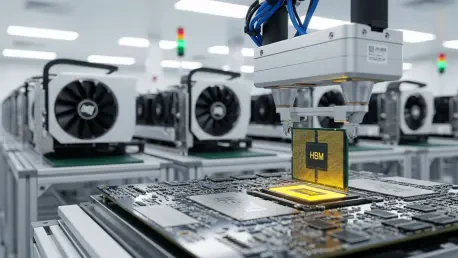
At the core of this decision is a critical resource allocation conflict. Faced with a strained supply chain for essential memory chips, Nvidia has reportedly chosen to funnel its available VRAM toward its professional AI accelerators. Corroborating this strategic pivot are credible reports that the company has also significantly slashed production of its current-generation RTX 5000 series gaming cards. This two-pronged approach—halting new product introductions while reducing the supply of existing ones—has sent a clear signal about the company’s immediate priorities.
Following the Money: The Unmistakable Allure of AI Margins
The financial logic behind this strategic shift is undeniable. The profit margins on high-end AI and data center accelerators vastly exceed those of consumer-grade GeForce cards. As global demand for AI processing power continues to surge, the financial incentive for Nvidia to prioritize its enterprise clients over its gaming base has become overwhelmingly powerful. This creates a direct competition where every high-bandwidth memory chip allocated to a gaming card represents a significant opportunity cost.
This economic reality suggests a long-term trend rather than a temporary adjustment. As long as the AI gold rush continues and the profitability gap between the two sectors remains so wide, the company is likely to continue allocating its most valuable resources to where they generate the highest return. For the gaming segment, this means facing a future where its needs are secondary to the voracious appetite of the AI industry.
The Fallout for PC Builders: Scarcity, Price Hikes, and Stagnation
The immediate consequence for consumers is a classic case of supply and demand economics. With production of current-generation cards reduced and no new models on the horizon, the available inventory of GPUs is shrinking. This scarcity is already creating price instability in the retail market, with the potential for significant price hikes on existing RTX 5000 series cards. PC gaming, an already expensive hobby, may become prohibitively so for many.
Beyond the financial impact, the lack of new hardware introduces the problem of technological stagnation. Game developers design their titles around the capabilities of current and upcoming hardware. A prolonged pause in the GPU release cycle could stifle innovation, as developers have less incentive to push graphical boundaries. Furthermore, a growing disconnect is emerging, where modern games increasingly demand more VRAM, yet the industry appears to be shifting focus away from producing the higher-capacity models that enthusiasts and developers need.
Corporate Responses and Market Ripples: Navigating the Narrative
In the face of growing community concern, Nvidia’s public response has been carefully managed and non-committal. The company has avoided directly confirming or denying the specifics of its production strategy, instead issuing generalized statements about its commitment to the GeForce product line and its efforts to maximize memory availability. This type of guarded corporate communication is designed to manage investor expectations and prevent market panic while doing little to reassure anxious gamers.
This situation is not isolated to a single company. Unsettling reports from the supply chain suggest that Nvidia’s main competitor, AMD, may be adopting a similar strategy, prioritizing the production of lower-VRAM models to conserve resources. If true, this points to a broader market shift where both major players are re-evaluating their commitment to the high-end consumer gaming segment. The result could be a less competitive and more expensive market for all PC builders.
The Reshuffled Roadmap: A Glimpse Into Gaming’s Future
This strategic pivot has had a cascading effect on Nvidia’s long-term product roadmap. Plans for a mid-cycle refresh of the RTX 5000 series, codenamed ‘Kicker’ and widely expected to be the RTX 5000 Super lineup, were officially delayed in late 2025. This series was rumored to feature significant VRAM increases, making its postponement a direct consequence of the ongoing memory shortage.
The cancellation of the 2026 refresh has, in turn, created a domino effect, pushing back the timeline for the next true GPU generation. The RTX 6000 series, which was originally anticipated to enter production in late 2027, is now unlikely to arrive before 2028. This extends the current hardware generation far beyond the typical two-year cycle, leaving gamers with a longer wait for meaningful performance improvements and creating a significant growth challenge for a hobby built on continuous innovation.
The Final Verdict: Has the Gamers’ Champion Found a New Calling?
The evidence strongly indicated a deliberate and significant strategic reorientation within Nvidia. The decision to halt new GeForce releases for an entire year while simultaneously deprioritizing the production of existing gaming cards represented a calculated business move. It was a clear response to the immense profitability and insatiable demand of the artificial intelligence sector, a market that now stands as the company’s primary focus.
This shift was not merely a temporary adjustment to supply chain pressures; it was a fundamental realignment of the company’s priorities. While Nvidia built its empire on the loyalty of gamers, its actions have shown that its future ambitions lie in powering the AI revolution. For the PC gaming community, this marked the end of an era. The years ahead were defined by higher costs, slower innovation, and the stark realization that their long-time champion had answered a new, more profitable calling.