
When it comes to the complex world where mobile technology, hardware design, and enterprise solutions converge, few have the depth of experience as Nia Christair. With a background spanning everything from mobile gaming to enterprise-grade mobile deployments, she has a unique perspective on the next major shift in computing. Today, we delve into the emergence of “Physical AI,” a trend reshaping how businesses think about robotics, automation, and the very fabric of their IT infrastructure.
We’re seeing a shift from agentic AI to “Physical AI.” How does training “world models” on simulations and video differ from traditional AI training, and what new infrastructure challenges does this create for enterprises? Can you share a step-by-step example?
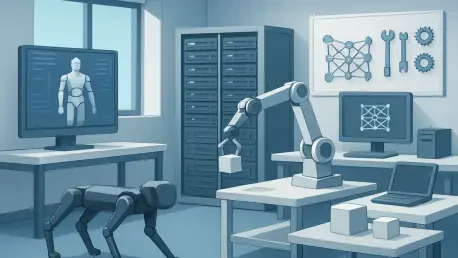
It’s a fundamental change in the very nature of the data. For years, we trained AI on digital information—text, code, images. Agentic AI could read a manual and learn a task. But Physical AI has to understand the real world, with all its messy physics. This requires what we call “world models,” which are not trained on static text but on dynamic, high-fidelity video and complex physics simulations. Imagine teaching a robot to pick up an object. First, you’d build a photorealistic digital twin of your warehouse. Second, you’d run millions of simulations within that digital environment, teaching the AI how gravity, friction, and object weight work in countless scenarios. Finally, you deploy that trained model to the physical robot. The infrastructure challenge is immense because this isn’t just about data storage; it’s about generating massive amounts of synthetic data, which demands a whole new class of heavy, simulation-driven computing power that most enterprises are not yet equipped for.
As AI workloads for robotics move to the edge, what specific trade-offs must CIOs make between device reliability and cloud scale? Please walk us through how you would design a hybrid architecture for a factory automation system to balance these competing needs.
That’s the central tension every CIO is facing. On the one hand, you have the almost infinite scale of the cloud, perfect for training those massive world models we just discussed. On the other hand, a robot on a factory floor cannot afford a millisecond of network lag to ask the cloud what to do next; it needs instantaneous, reliable decision-making right there on the device. The trade-off is clear: you sacrifice the cloud’s raw power for the edge’s immediate reliability. To design a balanced system, I’d implement a hybrid architecture. The heavy lifting—the initial training and continuous learning from all the robots in the fleet—remains in the cloud. But the critical, real-time functions, like inference for object recognition and motor control, are pushed to Arm-based accelerators directly on the robot. This way, the robot operates autonomously and safely, while the cloud acts as a central brain, a system of learning that periodically pushes updated, smarter models down to the edge.
Why is predictable, low-latency networking so critical for Physical AI systems in factories or warehouses? Explain how technologies like private 5G address these needs differently than traditional enterprise Wi-Fi, and provide a key performance metric that IT leaders should monitor.
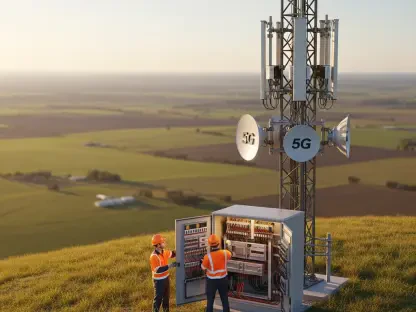
In a dynamic environment like a factory, predictability is everything. You have multiple autonomous systems that need to coordinate their movements with split-second precision. A dropped packet or a moment of high latency isn’t just an inconvenience; it could lead to a collision or a halt in the production line. Traditional enterprise Wi-Fi is built for “best-effort” delivery, which is fine for email but disastrous for robotics. Technologies like private 5G or Wi-Fi 7 are designed for deterministic performance. They provide a dedicated, controlled network where you can guarantee a certain level of service and incredibly low latency. They don’t just make the connection faster; they make it consistently reliable. The key performance metric I would have IT leaders laser-focused on is “jitter,” or the variation in latency over time. A low, stable jitter is the true sign of a network that’s ready for the demands of Physical AI.
The concept of a “seamless compute fabric” from the data center to the robot is gaining traction. What are the practical benefits of this standardization for developers and IT teams? Can you provide an anecdote on how this approach simplifies moving AI models from the cloud to a device?
The “seamless compute fabric” is a game-changer for efficiency and speed. The practical benefit is that it eliminates the soul-crushing work of rebuilding and re-optimizing software for every different piece of hardware. When your cloud servers and your edge devices are all built on a standardized architecture like Arm, your developers can finally breathe. Imagine a developer who spends weeks training a sophisticated AI model on a powerful server in the data center. In the old world, moving that model to a power-constrained robot would be a nightmare of code translation and optimization. With a seamless fabric, it’s almost like hitting “send.” Because the underlying architecture is the same, the model can move from the cloud to the device without that painful rebuilding process. This drastically shortens development cycles and allows IT teams to manage a single, unified stack, which is far simpler and more secure.
For a CIO just beginning to explore Physical AI, what are the first three practical steps to integrate robotics into their core IT stack rather than treating it as a niche experiment? Please detail how they should structure a pilot project to validate performance before scaling.
First, and most importantly, they must shift their mindset. Treat robotics as a fundamental extension of the core IT stack, not some siloed, niche operational technology (OT) experiment. Second, design applications with a clean separation of concerns: one component for training in the cloud, one for orchestration, and one for real-time execution on the device. This modularity is key to flexibility. Third, structure a rigorous pilot project. Don’t just throw a robot at a problem. Instead, choose a controlled environment, like a single packaging line or a specific warehouse aisle. Define crystal-clear metrics for success—things like cycle time, pick-and-place accuracy, and energy efficiency. The goal of this pilot isn’t just to see if the robot works; it’s to validate its integration with your security, management, and networking infrastructure before you even think about scaling.
As enterprises standardize on a single architecture for this new compute fabric, how does the risk of dependency on a company’s roadmap differ from traditional vendor lock-in? What specific strategies can CIOs use to mitigate this dependency while still benefiting from the ecosystem?
It’s a more nuanced risk. Traditional vendor lock-in was about being stuck with a specific product, making it painfully expensive to switch. This new risk is a dependency on a single company’s strategic direction. If your entire compute fabric, from cloud to edge, is based on Arm, your future capabilities are directly tied to Arm’s roadmap, its licensing decisions, and its pace of innovation. You’re not just buying a product; you’re buying into a long-term vision. To mitigate this, CIOs should focus on abstraction and open standards. By containerizing applications, for instance, you maintain a degree of portability. It’s also critical to actively participate in the ecosystem, engaging with partners and consortiums to ensure your enterprise’s needs are influencing the roadmap, rather than just being a passenger on it.
What is your forecast for enterprise robotics and Physical AI over the next three to five years?
I believe we’re on the cusp of a significant, though gradual, transformation. Over the next three to five years, you won’t see a sudden robot takeover, but you will see a strategic and steady integration of Physical AI into core business operations. The initial adoption will be highly targeted, focusing on controlled environments like factories and warehouses where the ROI is clearest and the risks are manageable. As CIOs become more comfortable with the technology and the “seamless compute fabric” matures, we will see these autonomous systems expand more broadly across logistics, retail, and even into more public-facing roles. It will move from a niche technology to an essential, integrated component of the modern enterprise IT infrastructure.