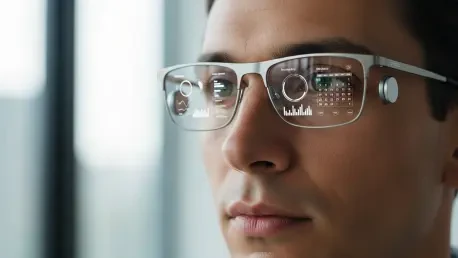

The transition from pocket-sized screens to immersive, head-mounted displays has reached a definitive tipping point this year as hardware capabilities finally align with advanced neural networks. For the past several cycles, the technology industry has promised a seamless overlay of digital information onto the physical world, yet the bulky prototypes and limited battery life of previous iterations often hindered widespread adoption. Today, the landscape is fundamentally different, characterized by the release of sleek, high-performance glasses that function as primary interfaces rather than mere smartphone accessories. This shift is not merely an incremental upgrade in display technology but represents a profound reorganization of how data is consumed and processed in real-time. By moving the digital layer directly into the user’s line of sight, developers are eliminating the friction of physical devices, allowing for a more natural interaction with artificial intelligence that responds to environmental context and user intent.
Structural Shifts in the Tech Ecosystem
Synergy Between Generative Models and Lightweight Optics
Google has aggressively positioned its Gemini AI at the forefront of this movement by embedding sophisticated multimodal capabilities into its latest eyewear line. These devices prioritize hands-free navigation and contextual search, enabling users to receive real-time updates about their surroundings without breaking stride. By leveraging a massive index of geographical and visual data, the software can identify landmarks, translate foreign text instantaneously, and provide walking directions that appear as glowing paths on the actual pavement. This integration marks a departure from traditional notification-based systems, moving toward a proactive assistance model where the AI anticipates needs based on visual cues. The result is a device that feels less like a computer and more like an intellectual extension of the human senses, providing a level of utility that makes the constant retrieval of a smartphone feel increasingly archaic and disruptive to social flow.
Samsung is simultaneously capitalizing on its manufacturing prowess to deliver a competing vision through its long-standing partnership with major software providers. This collaboration has yielded augmented reality glasses that integrate deeply with the existing Galaxy ecosystem, ensuring that users can transition from their tablets and home appliances to their wearable displays without data silos. By focusing on the miniaturization of processors and the refinement of display brightness, Samsung is addressing the aesthetic concerns that previously relegated AR tech to the niche enthusiast market. Their latest units feature ultra-thin lenses that maintain high transparency while projecting crisp, high-definition graphics even in direct sunlight. This emphasis on form factor is a strategic move to ensure that augmented reality becomes a standard accessory for the general population, bridging the gap between professional-grade tools and fashionable consumer electronics that people are willing to wear all day.
The Emergence of Sovereign AI Hardware
OpenAI has recently disrupted the status quo by expanding its focus from large language models into the production of bespoke consumer hardware. This strategic pivot suggests that software developers are no longer content to rely on third-party manufacturers to showcase the full potential of their generative agents. Reports indicate that the organization is developing exploratory eyewear and smart home peripherals designed to run localized versions of their most advanced models. By controlling the entire stack from the silicon to the user interface, they can optimize latency and power consumption in ways that were previously impossible. This vertical integration allows for a more responsive experience where the AI can process visual inputs locally, reducing the dependence on cloud servers and enhancing user privacy. This move has forced traditional tech giants to accelerate their own development timelines to prevent a new player from dominating the nascent wearable computing market.
While Apple continues to refine its premium vision for high-fidelity spatial computing, a wave of smaller manufacturers is finding success in task-specific frames. These developers are moving away from the “do-everything” approach, instead focusing on “lite” versions of augmented reality that prioritize extreme battery life and specific use cases like cycling, industrial maintenance, or live transcription for the hearing impaired. These devices often strip away complex gesture controls in favor of voice-activated interfaces and simple heads-up displays. This diversification of the market ensures that there is a entry point for every demographic, preventing the technology from becoming a luxury exclusive to the high-end sector. As these specialized tools gain traction in professional environments, the resulting improvements in durability and optical clarity are quickly being incorporated into more generalized consumer products, accelerating the overall maturity of the industry.
Overcoming Barriers to Mainstream Integration
Professional Foundations and Consumer Adoption
The enterprise sector has acted as a critical proving ground for the current wave of augmented reality hardware, providing the necessary capital to refine complex components. In fields such as logistics, field service, and complex manufacturing, workers have already demonstrated that head-mounted displays can significantly increase efficiency and reduce error rates. By following digital blueprints or inventory maps overlaid on their actual workspace, employees can operate with both hands free, a benefit that is now being translated for the average consumer. As these industrial applications have matured, manufacturers have solved significant engineering challenges related to thermal management and ruggedization. The heat dissipation technologies developed for high-stress factory environments are now being utilized to keep consumer glasses cool during prolonged use, ensuring that the devices remain comfortable for hours on end regardless of the processing load.
Building on the success of these professional workflows, the latest consumer models are now incorporating advanced spatial mapping sensors that were once reserved for high-end research. These sensors allow the glasses to “understand” the geometry of a room, enabling digital objects to persist in physical locations even when the user looks away. For example, a virtual television can be “anchored” to a living room wall, or a digital recipe card can remain visible above a kitchen stove. This level of environmental awareness transforms the home into a dynamic interface where digital content occupies the same space as physical furniture. This approach naturally leads to a more intuitive user experience, as people can interact with data using the same spatial logic they apply to the physical world. The seamless blending of these two realms is what distinguishes the current generation of hardware from the fragmented and often clunky experiences of the early decade.
Addressing Security Protocols and Economic Accessibility
As the proliferation of cameras and microphones in everyday eyewear becomes more common, the industry is facing a renewed debate regarding data governance and surveillance. Manufacturers have responded by implementing hardware-level privacy indicators, such as physical shutters or bright light-emitting diodes that signal when a recording is active. Furthermore, decentralized data processing has become a standard feature, with many devices ensuring that sensitive visual information never leaves the local hardware. These measures are designed to build public trust, as the success of the AR revolution depends heavily on the social acceptance of these devices in public spaces. Tech firms are now working closely with regulatory bodies to establish clear guidelines on where and how these devices can be used, aiming to balance the immense benefits of persistent digital assistance with the fundamental right to privacy in shared environments.
The economic landscape for these devices has also stabilized, with a range of pricing tiers that make the technology accessible to a broader audience. While premium models featuring high-end optics and advanced biometric sensors still command a significant price, basic smart frames have become comparable in cost to high-end traditional eyeglasses. This affordability is a key driver in the push to replace the smartphone as the primary digital interface. To ensure long-term viability, manufacturers focused on creating sustainable business models that move away from aggressive data harvesting toward subscription-based services or premium app ecosystems. Organizations optimized their supply chains to handle the unique demands of wearable production, resulting in a more resilient market that is less susceptible to component shortages. These strategic adjustments ensured that the transition to head-worn computing was not only technologically feasible but also economically sustainable for both producers and consumers.