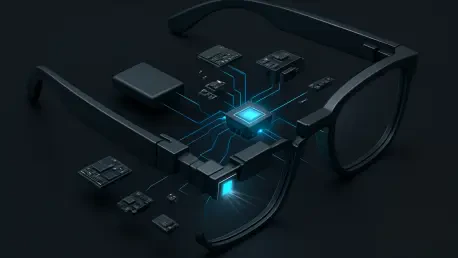

The long-held vision of augmented reality glasses that seamlessly integrate digital information into our daily lives has consistently been challenged by the fundamental technological barriers of size, power consumption, and visual quality. OMNIVISION has now introduced a groundbreaking solution with its announcement of the OP03021, a revolutionary single-chip microdisplay poised to serve as a foundational component for the next generation of AR devices. This full-color, sequential Liquid Crystal on Silicon (LCOS) display is not merely an incremental hardware update but a critical enabler designed to transition AR glasses from bulky, niche gadgets into the lightweight, fashionable, and practical consumer electronics essential for all-day use. By delivering exceptional performance within an ultra-low-power and compact package, OMNIVISION aims to provide the vital visual interface necessary for widespread interaction within the burgeoning metaverse and to finally make wearable computing a comfortable and ubiquitous reality.
A New Standard in Integrated Architecture
At the core of the OP03021’s innovation is its “all-in-one” single-chip architecture, a design that integrates the pixel array, driver circuitry, and frame buffer memory onto a single silicon backplane. This consolidated approach marks a significant departure from conventional multi-chip solutions, setting a new industry standard for efficiency and miniaturization in LCOS technology. This compact yet powerful microdisplay delivers impressive technical specifications, including a high resolution of 1632 x 1536 pixels and a smooth 90 Hz refresh rate, all within a minuscule 0.26-inch optical format with a small 3.0-micron pixel pitch. As a full-color sequential LCOS panel, it supports up to six color fields, ensuring that users experience crisp, stable, and fluid visuals free from common issues like image retention. This comprehensive integration is what positions the OP03021 as a leader, engineered from the ground up for the ultra-low power consumption required by next-generation smart glasses.
The most significant advantage stemming from this integrated design is its remarkable power efficiency. OMNIVISION claims the OP03021 consumes up to 40% less power than traditional two-chip systems, a crucial breakthrough for battery-dependent wearable devices. This substantial reduction is paramount for enabling longer usage times between charges and minimizing heat generation, a critical factor for ensuring user comfort during extended wear. For manufacturers, this simplification streamlines the entire system design, potentially lowering development costs and accelerating the time-to-market for more compact and cost-effective final products. By solving multiple engineering challenges at once—power, size, and complexity—this single-chip approach provides a robust foundation upon which the next wave of AR hardware can be built, moving the industry closer to its mainstream ambitions.
Redefining the User Experience for Mass Adoption
The technological advancements embedded within the OP03021 translate directly into a vastly improved user experience, systematically addressing the primary obstacles that have hindered widespread AR adoption. Its significantly reduced size and minimal power requirements empower device manufacturers to design AR glasses that are smaller, lighter, and more aesthetically pleasing, bringing their form factor closer to that of traditional eyewear. This shift away from bulky, obtrusive hardware is identified as a crucial step toward making smart glasses not only functional but also socially acceptable and comfortable enough for all-day wear. The ability to create a device that users forget they are wearing is fundamental to integrating AR technology seamlessly into daily routines, transforming it from a novelty into an indispensable personal tool.
Beyond the critical improvements in comfort and style, the chip promises a superior visual experience that is essential for genuine immersion. The combination of its high resolution and a high refresh rate is key to rendering realistic and compelling digital content, effectively eliminating distracting visual artifacts like the “screen-door effect.” This enhanced visual fidelity provides the clear, stable imagery necessary for seamless interaction within the persistent, shared virtual spaces of the metaverse. For AR to become truly compelling, the digital overlay must feel like a natural extension of the physical world, not a distracting or low-quality projection. The OP03021 delivers the performance needed to make AR not just functional but genuinely captivating, which is essential for driving consumer interest and making the technology a valuable part of everyday life.
A Catalyst for the Broader Technology Ecosystem
The introduction of the OP03021 is poised to create significant ripple effects across the technology landscape, impacting everyone from AI developers to global tech giants. For companies focused on artificial intelligence, the microdisplay serves as a high-fidelity input and output mechanism. The improved visual quality directly enhances the performance of computer vision algorithms, enabling more accurate Simultaneous Localization and Mapping (SLAM), object recognition, and gesture tracking. For AI applications generating realistic digital content and assistants, the chip provides the high-quality canvas required to render that content convincingly, strengthening the synergy between AI and display technology. Tech corporations like Apple, Meta, and Alphabet, which are heavily invested in building metaverse platforms, stand to be major beneficiaries. The OP03021 offers a foundational display technology that can accelerate their product roadmaps, allowing them to integrate it with their proprietary software and content platforms to create the sleek, untethered smart glasses required for mass-market appeal.
For startups and smaller hardware innovators, the OP03021 has the potential to level the playing field in the competitive AR hardware market. By providing a high-performance, low-power, and integrated “off-the-shelf” display solution, it allows emerging companies to reduce research and development expenditures and shorten development timelines associated with complex microdisplay engineering. This frees up critical resources to focus on innovation in other areas, such as application development, unique user experiences, advanced optics, and aesthetic design, which are crucial for market differentiation. Simultaneously, the component’s launch intensifies competition among display manufacturers, positioning LCOS technology as a strong contender against alternatives like OLED microdisplays, particularly in applications where the balance of power, cost, and brightness is critical. This advancement also shifts the focus of hardware designers away from overcoming basic display limitations and toward innovating on higher-level system components.
Charting the Course for Spatial Computing
The OP03021 represents more than just a component; it is a critical piece of enabling hardware for the spatial computing revolution. Much like GPUs were indispensable for the deep learning boom or high-resolution touchscreens were for the mobile AI era, this microdisplay removes a significant hardware bottleneck. It provides the necessary visual interface for AI-generated content and intelligent systems to be delivered effectively and unobtrusively into a user’s direct field of vision. This convergence of sophisticated AI with advanced display technology is a cornerstone of the push toward spatial computing, where digital information and AI-driven insights are seamlessly overlaid onto the physical world. Market forecasts underscore the significance of this shift, projecting the AR/VR chip market to expand from USD 5.2 billion in 2024 to USD 24.7 billion by 2033, illustrating the immense growth potential this enabling technology helps unlock.
Despite the promising advancements, the path to ubiquitous AR was understood to have remaining hurdles. The high costs and technical complexities associated with manufacturing advanced microdisplays, ongoing challenges in thermal management for compact devices, and the lack of standardization across AR/VR platforms were acknowledged as persistent obstacles. Furthermore, the increasing immersion and integration of AI raised significant ethical questions regarding data privacy, security, and the potential for digital manipulation that required careful societal and regulatory consideration. The global DRAM shortage, driven by AI’s intense demand for HBM, was also noted as a potential supply chain risk. The industry was thus positioned to watch for the mass production of the OP03021 in the first half of 2026, with the subsequent wave of next-generation smart glasses serving as the key indicator of the technology’s success in finally unlocking the vast potential of the spatial computing era.