
Imagine a world where motorcycle riders no longer need to glance away from the road to check their speed or navigation, where critical information appears seamlessly in their line of sight, enhancing safety without sacrificing focus. This vision has become reality with Shoei’s latest innovation, a helmet that integrates augmented reality (AR) technology directly into its design. As a leader in motorcycle gear, Shoei has pushed boundaries by unveiling a product that not only prioritizes rider protection but also redefines the riding experience through cutting-edge tech. Developed in partnership with EyeLights, a French company specializing in head-up displays (HUD), this helmet represents a monumental step forward in merging safety with smart functionality. It’s a bold move in an industry increasingly focused on connectivity, raising the bar for what riders can expect from their gear.
Revolutionizing Rider Safety with Advanced Technology
Seamless Integration of Augmented Reality
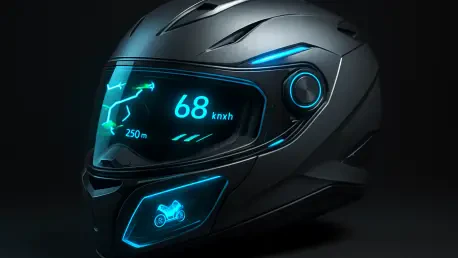
The standout feature of this helmet lies in its visor HUD, powered by EyeLights’ third-generation technology, which projects essential data like speed, GPS directions, incoming calls, and radar alerts directly into the rider’s field of vision at a perceived distance of three meters. This innovation addresses a critical pain point for motorcyclists—distraction. By eliminating the need to look down at a dashboard or external device, the system reportedly cuts reaction times by over 32%, a statistic that could mean the difference between a close call and a collision. The nano-OLED display ensures clarity in Full HD resolution, even under harsh sunlight, overcoming a frequent limitation of earlier HUD attempts. This level of integration marks a significant departure from traditional setups, offering a futuristic yet practical solution that keeps the rider’s attention where it belongs—on the road ahead.
Enhanced Communication for Connectivity
Beyond its AR capabilities, the helmet incorporates a universal intercom system that boasts unlimited range and cross-brand compatibility, ensuring riders can stay connected no matter the gear their companions use. Operating in both online and offline mesh modes, this system includes a microphone with active noise cancellation, as well as support for voice assistants like Siri and Google. The audio kit, complete with battery, projector, speakers, and wiring, is fully embedded into the helmet shell, delivering over 10 hours of battery life for extended journeys. This thoughtful design eliminates the clutter of external attachments, reflecting a growing trend toward streamlined, all-in-one solutions in motorcycle gear. Such features not only enhance communication but also underscore a commitment to convenience, allowing riders to focus on the ride while staying in touch with their surroundings and fellow travelers.
Uncompromising Design and Market Positioning
Safety Standards and Build Quality
When it comes to safety, Shoei’s reputation remains unassailable, and this helmet upholds that legacy by meeting both DOT and ECE 22.06 standards, ensuring top-tier protection for riders across various regions. Constructed with Shoei’s Advanced Integrated Matrix (AIM) multi-layer composite, the shell offers robust durability without unnecessary bulk. While the standard version weighs around 3.9 pounds, the smart edition is slightly heavier due to the integrated tech, though exact specifications are still under wraps. Comfort features, such as the QSV-2 drop-down sun visor, Pinlock-ready CNS-1C outer shield, and a Defogger system with adjustable vents, further enhance usability in diverse conditions. This meticulous attention to construction details ensures that technological advancements do not come at the expense of the fundamental purpose of a helmet—keeping the rider safe in every scenario.
Pricing and Competitive Edge
At a price point of $1,199, this smart helmet positions itself in the premium segment, nearly doubling the cost of its non-smart counterpart and aligning with high-end competitors that also hover around the same figure. However, what sets it apart is the unique integration of HUD technology, a feature not yet replicated by other brands focusing primarily on advanced intercom systems. Available in five striking color options and sizes from S to XXL, it caters to a wide range of preferences while maintaining an exclusive appeal. The steep cost sparks debate about accessibility and value, especially when compared to more affordable alternatives in the market that prioritize different functionalities. Yet, being the first of its kind to embed AR directly into the helmet offers a compelling argument for the investment, particularly for riders who prioritize cutting-edge innovation over budget constraints.
Reflecting on a Milestone in Helmet Innovation
A Leap Forward in Riding Gear
Looking back, the launch of Shoei’s GT-Air 3 Smart stood as a defining moment in the evolution of motorcycle helmets, blending augmented reality with uncompromising safety standards. The seamless projection of critical data into the rider’s view, paired with a robust communication system, marked a shift toward gear that not only protected but also empowered riders with real-time information. This integration addressed long-standing challenges of distraction and connectivity, setting a precedent for how technology could enhance rather than complicate the riding experience. It was a bold statement in an industry hungry for innovation, proving that helmets could transcend their traditional role and become sophisticated tools for modern motorcyclists.
Future Implications for Riders and Industry
Reflecting on this achievement, it became clear that the path forward involved broader accessibility and refinement of such technologies to cater to diverse rider needs. Industry stakeholders were prompted to explore ways to balance cost with cutting-edge features, ensuring that advancements like HUD systems could reach a wider audience over time. For riders, the invitation was to consider how much value they placed on enhanced safety and connectivity, weighing the investment against tangible benefits. As helmet technology continued to evolve, the expectation was for more brands to follow suit, potentially driving competition that would refine and democratize these innovations. This milestone sparked a conversation about the future of riding gear, encouraging a focus on smarter, safer solutions for every journey.