
Nia Christair is a leading voice in the mobile technology sector, bringing years of hands-on experience in app development, hardware design, and enterprise solutions to the table. As Apple signals a major strategic shift toward the Indian subcontinent, Nia’s expertise offers a unique lens into how hardware and financial services converge in emerging markets. In this discussion, we explore the intricate dynamics of the Indian fintech landscape, the technical hurdles of regulatory compliance, and the broader geopolitical implications of Apple’s expansion beyond its traditional strongholds.
India’s digital payment market is approaching a $10 trillion valuation this year. How does this volume compare to other major global regions, and what specific metrics suggest that a hardware-centric brand can successfully capture a slice of this massive fintech market?
The scale we are seeing in India is truly staggering, especially when you consider that digital transactions there are expected to hit $10 trillion this year alone. To put that in perspective, Apple’s global payment system currently handles about 9.5 trillion transactions for 800 million users, meaning the Indian market effectively matches the entire current global volume of one of the world’s largest tech giants. We are also seeing the broader fintech market in the region projected to reach $421 billion by 2028, creating a massive vacuum for premium services. For a hardware brand, the most telling metric is the “high-end” dominance; even though iPhones make up 10% of the total market, they rule the premium segment where users have the highest propensity for digital spending. This loyalty creates a perfect springboard to transition a hardware user into a lifetime financial services customer.
The Unified Payments Interface (UPI) currently dominates the Indian financial landscape. What are the technical steps required to integrate a proprietary wallet with the UPI system, and how do partnerships with major local banks like ICICI or HDFC help navigate these local protocols?
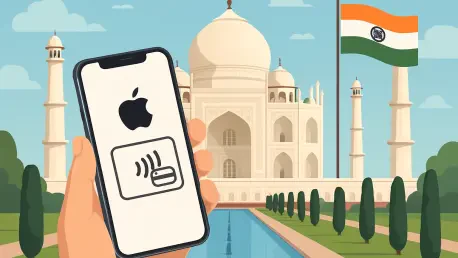
Integrating with UPI is a complex dance that requires a bridge between global encryption standards and India’s local financial architecture. The process begins with establishing secure API hooks into the National Payments Corporation of India (NPCI) framework, which manages the UPI rails. Because Apple Pay currently doesn’t support Indian debit or credit cards natively in the Wallet, partnering with institutions like ICICI, HDFC, or Axis Bank is the critical second step to provide the necessary backing for these digital tokens. These banks act as the regulated intermediaries that settle the transactions, ensuring that every “tap” on an iPhone communicates correctly with the local banking ledger. Finally, the integration must incorporate India’s specific biometric ID standards for authentication, which is a departure from the standard FaceID-only protocols used in other Western markets.
iPhones now represent a growing 10% of the smartphone market in India, particularly in the high-end segment. How will the introduction of local mobile payment services drive further hardware adoption, and what specific advantages will small business owners see when using their mobile devices to accept payments?
The introduction of Apple Pay creates a powerful “flywheel” effect where the utility of the software makes the hardware an essential business tool rather than just a status symbol. For a small business owner in Mumbai or Delhi, the ability to accept card and mobile payments using nothing more than a second-hand iPhone eliminates the need for expensive, dedicated Point-of-Sale hardware. I can imagine a local artisan or a boutique shop owner who previously relied on cash now being able to tap into the $28 trillion global digital wallet economy with a device they already carry. This ease of use lowers the barrier to entry for digital commerce, which in turn drives more people to purchase iPhones specifically to professionalize their business operations.
Local regulations demand that payment providers store data within national borders and utilize specific biometric ID standards for transactions. What are the logistical hurdles of setting up local data centers, and how do these compliance measures affect the timeline for launching a new financial service?
Data localization is perhaps the steepest mountain to climb because it requires a physical footprint that mirrors the digital one. Setting up local data centers involves not just massive capital expenditure, but also navigating the local power grid, cooling requirements, and physical security protocols that meet the Reserve Bank of India’s strict mandates. These compliance measures act as a natural brake on speed; you cannot simply flip a switch and host Indian financial data on a server in California or Ireland. Because Apple must ensure that every transaction involving an Indian citizen stays within national borders, the timeline for a launch often stretches by several months as local infrastructure is built or partnered out. We saw a shift in momentum late last year when India allowed biometric ID for payments, which finally provided the regulatory green light needed to move toward a mid-year launch.
Global mobile payment systems already handle trillions of transactions for over 800 million users. Beyond immediate transaction revenue, how does expanding financial services into India help a company diversify its manufacturing and business risks away from its traditional reliance on China?
Expanding into India is a masterstroke of geopolitical de-risking that goes far beyond the $2.7 billion in revenue generated by payment services in 2024. By deeply embedding its financial ecosystem into the Indian economy, Apple creates a symbiotic relationship with a nation where it is also rapidly scaling up its manufacturing lines. As the company opens more flagship retail stores and shifts production away from China, having a robust local services revenue stream protects the bottom line against supply chain shocks or trade disputes. It transforms India from just a “factory floor” into a comprehensive “home market” where products are both built and consumed within the same economic cycle. This diversification ensures that if one region faces stability issues, the Indian engine—powered by both hardware sales and high-margin digital transactions—can maintain the company’s global momentum.
What is your forecast for the digital payments market in India?
I expect the Indian digital payments market to experience an explosive upward trajectory, with its valuation climbing from $6.83 billion in 2025 to well over $33 billion by 2034. This fivefold increase will be driven by the total democratization of high-end financial tools, where even the smallest street vendors move away from physical currency in favor of encrypted, biometric-verified transactions. We will see a shift where the “wallet” becomes an invisible layer of the smartphone, and the friction between buying a device and using it for enterprise-level commerce completely disappears. Ultimately, India will move from being a follower in the fintech space to becoming the global blueprint for how a mobile-first nation handles its economy.