
In a digital landscape where flagship smartphones serve as all-encompassing portals to every facet of life, a distinct sense of communication fatigue has quietly taken root. The very devices designed to connect us often become sources of immense distraction, their vast glass screens pulling users into a vortex of notifications, applications, and media. Emerging from this environment is the Clicks Communicator, a device that champions a philosophy of focused utility. It is not intended to replace the modern smartphone but to augment it, serving as a purpose-built messaging machine for a specific demographic that values efficiency and tactile feedback above all else. Conceived by Clicks Technology, a venture helmed by respected mobile industry commentators Michael Fisher and Kevin Michaluk, the Communicator is a calculated gamble on the enduring appeal of the physical keyboard. It targets the “creator class,” professionals constantly on the move, and anyone who juggles multiple devices to maintain a separation between their work and personal lives, offering a streamlined solution to what GSMA research confirms is one of the most popular daily mobile activities: messaging.
A Modern Take on a Classic Ethos
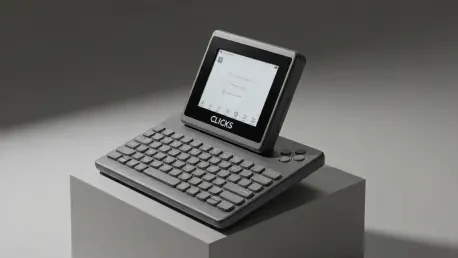
The hardware of the Clicks Communicator is a masterclass in blending nostalgic design with modern innovation, centered entirely around its physical keyboard. This is not a mere cosmetic addition but a core functional element, engineered by a veteran of past BlackBerry projects to provide a typing experience that is both satisfying and precise. The sculpted keys offer significant travel and distinct tactile feedback, allowing for the kind of rapid, eyes-free typing that has become a lost art. A crucial advancement is the integration of a capacitive, touch-sensitive surface across the key array. This allows users to perform gestures like scrolling through long message threads or maneuvering a text cursor with a simple swipe, eliminating the jarring workflow interruption of constantly moving a thumb between the keyboard and the screen. The entire system is designed to foster the development of muscle memory, a principle of human-computer interaction known to drastically reduce error rates when compared to typing on a flat glass surface. This thoughtful execution ensures the Communicator feels like a genuine evolution of a classic concept rather than a superficial tribute.
Beyond the keyboard, the device’s entire form factor is a deliberate rejection of contemporary smartphone trends. It features a 4-inch, near-square display, an unconventional aspect ratio perfectly suited for its primary function. This screen geometry provides more vertical real estate for viewing lists and conversation threads, optimizing the layout for text-based applications rather than widescreen video consumption. The overall chassis is described as “thoughtfully small,” providing a comfortable two-thumbed grip where the distance from thumb to key is minimized for ergonomic efficiency. This intentional design stands in stark contrast to the ever-expanding dimensions of flagship phones, which often prioritize media over comfortable, prolonged communication. The Communicator also champions user agency through a suite of features that have become rarities, including a 3.5mm headphone jack for high-quality wired audio, a physical SIM card slot for carrier flexibility, and a microSD card slot that supports up to 2TB of expandable storage, giving users full control over their local data. The most significant of these features is a user-removable battery, a tiny rebellion against the sealed-off, monolithic norm that promotes longevity and repairability.
Software and Market Philosophy
The focused design philosophy of the hardware extends seamlessly into the software experience. While the Clicks Communicator runs on Android 16, its user interface has been significantly customized to eliminate distractions and streamline communication workflows. It eschews the typical icon-laden, widget-heavy home screen in favor of a clean, “text-forward” launcher. This bespoke interface prioritizes the user’s chats and inbox, creating an environment built for efficiently managing notifications, jumping between conversations, and firing off quick replies without navigating a sea of unrelated applications. The entire user experience is engineered around the principle of reducing context switching, a cognitive burden that fragments attention and hinders productivity. By keeping the user in a state of flow while messaging, the software works in concert with the physical keyboard to create a cohesive and highly efficient communication tool, free from the visual clutter that defines the modern mobile operating system.
The Communicator’s arrival is strategically timed to capitalize on a growing cultural sentiment of “notification fatigue” and a renewed appreciation for single-purpose hardware that excels at its designated task. The historical precedent for such a device is strong; at its zenith, BlackBerry commanded roughly 40% of the U.S. smartphone subscriber market, proving the widespread viability of a keyboard-first design for both professional and high-volume personal communication. The philosophy behind the Communicator also directly counters the prevailing trend of disposability in consumer electronics. Features like its swappable battery, expandable microSD storage, and standard physical SIM slot are presented as tangible acts of resistance to cloud lock-in and planned obsolescence. This approach appeals to a discerning user base that values longevity, control over their personal data, and the freedom to use their hardware on their own terms, making the device not just a tool, but a statement.
The Road Ahead
The initial impressions of the Clicks Communicator’s near-final hardware mockups were overwhelmingly positive, with particular praise for the thoughtful industrial design, the comfortable in-hand feel, and the superb execution of its centerpiece keyboard. Based on this promising foundation, the device had the clear potential to become the most compelling physical keyboard phone since the very era it so effectively invoked. Slated for release in the second half of 2026, the device was positioned with a retail price of $499 and an attractive promotional preorder price of $399. However, the ultimate success of the Communicator hinged on Clicks Technology’s ability to deliver a final product where the software was as stable and polished as the hardware. Key performance aspects, including real-world battery life and radio performance, remained critical open questions that could only be answered with production units. If the company managed to align these final pieces, the Communicator was poised to make a powerful case for itself, not as a replacement for a primary smartphone, but as an essential second device that mastered the single, critical task of communication.