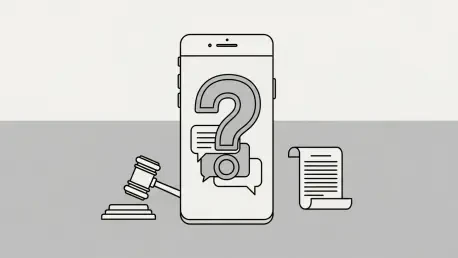

The rapid expansion of text message marketing has created a direct and powerful channel for businesses to engage with consumers, but it has simultaneously thrust them into a complex legal minefield governed by telecommunications laws drafted long before the first SMS was ever sent. This growing tension between modern marketing practices and aging regulations is now at the forefront of a significant legal battle in Florida. A federal court has pressed pause on a class-action lawsuit filed under the Telephone Consumer Protection Act (TCPA), a statute primarily designed to curb unwanted telephone calls. The case, McGonigle v. Pure Green Franchise Corp., was halted not to debate the facts of the marketing campaign but to first address a more fundamental and potentially case-dispositive question: do text messages legally constitute “calls” under the TCPA’s stringent do-not-call (DNC) provisions? This pivotal decision to stay the proceedings highlights an increasingly fractured legal landscape, forcing companies and courts alike to re-examine the scope of a law enacted in 1991 in the context of twenty-first-century communication technology.
A Pivotal Legal Question Pauses Discovery
The court’s decision to stay discovery in the McGonigle case stems from a strategic legal maneuver by the defendant, Pure Green Franchise Corp. The plaintiff initiated the class-action lawsuit by alleging that the company had sent a series of unsolicited marketing text messages, which the plaintiff argued was a clear violation of the TCPA’s rules prohibiting calls to numbers on the National Do-Not-Call Registry. In response, instead of immediately diving into the expensive and time-consuming process of class discovery, the defendant filed a motion to halt the proceedings. The core of their argument was that the entire case rested on a threshold question of law. If text messages are not considered “calls” under the relevant section of the TCPA, then the plaintiff’s primary claim would collapse, rendering the need for factual discovery moot. The court sided with this logic, agreeing that resolving this legal ambiguity was the most efficient path forward. Further complicating the issue, the presiding judge expressed notable skepticism about the Federal Communications Commission’s (FCC) broad interpretation that equates texts with calls, questioning if the agency had overstepped its delegated authority.
Implications for SMS Marketing and Legal Strategy
This ruling in Florida sent a clear signal to businesses that rely on SMS marketing, underscoring the unsettled and high-risk legal environment they navigate. The decision created a valuable precedent for defendants in similar TCPA lawsuits, demonstrating that an early, targeted motion focused on a core legal question could successfully pause or even derail a potentially costly class-action suit before it gained momentum. The growing split among federal district courts on this very issue meant that the legality of a text message campaign could depend entirely on the jurisdiction in which a lawsuit was filed. In response to this fragmented legal landscape, companies were advised to closely monitor these jurisdiction-specific rulings. This development prompted a widespread reassessment of corporate risk strategies related to the TCPA. Legal experts urged businesses to re-evaluate their consent acquisition practices for text message marketing and to bolster their compliance protocols to account for the profound legal uncertainty surrounding one of their most popular communication channels.