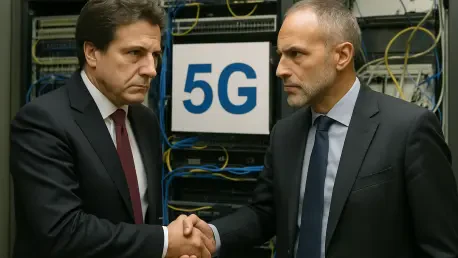

In Italy’s hyper-competitive mobile telecommunications landscape, a seismic strategic shift is compelling sworn rivals to set aside their differences and join forces in an unprecedented manner. This move toward cooperation is not born from a newfound camaraderie but from the harsh economic reality of a market battered by a decade of relentless price wars and declining revenues. To manage the staggering financial burden of deploying next-generation 5G networks, operators are concluding that building separate, redundant infrastructure is a luxury they can no longer afford. Consequently, they are turning to network sharing as an essential survival mechanism, a pragmatic solution that promises to reshape the industry’s competitive dynamics by separating the foundational infrastructure layer from the customer-facing service layer. This collaborative pivot is a clear signal that in the battle for 5G supremacy, the old rules of engagement have become obsolete, forcing a fundamental re-evaluation of what it means to compete in the modern telecom era.
The Crushing Economics of Competition
The primary catalyst for this strategic realignment is the severe and prolonged financial strain that has plagued Italy’s mobile operators for more than a decade. According to industry group Asstel, the sector’s revenues have contracted by nearly one-third since 2010, a stark indicator of a market in distress. This revenue decline has been compounded by a dramatic erosion of profitability, with post-investment cash flow collapsing from a healthy €10.5 billion to virtually zero over the same period. At the heart of this financial crisis lies a relentless price war that has driven the cost of consumer plans to unsustainably low levels, with providers frequently offering large data packages for under €10 per month. Such aggressive pricing leaves operators with razor-thin margins, making it exceedingly difficult to recoup the enormous capital expenditures associated with next-generation technology, a challenge underscored by the fiercely competitive 2018 spectrum auction where companies collectively spent a staggering €6.5 billion for 5G licenses.
This environment of shrinking returns and escalating costs has made the traditional model of independent network buildouts economically untenable. The immense investment required for advanced technologies like standalone 5G, which promises ultra-low latency and a host of new industrial applications, is simply too great for individual operators to bear in a market where returns are so heavily suppressed. The consensus viewpoint emerging among industry leaders is that duplicating expensive network infrastructure, particularly in less densely populated and less profitable areas, is no longer a viable competitive strategy. This shift in thinking is part of a broader European phenomenon, with a recent JPMorgan outlook report describing Italy as one of the continent’s cheapest and therefore most challenging mobile markets. As a result, cooperation on the physical network layer is transitioning from a novel concept to a standard operating model, allowing companies to channel their limited resources toward service innovation and customer experience rather than redundant physical assets.
A New Paradigm for Infrastructure
A prime example of this evolving strategy is a specific, impending agreement between Telecom Italia and Fastweb, the Italian subsidiary of Swisscom. This landmark deal, internally known as “Prism,” is aimed at sharing active network elements, which include critical and costly components like antennas, base stations, radio units, and backhaul infrastructure. The strategic objective is twofold: to significantly reduce the costs associated with upgrading to standalone 5G and to alleviate the broader financial strain on both companies. The plan is specifically targeted at towns with populations under 35,000, areas where the return on investment for new infrastructure is often weakest, making a shared approach particularly logical. The projected financial benefits are substantial, with estimates suggesting that each operator could save between €250 million and €300 million over a ten-year period by spreading the costs of building and maintaining a single, unified grid in these regions.
The mechanics of the proposed shared network are designed to ensure operational clarity and efficiency, preventing the kind of complications that can derail complex joint ventures. Under the plan, each operator would assume responsibility for upgrading the technology within specific, designated geographical areas. This clear division of labor is intended to prevent overlapping investments and streamline the day-to-day management of the shared network. The ambitious goal is to have this cooperative grid encompass around 15,500 sites by the end of 2028. This deal also signifies a revival of network-sharing concepts in Italy, referencing a previous plan between Telecom Italia and Vodafone that followed their 2019 tower asset merger into INWIT but was never fully implemented. The current involvement of Fastweb, a company strengthened by its recent €8 billion acquisition of Vodafone’s Italian business, underscores the shifting market dynamics and the increased urgency for such cooperative ventures to succeed.
Forging a New Digital Future
The long-term impacts of this trend toward network sharing were nuanced but significant for the market, its regulators, and ultimately, its customers. For regulatory bodies, this shift presented a complex challenge: balancing the crucial need to maintain a competitive market with the equally important goal of fostering sustainable investment in critical national infrastructure. The lobbying efforts by industry group Asstel for the renewal and extension of spectrum licenses were a part of this broader conversation, as longer license terms were argued to be necessary to provide the stability required for major capital investments. For customers, particularly in the enterprise sector, the immediate effects were subtle, as service provision and customer relationships remained with the individual operators. However, over time, the strategy profoundly influenced the quality of network coverage, the speed of the standalone 5G rollout, and the economic viability of advanced 5G use cases that depend on features like ultra-low latency. Crucially, in rural and smaller urban regions, shared infrastructure represented the only feasible pathway to extend the benefits of standalone 5G beyond the country’s major cities, thereby helping to bridge the digital divide. The move toward network sharing in Italy was a pragmatic and necessary evolution, reshaping competition by separating the collaborative infrastructure layer from the competitive service layer in response to immutable economic realities.