
The bustling halls of the Fira de Barcelona at this year’s Mobile World Congress have effectively redefined the boundary between telecommunications and the automotive industry, signaling a permanent shift in how mobility is perceived globally. For decades, this event served as the altar of the smartphone, yet in 2026, the roar of the silicon-powered engine has completely eclipsed the glow of handheld screens. The vehicle is no longer a peripheral accessory to the digital life but has instead ascended to the status of the ultimate mobile intelligent terminal. This evolution is driven by a deep integration of advanced semiconductors, sophisticated artificial intelligence, and a communication infrastructure that spans both terrestrial and orbital networks. As manufacturers move beyond the initial hurdles of battery density and electric drivetrains, the focus has shifted toward the “second half” of modernization. This phase is characterized by the Software-Defined Vehicle, where the value of a car is determined by its ability to process data, connect to a global network, and provide an intelligent environment that anticipates human needs. The synergy between chipmakers and automakers is now the primary engine of innovation, turning the automotive sector into the largest growth driver for the tech world.
Bridging the Gap: The Emergence of Always-On Satellite Connectivity
The pursuit of “always-on” connectivity has reached a fever pitch, with industry leaders demonstrating that traditional cellular networks are no longer the ceiling for vehicular communication. MediaTek showcased a monumental leap in this domain by introducing the world’s first 5G Non-Terrestrial Network (NTN) satellite video call solution specifically optimized for the automotive sector. This technology is powered by the latest Dimensity automotive platform, which utilizes a highly efficient 3nm process to handle the massive computational overhead required for orbital data transfers. By integrating satellite capabilities directly into the vehicle’s communication stack, the industry is effectively eliminating the “dead zones” that have historically plagued remote travel in mountainous or desert regions. This development marks a transition from satellite features being exclusive luxury gimmicks to becoming foundational components of the modern safety architecture. The ability to maintain a high-bandwidth video connection via satellite ensures that passengers remain connected to the digital world regardless of terrestrial infrastructure, while simultaneously providing a robust backbone for autonomous systems that require constant cloud synchronization for navigation and safety updates.
Beyond mere entertainment and convenience, this shift toward satellite-integrated communication is fundamentally rooted in the enhancement of global safety standards. Rohde & Schwarz addressed this critical need by unveiling advanced testing solutions for Hybrid eCall systems, which are designed to function seamlessly across both 5G and satellite networks. These systems ensure that in the event of a severe accident in a remote area without cellular coverage, the vehicle can automatically trigger an emergency rescue protocol through an orbital link. This level of reliability is becoming a non-negotiable requirement for automakers as they strive to achieve higher levels of safety certification. The demonstrations at the event prove that connectivity is no longer an isolated feature but a life-saving infrastructure. As the “Internet of Everything” continues to expand, the car is evolving into a critical node that bridges the gap between urban centers and the most isolated corners of the globe. The democratization of these technologies suggests that within the next few development cycles, the hardware necessary for satellite communication will become standard across a wider range of vehicle segments, moving well beyond the ultra-high-end luxury market.
Intelligent Infrastructure: Networking the Autonomous Future
The intelligence track at the summit has moved decisively beyond simple voice assistants and basic infotainment towards a sophisticated ecosystem of autonomous “neural systems.” Huawei’s “Agentic Core” solution served as a centerpiece for this discussion, offering a blueprint for how vehicle networks can manage the staggering volume of data traffic generated by modern sensors and artificial intelligence. By integrating intelligence directly into the network elements themselves, this architecture provides the necessary coordination for vehicle-road collaboration. This allows for a proactive communication environment where the car is not just reacting to its surroundings but is actively exchanging data with the city infrastructure to optimize traffic flow and safety. This infrastructure-centric approach ensures that the massive influx of data from high-definition cameras, LiDAR, and radar does not overwhelm the vehicle’s onboard processing units. Instead, the network itself acts as an extension of the car’s brain, facilitating real-time decision-making that is essential for the safe operation of autonomous fleets in complex urban environments.
Practical applications of these advancements were evident in the demonstration of Level 4 autonomous driving capabilities, which have moved into a phase emphasizing human-centric safety and empathy. KDDI showcased systems that utilize intelligent interior cameras and biometric sensors to monitor the physical well-being of the driver. In a scenario where a sudden medical emergency is detected, the vehicle is capable of taking full control, navigating to the side of the road, and contacting emergency services autonomously. This highlights a growing trend where the car’s intelligence is used not just for navigation, but as a proactive health and safety guardian. Furthermore, collaborations between software providers like Wind River and major manufacturers like Ford have demonstrated that 5G perception modules are now being integrated into the very design language of performance vehicles. These modules are no longer unsightly additions but are woven into the branding and aesthetics of the car, signifying that high-performance intelligence is now as much a part of a vehicle’s identity as its horsepower or torque.
Redefining the Interior: The Digital Cockpit as a Living Space
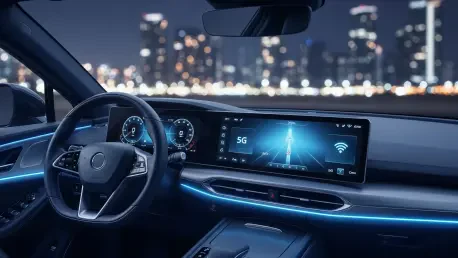
The transformation of the vehicle interior has reached a point where the cabin experience is indistinguishable from high-end consumer electronics or professional workstations. TCL CSOT introduced a groundbreaking “Super Pixel” technology and printed OLED displays specifically designed for the rigorous demands of the automotive environment. Unlike standard consumer screens, these printed OLEDs are manufactured through a more cost-effective inkjet process that allows for larger, more vibrant displays without the prohibitive costs of traditional methods. These screens are engineered to withstand the extreme temperature fluctuations and constant vibrations inherent in road travel, ensuring that color accuracy and picture purity remain consistent over the vehicle’s lifespan. The result is a cockpit dominated by expansive, immersive displays that serve as the primary interface for both the driver and passengers. This move toward high-fidelity visual hardware reflects the changing role of the car, where the time spent during a commute is increasingly used for media consumption, gaming, or high-definition video conferencing.
To complement these visual strides, the auditory environment of the vehicle is being completely reimagined to create a fully immersive sensory experience. Harman Automotive showcased its “Harman Embedded Audio” solution, which utilizes sophisticated software to adapt the soundstage to the unique acoustics of a vehicle’s cabin. By integrating hardware and software at a deep level, the system can transform the interior into a high-fidelity concert hall or a perfectly silent, serene workspace depending on the user’s preference. This flexibility is essential as the vehicle becomes a primary site for both leisure and labor. The intelligent cockpit now functions as a versatile “third space,” filling the gap between the home and the office. This integration of sensory technology ensures that the transition to autonomous driving is accompanied by a significant upgrade in passenger comfort and utility. As vehicles take over more of the driving responsibility, the focus of innovation has shifted toward maximizing the value of the time spent inside the cabin, turning every journey into an opportunity for productivity or relaxation.
Beyond Transportation: The Automotive Digital Ecosystem
The final day of the summit solidified the concept of hardware-software synergy as the foundational requirement for future automotive development. LG demonstrated a new-generation in-vehicle information service that successfully integrates 5G, GPS, and satellite antennas into a single, compact Telematics Control Unit. This level of hardware consolidation is a significant departure from the fragmented systems of the past, as it reduces latency, simplifies the vehicle’s electrical architecture, and lowers the overall weight. By creating a unified digital backbone, manufacturers can more easily deploy over-the-air updates and roll out complex autonomous features without the need for hardware retrofits. This streamlined approach allows the vehicle to function as a seamless node within a broader digital ecosystem, where the car, the home, and the workplace are all part of a single, interconnected network. This integration is the key to unlocking the true potential of the Software-Defined Vehicle, where the ownership experience is constantly enhanced through digital improvements rather than mechanical upgrades.
The broader implications of this connectivity were further explored through projects like “CircuitX,” which illustrated how automotive technology is now influencing sectors such as professional motorsports and remote security. Using 5G and 6G experimental networks, Ericsson demonstrated how real-time telemetry and augmented reality could allow for remote driving and drone-assisted security protocols that were once the domain of science fiction. The consensus among the world’s leading technology firms was that the vehicle’s value is no longer tied to its mechanical engine, but to its processing power and its status as a permanent node in a global network. Stakeholders moved toward a strategy that prioritizes the development of edge-side AI and robust cloud integration to ensure that cars can operate safely and efficiently in an increasingly crowded digital landscape. As the event concluded, the path forward for the industry became clear: success in the automotive market now requires a mastery of chips, code, and connectivity. The historical divide between “tech companies” and “car companies” was effectively erased, replaced by a unified vision of a mobile, intelligent, and perpetually connected world.