
Nia Christair is a leading voice in the mobile technology sector, bringing years of expertise in mobile gaming, app development, and hardware design. Her deep understanding of enterprise solutions and hardware architecture makes her the perfect guide for navigating the latest advancements in tablet computing. Today, we discuss the significant leap forward represented by the newly unveiled hardware and what it means for the broader consumer market.
The base model remains at $599 while upgrading to an M4 chip that is reportedly 2.3x faster than the M1 version. How does this jump in processing power redefine the value proposition for mid-range tablets, and what specific creative or professional workflows will benefit most from this increased speed?
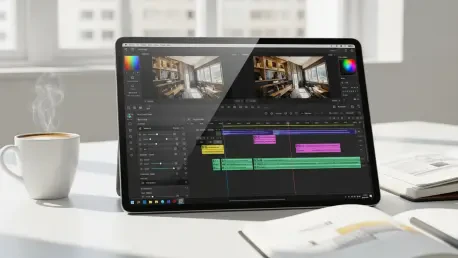
The jump to the M4 chip essentially erases the line between mid-range and high-end performance, offering a 30% speed increase over even the previous M3 generation. When you look at professional workflows like 4K video editing or high-resolution photo manipulation, the 8-core CPU and 9-core GPU provide a level of fluidity that was previously reserved for much more expensive machines. It’s a massive win for mobile creators who need to render complex scenes or layers without hitting a performance ceiling. Maintaining that $599 entry price while delivering 2.3x the speed of the M1 model makes this one of the most aggressive value plays we’ve seen in years.
The latest hardware features 12GB of unified memory and a 16-core Neural Engine designed for on-device AI. What are the practical advantages of these memory upgrades for everyday users, and how do they differentiate this device from previous generations in terms of complex multitasking and background processing?
Increasing the unified memory by 50% to 12GB is a game-changer for anyone who keeps dozens of browser tabs open while swapping between heavy apps. With a memory bandwidth reaching 120GB/s, the device can shuffle data between components with incredible efficiency, meaning fewer app refreshes and smoother background processing. The 16-core Neural Engine is specifically tuned for the AI era, performing three times faster than the M1 version to handle on-device machine learning tasks locally. This translates to near-instant results for tasks like background removal in images or real-time language translation, all while keeping your data more secure on the device.
With the integration of Wi-Fi 7 and Bluetooth 6 alongside support for the Apple Pencil Pro, these devices are leaning into more professional territory. What technical challenges do these connectivity standards solve for mobile workers, and how should a buyer choose between the 11-inch and 13-inch configurations?
The integration of Wi-Fi 7 and Bluetooth 6, powered by the new N1 and C1X connectivity chips, solves the dreaded bottleneck of slow data transfers for workers in crowded environments. These standards ensure more stable connections and faster throughput, which is vital when you are uploading massive files to the cloud from a busy cafe or office. Choosing between the 11-inch and 13-inch models really comes down to your physical workspace needs; the 11-inch remains the king of portability at roughly 9.7 by 7 inches, whereas the 13-inch model provides that extra canvas for split-screen multitasking. If you find yourself frequently using the Magic Keyboard or the Apple Pencil Pro for detailed illustrations, the 13-inch screen’s 11.04-inch height offers a much more natural, paper-like experience.
New product launches are currently coinciding with major industry events like Mobile World Congress, where global competitors are also unveiling hardware. How does releasing significant upgrades through standalone regional events impact brand momentum, and what does this timing suggest about the current competitive landscape for high-end tablets?
By timing these releases alongside the Mobile World Congress, the brand is effectively stealing the spotlight from rivals like Samsung and Xiaomi without even setting foot in Barcelona. This strategy allows them to control the narrative through intimate hands-on events in select cities, creating a sense of exclusivity that a crowded trade show floor can’t replicate. It suggests a high level of confidence in their product cycle, signaling to the market that their ecosystem is strong enough to compete with global innovations through sheer brand momentum. This simultaneous launch of the iPad Air, the iPhone 17e, and MacBook upgrades creates a wall of news that forces competitors to fight for any remaining media oxygen.
Educational pricing now brings the entry point down to $549 for the 11-inch model. Considering the storage options range from 128GB to 1TB, what is the most cost-effective way for students to configure this device, and which accessories are truly essential for a paperless classroom experience?
For a student looking for the best bang for their buck, the $549 educational price for the 11-inch model is the absolute sweet spot, especially if they stick with the 128GB or 256GB storage tiers and utilize cloud storage for older projects. To truly go paperless, the Apple Pencil Pro is the one non-negotiable accessory because it transforms the tablet from a media viewer into a powerful note-taking and annotating machine. While the 1TB option is tempting for those doing heavy video work, most students will find that the mid-range storage options provide plenty of room for apps and textbooks. Adding a protective case or the Magic Keyboard rounds out the kit, making it a viable laptop replacement for most classroom scenarios.
What is your forecast for the iPad Air?
I expect the iPad Air to become the dominant choice for the “prosumer” market, potentially cannibalizing sales of the higher-end Pro models because the performance gap has narrowed so significantly with the M4 chip. As on-device AI features become more standard in software updates, the 12GB of memory and the enhanced Neural Engine will keep this hardware relevant and snappy for at least the next four to five years. We are looking at a future where this specific model serves as the primary computing device for a generation of students and mobile professionals who prioritize a balance of extreme power and portability. The inclusion of professional-grade connectivity like Wi-Fi 7 ensures it won’t just be a fast tablet today, but a future-proofed tool for the evolving wireless landscape.