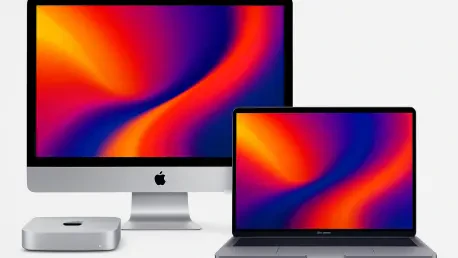

The relentless escalation of state-sponsored cyberattacks has transformed the digital landscape into a battlefield where conventional defenses are no longer sufficient, prompting a fundamental reimagining of computer security from the silicon up. In this high-stakes environment, Apple’s latest M5-powered Macs have entered the conversation not just for their processing power, but for a security architecture that promises a new era of digital defense. This examination delves into whether these machines truly represent the pinnacle of personal computer security or if they are simply the next fortified position in an unending technological arms race.
Beyond Performance Redefining Security in the Age of a New Chip
Apple has long cultivated a reputation for building secure, user-friendly devices, a perception that has been a cornerstone of its brand identity. However, the modern threat landscape has evolved dramatically. The rise of sophisticated, well-funded mercenary spyware and state-level actors has demonstrated that software-level protections alone are no longer adequate. These advanced threats target the very foundation of a computer’s operating system, necessitating a more deeply integrated form of defense.
Consequently, the debut of the M5 chip marks a pivotal moment, shifting the focus from incremental speed improvements to a fundamental redesign of hardware-based security. This strategy suggests that true digital safety cannot be an afterthought patched onto an operating system; it must be forged directly into the silicon. By embedding security features at the hardware level, the M5 chip aims to create a trusted foundation upon which the entire software ecosystem can be built securely.
This exploration will navigate through Apple’s comprehensive, multi-layered security framework. The journey begins deep within the chip’s architecture with groundbreaking memory protection, extends to future-proofing communications against the looming threat of quantum computing, and culminates in an analysis of how this integrated approach redefines what it means for a personal computer to be secure.
Decoding Apple’s New Digital Fortress
Forging an Impenetrable Core The Revolution of Memory Integrity Enforcement
At the heart of the M5’s defensive capabilities is Memory Integrity Enforcement (MIE), a feature engineered directly into the silicon to provide a powerful shield for the system’s core. MIE is designed to prevent a class of attacks known as memory corruption, where malicious code exploits vulnerabilities to take control of a device. By enforcing strict rules about how memory can be accessed by the kernel, the central component of the operating system, MIE effectively closes a major pathway used by the most advanced malware.
Apple has positioned this technology as the “most significant upgrade to memory safety” in the history of consumer operating systems, a bold claim backed by its targeted effectiveness against the tools of mercenary spyware. These sophisticated exploits, often deployed against high-profile targets, rely on manipulating memory to gain control. MIE represents a direct hardware-level countermeasure developed over five years to neutralize this specific and dangerous threat vector.
This development has ignited a debate within the security community. One perspective holds that MIE is a true game-changer, making the cost and complexity of developing a successful kernel exploit prohibitively high for all but the most powerful adversaries. In contrast, other experts argue that while MIE raises the bar considerably, it is not an insurmountable obstacle. They contend that elite attackers will eventually devise new methods to bypass this hardware defense, continuing the cat-and-mouse game between platform security and cyber espionage.
Preparing for Tomorrow’s Threats Apple’s Quantum Cryptography Gambit
Looking beyond present-day dangers, Apple is taking proactive steps to counter a future threat that could render all current encryption obsolete: quantum computing. The company’s implementation of Post-Quantum Cryptography (PQ3) is a forward-looking strategy designed to protect user data from “harvest now, decrypt later” attacks, where encrypted data is stolen today with the intention of decrypting it once quantum computers become powerful enough to do so.
This is not a limited or experimental deployment. Apple is integrating PQ3 across its entire ecosystem, hardening communications in iMessage and building it into the core of its latest operating systems like macOS 26. Furthermore, by providing developers with CryptoKit, Apple is empowering the entire app ecosystem to adopt this next-generation encryption standard, ensuring that third-party applications can offer the same level of future-proof security.
This aggressive adoption of quantum-resistant protocols positions Apple as a long-term guardian of user data. For enterprise and government sectors, where the confidentiality of information can have decades-long implications, this commitment to data integrity is a powerful differentiator. It transforms the security proposition from simply protecting data today to guaranteeing its privacy against the computational breakthroughs of tomorrow.
Beyond the Silicon Securing Every Digital Interaction
Apple’s security philosophy extends far beyond the processor, aiming to protect the full spectrum of the user experience. This is evident in the new Platform Single Sign-On (SSO) architecture, which provides a dedicated and secure framework for user authentication. By working closely with identity service providers, this system streamlines the login process without compromising security, ensuring that the initial point of access to corporate and personal data is robustly defended.
The company’s attention to detail is also demonstrated in its newly detailed security protocols for satellite communications. These features, designed for emergency situations when users are off-grid, ensure that even these remote transmissions are protected with strong encryption and pseudonyms. This guarantees that a user’s location and messages remain private and their data integrity is maintained, even when relying on a non-traditional network.
These enhancements challenge the common, narrow focus on malware protection. Instead of just blocking viruses, Apple’s strategy is to secure every digital interaction. From the moment a user logs in with SSO to sending a critical emergency message via satellite, the goal is to create a seamless and holistically secure environment, protecting data in transit, at rest, and in every conceivable use case.
The Unbreakable Bond Why Integrated Hardware and Software Is Apple’s Ultimate Defense
The core principle underpinning Apple’s entire security model is the conviction that truly secure software must be built upon a foundation of secure hardware. This synergy between the M5 chip and macOS is not accidental; it is a deliberate architectural choice that allows for a level of security that is difficult to achieve in more fragmented ecosystems. By controlling the design of both the silicon and the software that runs on it, Apple can create defenses that are deeply intertwined and mutually reinforcing.
This end-to-end approach stands in stark contrast to the broader PC market, where hardware from numerous manufacturers is paired with an operating system from a separate company. While that model offers flexibility, it can also create security gaps and inconsistencies. Apple’s integrated model, however, allows for features like MIE to function seamlessly, as the hardware and software were designed from the ground up to work together to enforce security policies.
Nevertheless, this symbiotic relationship is not without potential risks. A vulnerability discovered in the hardware foundation could have systemic implications for the entire platform. Critics argue that this tight integration, while powerful, creates a single point of failure. The central question remains whether this model creates a fundamentally more defensible platform or if its monolithic nature introduces a unique, albeit different, set of security challenges.
The Verdict A New Standard of Security with a Human Element
The combination of Memory Integrity Enforcement, proactive post-quantum cryptography, and comprehensive ecosystem hardening collectively establishes a new benchmark for consumer computer security. These advancements demonstrate a clear commitment to defending against the most sophisticated threats currently known, as well as those anticipated in the future. M5-powered Macs are not merely faster; they are architected with a security-first mindset that is deeply embedded in their core design.
The definitive takeaway is that while M5 Macs represent a monumental leap forward in built-in, hardware-level protection, they do not grant invincibility. No technology can completely eliminate the risk of a security breach. These machines dramatically raise the cost and complexity for attackers, effectively removing casual and mid-level threats from the equation, but a determined and well-resourced adversary may still find a way through.
Ultimately, this powerful technology must be complemented by user vigilance. Responsible security practices remain essential. This includes using strong, unique passwords or passkeys, maintaining a keen awareness of phishing attempts and social engineering tactics, and ensuring that all software is kept up to date with the latest security patches. Apple provides the lock, but the user must still be careful with the key.
The Final Analysis A Fortified Future Not an Invincible One
The advanced security architecture of the M5 Mac was clearly developed as a direct response to the weaponization of sophisticated exploits by state-level actors and the growing surveillance-as-a-service industry. These protections moved the baseline for consumer security significantly higher, creating a far more challenging target for those who seek to compromise personal data and privacy.
It was emphasized, however, that technology, no matter how powerful, is only one part of the security equation. The user remained a critical and unpredictable variable. The most robust hardware defenses could be rendered moot by a single click on a malicious link or the divulging of credentials, a timeless truth in the world of cybersecurity.
The M5 Mac may have been the closest the industry had come to a truly secure personal computer out of the box. Its ultimate success, however, was defined not just by the strength of Apple’s silicon, but by the shared responsibility between its technological fortress and the vigilant human who operated within its walls.