
The long-standing digital divide that once dictated how smartphone users exchanged high-resolution media has finally begun to dissolve as Samsung and Apple move toward an era of unprecedented interoperability. For over a decade, the inability to beam a 4K video or a massive folder of documents between an iPhone and a Galaxy device without relying on third-party cloud services or data-compressing messaging apps remained a persistent frustration for millions of users worldwide. This friction point was not merely a technical limitation but a strategic cornerstone of the “walled garden” philosophy that defined the early 2020s. However, the release of iOS 26.3 and the debut of the Galaxy S26 series represent a fundamental shift in this landscape, signaling a truce that prioritizes user convenience over ecosystem lock-in. By leveraging standardized wireless protocols and responding to global regulatory pressures, these tech giants have established a direct bridge that effectively eliminates the need for cumbersome workarounds. The result is a seamless transfer experience that finally treats smartphones as universal tools rather than isolated islands of data.
1. The Technological Convergence of Quick Share and AirDrop
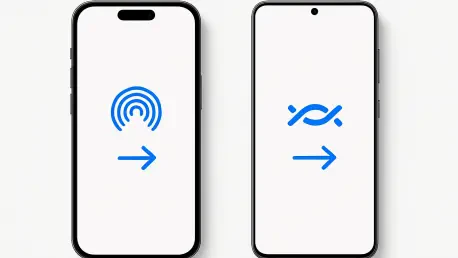
The technical foundation of this breakthrough lies in the implementation of the Wi-Fi Aware standard, a move that allows the Galaxy S26 to “speak” the same language as Apple’s AirDrop protocol. Previously, this capability was limited to a few select devices, but the latest iteration of Samsung’s Quick Share has been engineered to recognize Apple’s proprietary broadcasting signals when specific conditions are met. When a user on a Galaxy S26 opens the sharing menu, nearby iPhones running iOS 26.3 now appear as visible targets, provided the receiving device has been set to allow discovery for ten minutes. This process bypasses the traditional Bluetooth pairing limitations by establishing a peer-to-peer Wi-Fi connection that is both secure and significantly faster than legacy methods. Consequently, the transfer of large files, such as ProRAW photos or uncompressed cinematic videos, no longer requires an internet connection or a shared cloud account, making the process as instantaneous as sharing between two devices of the same brand.
While this interoperability represents a massive leap forward, it operates within a specific set of security parameters designed to protect user privacy on both sides of the OS divide. Apple has not fully opened its contact-discovery encryption to external competitors, which means that a Galaxy S26 user will only see an iPhone if the recipient manually toggles their visibility to everyone. This minor step serves as a gatekeeper against unsolicited file-sharing requests, ensuring that the convenience of the new bridge does not come at the expense of digital safety. Furthermore, the integration of Bluetooth 6.1 on the Galaxy S26 enables more precise proximity sensing, allowing the device to prioritize the most relevant receivers in a crowded environment. This hardware-level optimization ensures that the handshake between Android and iOS occurs with minimal latency, even in high-traffic areas like airports or conferences. By standardizing these interactions at the firmware level, both companies have effectively neutralized one of the primary reasons consumers felt forced to stay within a single hardware ecosystem.
2. Native Migration Tools within iOS 26.3
Parallel to the improvements in direct file sharing, Apple has introduced a surprisingly robust “Transfer to Android” utility natively within the settings of iOS 26.3. This internal tool replaces the often-clunky third-party migration apps that previously served as the only gateway for users looking to switch from an iPhone to a Galaxy S26. By navigating to the general reset menu, users can now initiate a comprehensive data migration that handles everything from message history and call logs to photos and even eSIM configurations via a simple QR code scan. This shift indicates a broader acceptance of market fluidity, where the focus has moved toward providing a premium user experience regardless of the hardware platform. The inclusion of eSIM transfer is particularly noteworthy, as it removes one of the final logistical hurdles that once made switching carriers and devices simultaneously a multi-hour ordeal. This native integration ensures that data integrity is maintained throughout the process, preventing the loss of metadata or file organization that frequently plagued older migration methods.
The efficiency of these migration tools is further enhanced by the advanced processing power of the Snapdragon 8 Elite chip found in the Galaxy S26, which handles the incoming data stream with remarkable speed. During a transfer, the device creates a dedicated encrypted tunnel that prioritizes throughput, allowing hundreds of gigabytes of data to move in a fraction of the time it would have taken just a few years ago. This development is not just a win for consumers but also a strategic move that reflects the evolving regulatory landscape, where interoperability is increasingly becoming a legal requirement rather than an optional feature. As Apple and Samsung continue to refine these tools, the distinction between “closed” and “open” systems becomes less about technical barriers and more about individual software preferences. The ease with which an individual can now move their entire digital life between an iPhone 17 Pro and a Galaxy S26 Ultra suggests that the industry is entering a mature phase where competition is driven by feature innovation rather than consumer entrapment.
3. Impact on Ecosystem Dynamics and Data Integrity
Beyond the convenience of moving files, the recent updates have profound implications for the quality of shared media, which has historically suffered when crossing between Android and iOS. For years, the “WhatsApp compression” phenomenon forced users to accept degraded image quality or seek out complex workarounds to preserve the resolution of their photos and videos. With the native bridge established by iOS 26.3 and the Galaxy S26, these compromises are no longer necessary, as files are transmitted in their original, bit-for-bit state. This preservation of quality is essential for professionals and content creators who rely on their mobile devices for high-end production work and need to collaborate across different hardware platforms. Moreover, the direct connection ensures that critical metadata, such as GPS coordinates, timestamps, and camera settings, remains intact during the transfer. This level of consistency fosters a more professional workflow and ensures that the technical capabilities of high-end sensors are not wasted by inferior transmission protocols that previously limited the utility of cross-platform collaboration.
The evolution of these sharing protocols demonstrated that the industry was finally ready to move past the era of restrictive ecosystems and embrace a more collaborative future. Organizations and individual users alike recognized the necessity of implementing these standardized tools to maintain productivity in a world where hardware diversity was the norm. Moving forward, it became clear that the next phase of development would focus on expanding this interoperability to include wearable devices and smart home hubs, creating a truly unified digital environment. Stakeholders in the tech industry encouraged the continued adoption of open standards to ensure that future innovations remained accessible across all platforms. Developers focused on building applications that leveraged these native bridges to enhance real-time collaboration features. Ultimately, the integration of these features on the Galaxy S26 and iOS 26.3 proved that removing artificial barriers was the most effective way to drive consumer satisfaction and technological progress throughout the entire mobile market.