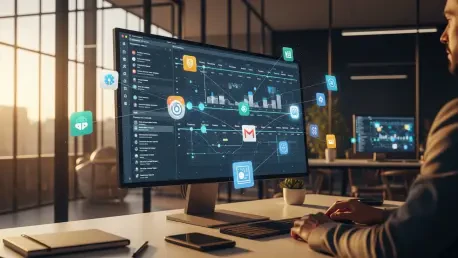

Modern creative professionals are witnessing a fundamental shift as design tools evolve into sophisticated, autonomous ecosystems capable of managing entire operational workflows without constant human intervention. The professional design landscape is undergoing a transformation as traditional tools pivot toward agentic automation. By integrating autonomous agents, platforms like Canva are moving beyond static creation to become comprehensive productivity hubs that manage entire workflows.
This shift highlights a significant trend where technological influences from major AI players and new interoperability standards are redefining the roles of designers and knowledge workers alike. Transitioning from basic assistance to independent action marks a turning point for digital collaboration. Instead of requiring a human to initiate every specific task, these systems learn to anticipate needs based on existing data.
Catalysts and Projections for the Autonomous Productivity Market
From Generative Drafting to Agentic Task Execution
Current industry trends show a move away from simple prompt-and-response AI toward systems that operate independently. Users no longer want just a tool to help them draw; they want a system that understands context and manages recurring responsibilities. The integration of the Model Context Protocol acts as a primary driver, allowing these agents to bridge the gap between fragmented software silos like Gmail, Slack, and Notion.
This leap enables the AI to observe how information flows between different applications. By understanding the relationship between a project brief and a calendar invite, the agent can synthesize a coherent strategy. This shift effectively removes the friction associated with switching between multiple specialized tools throughout the workday.
Measuring the Economic Reach of AI-Driven Workflows
While the industry remains in an early adopter phase, market performance indicators point toward a massive expansion in the agentic sector. Forecasts suggest that as research previews transition into global releases, the volume of automated background tasks will scale exponentially. This data-driven growth reflects a broader movement toward democratizing complex logistical tasks for the average professional.
Investors are closely watching how these autonomous features impact long-term user retention. The ability to save hours of administrative labor daily presents a compelling value proposition that traditional creative tools cannot match. Consequently, market share is likely to consolidate around ecosystems that provide the most seamless integration with established professional tech stacks.
Overcoming Technical and Operational Barriers in Automation
The transition to autonomous agents faces significant hurdles, particularly regarding data fragmentation and the busywork paradox. Developing a system that can effectively draft internal communications requires deep access to a user digital context. Strategy-wise, the industry is moving toward re-architecting tech stacks to support open standards, ensuring that AI can pull information without constant human intervention.
Standardizing how different platforms communicate remains a primary hurdle for developers. To achieve true autonomy, systems must interpret diverse data formats and permissions across various organizational layers. Solving these interoperability issues is essential for creating a cohesive experience where the AI functions as a reliable assistant rather than an unpredictable script.
Governance and Security in the Age of Connected Data
As autonomous agents gain access to sensitive platforms like Google Drive and Zoom, the regulatory landscape must adapt to ensure data integrity and user privacy. Compliance with emerging AI standards and the implementation of robust security measures are critical for maintaining trust. The move toward open protocols represents a step toward standardized, secure communication between AI agents and third-party applications.
Establishing clear boundaries for AI behavior is another vital component of the governance framework. Organizations must define exactly how much authority an agent has when interacting with external clients or internal databases. This careful management of digital permissions ensures that automation enhances efficiency without compromising the security of proprietary information.
The Future Trajectory of Human-Centric AI Agents
The productivity industry is headed toward a future where designing with AI becomes a seamless, invisible process. Market disruptors will focus on increasing the number of software connectors, allowing AI to handle increasingly complex and cross-functional workflows. As these tools evolve, the focus will remain on keeping the human at the center, utilizing machine efficiency to handle logistical burdens while workers provide final creative refinement.
Future iterations of these platforms will emphasize personalization, learning the specific brand voice and stylistic preferences of individual users. This hyper-localization of AI behavior will make the generated outputs feel less like generic templates and more like bespoke creations. Eventually, the distinction between manual design and automated execution will blur into a singular, streamlined creative effort.
Strategic Implications for the Future of Professional Autonomy
The launch of agentic features like autonomous scheduling marked a precursor to a wider industry standard where AI handled the administrative heavy lifting. For organizations and investors, the potential for growth lay in tools that bridged the gap between human creativity and operational efficiency. By streamlining fragmented processes and automating recurring tasks, the next generation of AI platforms redefined productivity.
Leaders recognized that implementing these autonomous systems required a significant cultural shift within their teams. Workers had to transition from being task executors to becoming curators of AI-generated content, which demanded new skill sets in strategic oversight. Ultimately, this transformation empowered employees to reclaim their time, shifting the professional focus from logistical maintenance to genuine innovation.