
The illusion that artificial intelligence could be a simple “plug-and-play” utility has finally shattered against the complex reality of modern enterprise integration requirements. As organizations navigate the landscape of 2026, the initial hype surrounding foundational models has transitioned into a more sober, intentional effort to embed these technologies within core business workflows. This shift has exposed a critical talent gap, forcing technology leaders to choose between two primary paths for external assistance: the highly specialized Forward-Deployed Engineer (FDE) and the broad-spectrum traditional consultancy. While both models promise to accelerate the adoption of generative AI, they offer vastly different approaches to technical execution, long-term maintenance, and organizational sovereignty.
The current market environment is characterized by a sophisticated interplay between model providers such as OpenAI and Anthropic, technology giants like Microsoft, and global professional services firms like EY. Nader Henein of Gartner suggests that the industry has moved past the era where AI value could simply be purchased via a subscription. Instead, value is now built through deep, bespoke architectural work. Forward-Deployed Engineers are specialized technical experts from model providers who embed themselves directly within a client’s engineering team to handle the “in the trenches” work. In contrast, traditional consultants focus on high-level strategy, change management, and the complex governance frameworks required to align AI initiatives with corporate policy and regulatory mandates.
Choosing between these models requires a nuanced understanding of the fluctuating economics of AI, including volatile token costs and the high price of data security. The FDE model often offers the fastest route to a functional prototype, yet it carries the risk of deep technical dependency. Meanwhile, the consultancy model provides a buffer of vendor neutrality but may lack the specialized depth needed to optimize a specific model’s hidden parameters. As enterprises strive for operational resilience, the distinction between these two roles becomes a foundational decision that determines whether an organization builds its own intellectual property or merely rents someone else’s infrastructure.
Analyzing Key Operational and Strategic Differences
Model Mastery Versus Cross-Platform Strategic Governance
The most immediate distinction between the two models lies in the depth of specialized knowledge versus the breadth of strategic oversight. Forward-Deployed Engineers possess an insider’s understanding of their specific model’s roadmap, including upcoming features, training methodology, and architectural nuances that are not yet public. When working with an FDE from a provider like Anthropic, a company gains access to engineers who can optimize a prompt or a retrieval-augmented generation (RAG) system with surgical precision because they understand the underlying weights and biases better than any outsider. This deep mastery allows for rapid technical troubleshooting and the ability to push the boundaries of what a specific model family can achieve within a custom environment.
In contrast, professional services firms such as EY or Deloitte prioritize cross-platform strategic governance and the integration of AI with legacy infrastructure. These consultants are typically vendor-neutral, focusing on how a model—whether it is from OpenAI or a specialized open-source variant—fits into the broader enterprise architecture. Their primary value lies in navigating the complex organizational politics of large-scale deployments, managing the expectations of legal and compliance teams, and ensuring that the AI initiative aligns with the existing digital transformation strategy. While they may not know the exact latencies of a specific model update as intimately as an FDE, they are experts at ensuring the system remains auditable and secure within a corporate framework.
This comparison ultimately highlights a trade-off between technical optimization and organizational alignment. The FDE model is a tactical strike force designed to solve specific, high-intensity technical challenges, whereas the consultancy is a diplomatic corps designed to ensure the technology survives the friction of a large bureaucracy. For a company building a mission-critical, AI-first product, the deep mastery of an FDE is often indispensable. However, for an enterprise seeking to deploy AI across twenty different departments with varying security requirements, the governance-first approach of a traditional consultancy provides a more stable foundation for long-term operational success.
Technical Execution and the 20/80 Cost Allocation Split
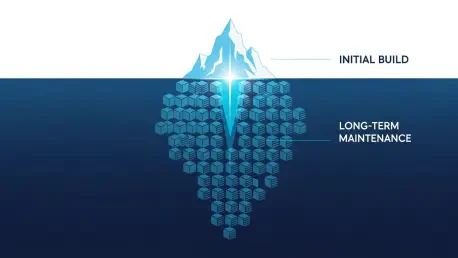
A significant challenge in modern AI budgeting is the “iceberg” effect of technical costs, where the initial deployment represents only a fraction of the total expenditure. John Sangyeob Kim of Solidroad has noted that approximately 20% of the effort and cost of an AI project is concentrated in the initial build and rollout. This is the phase where FDEs thrive, using their specialized tools to create impressive demonstrations and rapid initial integrations. However, the remaining 80% of the cost is consumed by long-term maintenance, which includes managing data drift, identifying edge cases that only appear in production, and adapting the system as the underlying model evolves.
FDEs are often incentivized to focus on the high-visibility 20% phase to prove the value of their employer’s model quickly. This can lead to a situation where the initial deployment is highly efficient, but the long-term maintenance burden is shifted entirely to the client. Moreover, the current era of “investor-subsidized” pricing for AI tokens can mask the true cost of these systems during the pilot phase. If an FDE builds a solution that relies on expensive, high-token-count calls without an eye toward long-term financial sustainability, the enterprise may find itself facing a budget crisis once the initial subsidies disappear and the system enters its multi-year maintenance cycle.
Consultancies, on the other hand, often take a more holistic view of the 20/80 split, planning for the ongoing operational realities from the start. They are more likely to insist on building robust monitoring systems and evaluation loops that account for data drift and model degradation over time. While the “build” phase might be slower and more expensive with a consultancy due to the focus on documentation and governance, the goal is often to create a system that is sustainable over a three-to-five-year period. By focusing on the 80% of the iceberg that lies beneath the surface, consultants aim to protect the enterprise from the sudden shocks of technical debt and unexpected scaling costs.
Vendor Lock-in and Architectural Independence
The strategic risk of vendor lock-in remains a central concern for Chief Information Officers who must maintain architectural flexibility in a rapidly evolving market. Flavio Villanustre of LexisNexis Risk Solutions points out that FDEs are not neutral actors; they are naturally incentivized to maximize the use of their own company’s tools, creating a “sticky” ecosystem that is difficult to leave. When an engineer from a model provider designs a system, they tend to use proprietary features and monitoring stacks that are optimized for that specific environment. This can result in a “future muscle memory” where the enterprise’s internal team becomes proficient in one specific vendor’s ecosystem but remains blind to alternative, potentially more efficient solutions.
In contrast, independent contractors and AI-specific consultancies generally advocate for a portable, multi-vendor strategy. They are more likely to recommend architectures that allow an enterprise to swap models as performance metrics change or as competitors “leapfrog” one another in capability. This architectural independence is crucial because it allows the organization to remain agile. If a model provider changes its pricing structure or its terms of service in 2026, a company with a portable architecture can pivot toward a different provider with minimal disruption. The FDE model, by its very nature, tends to pull the enterprise deeper into a single vendor’s commercial center of gravity.
Building internal capabilities through a consultancy engagement is often seen as a way to avoid the loss of strategic control. While an FDE might do the work for the company, a consultant is frequently tasked with teaching the company how to do the work for itself. This distinction is vital for maintaining “future muscle memory” within the internal engineering team. Relying too heavily on external experts who are beholden to a specific model provider can leave an organization without the necessary skills to manage its own AI future once the engagement ends, effectively hollowing out the enterprise’s long-term technical sovereignty.
Critical Risks and Implementation Constraints
The “observability crisis” is perhaps the most technical and overlooked risk when choosing an external support model. If a team of FDEs utilizes their own proprietary monitoring stack to manage an AI deployment, the enterprise loses all visibility into the system’s health the moment the contract expires. This creates a dangerous black box where the internal IT team is left to manage a complex system without the tools needed to debug it or understand its failure modes. John Sangyeob Kim identifies this as a critical failure point; without a production-grade observability layer that is owned and operated by the enterprise, any AI deployment is essentially a temporary achievement rather than a permanent asset.
Furthermore, post-departure capability gaps can cripple an organization that has become overly reliant on external specialized labor. Justin Greis of Acceligence warns that while Non-Disclosure Agreements can protect hard data, they are rarely effective at protecting “observed processes.” As external engineers work within a corporate environment, they inevitably learn the undocumented workarounds, approval bottlenecks, and security exceptions that define the company’s real-world operations. If the internal team does not proactively capture this knowledge during the engagement, they will find themselves unable to manage the “evaluation loop” or handle technical exceptions once the FDEs or consultants have moved on to their next client.
Cultural mismatches also pose a significant constraint, particularly in the context of “acquihiring” or embedding nimble AI startup teams within large corporate bureaucracies. The “speedboat” mentality of a high-speed AI engineering team often clashes with the “aircraft carrier” pace of a global enterprise. This mismatch can lead to a breakdown in communication where the external experts become frustrated by the lack of agility, while the internal teams feel overwhelmed by the rapid pace of technical change. This friction can result in undocumented technical debt as external engineers take shortcuts to bypass bureaucratic hurdles, leaving the enterprise with a system that is functionally sound but operationally fragile and difficult to audit.
Strategic Decision-Making: Selecting the Optimal AI Support Model
Navigating the choice between Forward-Deployed Engineering and AI consulting requires a clear framework that prioritizes long-term operational resilience over short-term deployment speed. For CIOs, the decision should be rooted in three core criteriownership of the evaluation loop, portability of the AI logic, and control over the observability stack. If a project is highly specialized and requires the absolute peak performance of a specific model, such as a custom-trained version of a Microsoft-hosted instance, the FDE model is likely the most effective choice. However, this must be balanced with a rigorous internal training program to ensure that the “intelligence” of the system does not leave the building with the external experts.
For broader enterprise-wide initiatives that involve legacy integration and high levels of regulatory scrutiny, a partnership with a firm like EY or a group of independent contractors may be more appropriate. These models favor a multi-vendor, open-source strategy that preserves data sovereignty and protects against the volatility of the AI market. By utilizing open-source models for certain workflows, organizations can avoid the “token trap” and maintain 100% control over their security and patching cycles. The primary goal of any external partnership should be to leave the internal team more capable, ensuring that they can manage the ongoing 80% of the maintenance iceberg without perpetual external assistance.
The most successful strategies in 2026 involved a hybrid approach that leveraged the strengths of both models while mitigating their respective risks. These organizations utilized FDEs for initial, high-speed technical sprints to establish a “north star” for what the technology could achieve. Simultaneously, they employed consultancies to build the governance frameworks and observability stacks that would allow the internal team to take over the project after the first six months. This approach ensured that the enterprise benefited from the latest model mastery without sacrificing its architectural independence or its ability to pivot toward more cost-effective solutions as the market matured.
The ultimate goal for any executive was to resist the urge to outsource the organization’s “decision architecture” to a single vendor. By maintaining control over the metrics that defined success and the tools that monitored performance, leaders ensured that their AI journey was an expansion of internal capability rather than a surrender to external dependency. Those who viewed FDEs and consultants not as replacements for internal talent, but as catalysts for internal growth, were the ones who successfully turned the “iceberg” of AI costs into a manageable and predictable part of their digital ecosystem. The transition toward a more resilient AI strategy was marked by a shift in focus from the novelty of the initial deployment toward the rigor of long-term operational excellence.
The strategic landscape of AI integration was fundamentally reshaped by the realization that speed and governance were not mutually exclusive but mutually dependent. Enterprises that prioritized quick wins via FDEs without a plan for internal transition often faced escalating costs and technical stagnation as their chosen vendors’ roadmaps diverged from their business needs. Conversely, those who relied solely on slow-moving consultancies risked falling behind competitors who were able to harness the raw power of the latest model updates more effectively. The most resilient organizations were those that treated their AI architecture as a living, portable asset, rather than a static installation provided by a single partner. This mindset allowed them to navigate the inherent volatility of the AI sector while ensuring that their core operational logic remained firmly under their own control. By the time the industry matured, the clear winners were the firms that had used external expertise to build a robust, internal “muscle memory” for artificial intelligence.