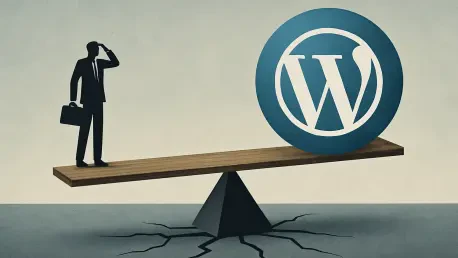

The global economy recently discovered that a significant portion of its digital architecture hangs by a surprisingly thin thread, woven from the personal decisions of a single individual rather than the robust safeguards of institutional governance. When the news broke that the board of directors at Automattic had placed its founder and CEO on a sudden, mandatory paid leave of absence, the shockwaves were felt far beyond the confines of the company’s headquarters. This event did more than just trigger executive palace intrigue; it exposed a fundamental instability in the engine that powers over 40 percent of the world’s websites. For a platform that has become synonymous with the modern internet, the revelation that its leadership could be sidelined—and then reinstated—within a period of just 33 hours highlighted a level of volatility that most enterprise IT departments spend their entire budgets trying to avoid.
The significance of this story lies in the inherent tension between the open-source ethos of community collaboration and the reality of centralized control. While the WordPress ecosystem appears to be a sprawling, democratic collective of developers and contributors, the operational heart of the platform remains under the influence of a singular figure who manages both a massive private corporation and the public software repository. This nut graph of the crisis suggests that the “WordPress risk” is no longer just about plugin vulnerabilities or slow loading times; it is now a question of geopolitical and economic security. If the leadership of a platform this large is subject to sudden shifts and personal disputes, every enterprise that relies on it for e-commerce, internal communications, or public branding is effectively operating on borrowed time.
The 33-Hour Vacuum: When the Internet’s Engine Stalled
The brief period during which Matt Mullenweg was sidelined from his role at Automattic served as a momentary but terrifying glimpse into a leaderless void. While 33 hours might seem like a negligible blip in a corporate timeline, for the tech industry, it represented a profound stress test of global digital infrastructure. The immediate ripple effect was a wave of uncertainty among stakeholders who realized that the “engine of the internet” lacked a clear succession plan or a transparent protocol for handling executive crises. The timeline of this intrigue suggests a deep rift between the board’s fiduciary duties and the founder’s personal vision, a conflict that usually takes months to resolve but in this case, exploded and subsided with jarring speed.
This paradox of a platform powering a massive portion of the web while being tethered to a single individual’s status creates a unique category of risk. In most industries, a platform with a 40 percent market share would be subject to intense regulatory oversight and institutional stability. However, WordPress exists in a gray area where the transition from a hobbyist’s project to an enterprise-grade utility never quite shed its reliance on its original architect. A single weekend of leadership uncertainty proved that the infrastructure of the internet is far more fragile than the polished interfaces of modern websites would suggest, prompting a re-evaluation of what it means to be “too big to fail” in the digital age.
The return of the founder to his position did little to quell the underlying anxiety within the professional community. If anything, the speed of the reversal suggested that the board might have encountered the very problem that IT analysts had long feared: the individual in question is so deeply integrated into the vital organs of the platform that removing him might cause more damage than keeping him. This realization forced a shift in perspective among global digital leaders, who began to view the platform not as a stable foundation, but as a personality-driven project that requires constant monitoring to ensure business continuity.
Structural Fragility in an Open-Source Giant
The vulnerability of the WordPress model is rooted in the blurred lines between Automattic, the for-profit corporation, and WordPress.org, the community repository. Most users assume that the .org side of the ecosystem is a neutral, non-profit entity similar to the Linux Foundation, but the reality is far more complex. Because WordPress.org is personally owned and controlled, there is no institutional buffer between the software that millions of businesses use and the personal discretion of its owner. This lack of a formal, independent governance structure means that the “systemically important” piece of the global economy is effectively a private asset, a situation that would be unthinkable in other sectors like finance or telecommunications.
Modern enterprises often rely on a pipeline they do not control, assuming that the flow of security patches and core updates is a guaranteed utility. However, the reliance on a centralized repository for plugins and themes creates a hidden dependency that can be disrupted at any moment. From enterprise e-commerce sites to sensitive internal portals, the entire stack of a modern WordPress installation is connected to a single point of failure. Recognizing the difference between the freedom of open-source code and the vulnerability of centralized infrastructure is the first step toward understanding why the current governance model is increasingly viewed as a liability by corporate risk managers.
Furthermore, the scale of WordPress has reached a point where its health is tied directly to the stability of the global economy. When a major portion of online retail and news dissemination relies on a single software distribution point, any friction in that distribution becomes a macro-economic threat. The structural fragility is not found in the code itself, which is often robust and well-audited, but in the delivery mechanism. This disconnect between a decentralized community of contributors and a highly centralized distribution authority creates a bottleneck that is incompatible with the high-availability requirements of the modern enterprise.
The Intersection of Personality and Infrastructure
The concept of “concentration risk” takes on a new meaning when an entire software category is dominated by a single personality. Evaluating the impact of Matt Mullenweg’s dual roles reveals a situation where personal grievances can manifest as technical hurdles for millions of users. The recent and ongoing dispute with WP Engine serves as a primary example of how a repository can be weaponized to achieve corporate or personal goals. By unilaterally blocking a major hosting provider’s access to the .org repository, the platform demonstrated that security updates—the very lifeblood of a safe internet—can be used as leverage in a commercial fight.
This event proved that the “Update Pipeline” is not a neutral service but a discretionary tool. For IT leaders, the realization that personal discretion can outweigh institutional policy is a significant red flag. In a standard corporate environment, a board of directors or a set of bylaws would prevent such a disruption to the supply chain. In the WordPress model, however, the lack of fiduciary oversight for the .org ecosystem means that there are no checks and balances to prevent the infrastructure from being used as a tactical asset. This lack of institutional control directly impacts corporate risk assessments, making it difficult for compliance officers to sign off on the platform’s long-term safety.
The volatility observed in leadership behavior translates into a direct threat to the stability of the software itself. When the public discourse surrounding a platform becomes dominated by litigation and social media conflicts, the actual development of the software often takes a backseat to damage control and legal positioning. This environment discourages conservative enterprise partners from deepening their investment in the ecosystem. The intersection of a founder’s personal brand and the world’s most popular content management system has created a situation where the software’s reputation is perpetually tied to the news cycle, a trait that is the opposite of the “boring stability” that enterprise IT craves.
Strategic Implications for Enterprise IT
Chief Information Security Officers are increasingly moving beyond fragmented security controls toward a more holistic view of their software supply chain. The inconsistent support for third-party modules and the decentralized nature of plugin development already made WordPress a difficult platform to secure at scale. However, the current leadership volatility adds a layer of “governance risk” that traditional security tools cannot mitigate. If the platform’s central authority is unpredictable, then no amount of firewalls or malware scanners can protect a business from a sudden loss of access to the core software updates that keep those tools functioning.
The “Single Point of Failure” theory is no longer a hypothetical scenario for those managing large-scale WordPress deployments. Industry analysts have noted that the board’s recent attempt to sideline the founder signaled a deep-seated financial and legal alarm that should resonate with every CIO. When a corporate board feels the need to take such drastic action, it indicates that the risks have moved from the technical realm into the legal and financial spheres. Comparing this governance model against the institutional standards required by global enterprises reveals a significant gap that most organizations are now scrambling to fill through redundant systems and migration planning.
Experts suggest that the current model is a relic of an earlier era of the internet that has failed to evolve alongside its own success. The institutional standards required by modern CIOs involve clear service-level agreements, transparent governance, and predictable roadmaps. WordPress, in its current state, offers the opposite: a platform where the roadmap can be diverted by personal disputes and where the “service” of software distribution is provided at the whim of an individual. This misalignment is forcing many organizations to reconsider their “WordPress-first” strategies in favor of platforms that offer more traditional, board-governed stability and clear lines of accountability.
Navigating the Future: De-Risking the WordPress Dependency
The path toward structural reform for the WordPress ecosystem involved a necessary transition toward an independent foundation that could manage plugin and theme repositories without the interference of any single corporation or individual. This movement aimed to separate the creative and commercial aspects of the platform from the technical infrastructure that sustained the web. By advocating for a governance model that resembled other successful open-source projects, the community attempted to provide the transparency and predictability that enterprise stakeholders demanded. These efforts focused on creating a mandate for institutional governance that could survive the departure or disagreement of any single leader.
IT leaders simultaneously adopted strategies to evaluate their supply-chain dependencies in real-time, treating the platform as a third-party vendor rather than a community resource. This “de-risking” framework involved maintaining a WordPress presence for its ease of use and massive developer pool while mitigating the impact of centralized disruptions through mirrored repositories and static site generation. Organizations began to isolate their WordPress installations, ensuring that even if the central .org servers were to become unavailable or compromised, their local versions could continue to function securely. This shift represented a more mature approach to open-source management, where the benefits of the software were balanced against the realities of its governance.
The eventual move toward a more stable governance structure signaled a new era for the platform, one where the focus returned to innovation and security rather than executive drama. Organizations that successfully navigated this period of transition were those that recognized the need for institutional safeguards long before a crisis forced their hand. They established a mandate for governance that prioritized the health of the ecosystem over the interests of any single entity. By diversifying their technology stacks and demanding higher standards of accountability from their platform providers, these enterprises ensured that their digital futures were no longer tethered to the personal fortunes of a single individual. In the end, the period of uncertainty acted as a catalyst for a more resilient and professionally managed internet infrastructure.