
Studio-grade electric piano tone used to mean dragging heavy cases or tethering to a desktop, yet mobile musicians now expect character, immediacy, and credible dynamics in a pocketable rig that boots fast and never stumbles on stage or in transit. That expectation set a high bar for an iOS instrument claiming classic Rhodes, Wurlitzer, and Electric Grand flavors, especially when storage is tight and sessions jump between apps through AUv3. The proposition here is clear: a lean 150MB footprint, a hybrid engine that fuses physical modeling with multi-samples printed to analog tape by a Grammy-nominated engineer, and an emphasis on vibe over deep, arcane parameter hunts. Moreover, the promise hinges on how convincingly the subtle grit, bark, and bell are rendered under the fingers, and how quickly that tone sits in a mix with mobile tools.
Vintage Tone on a Mobile Canvas
Sound Engine and Character
Retro Keys takes a streamlined path to authenticity by anchoring its palette in four immediately recognizable timbres: Rhodes Stage 73, Wurlitzer 78, a CP-style Electric Grand, and a brighter “Retro Piano” designed to cut through denser arrangements. The hybrid core matters because it lets velocity curves, timbral transitions, and release behavior feel elastic while avoiding the multi-gigabyte footprints of deep-sampled desktops. Multi-samples captured to analog tape contribute soft compression, harmonic smear, and a touch of hiss, all of which interact with modeled elements to keep transients lively instead of plastic. That balance keeps the EP bark intact at high velocities, preserves tine shimmer on the Rhodes set, and retains the signature reed growl on the Wurli without lifeless static layers.
Building on this foundation, the instrument’s minimal front-panel controls—essentially fine-tune and volume—telegraph its philosophy: tone first, choices second. In practice, that restraint encourages trusting the baseline voicings and reaching for context via effects rather than dismantling the core model. It also shortens the distance from launch to usable sound when tracking ideas from a couch or backstage. The low storage demand becomes meaningful on phones that juggle stems, samplers, and hosts; even a 150MB budget can feel plush next to gigabyte-class pianos. More importantly, the engine’s responsiveness holds up under tight buffers in AUv3 hosts, so dynamic phrasing and split-second stabs maintain energy without a sluggish envelope or mushy attack that would betray a mobile compromise.
Controls, Effects, and Modulation
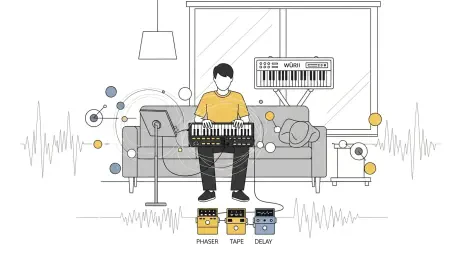
The editing story shifts from instrument internals to well-chosen processing that evokes studio chains common to classic EP records. Tape noise can be dialed for realism or erased for modern cleanliness, while an eight-track doubling mode mimics analog layering for immediate width without obvious chorusing. A Lo-Fi processor reduces bandwidth and resolution tastefully, the tone filter tames icepick highs on bell-like patches, and a vinyl module sprinkles mechanical irregularities for indie aesthetics. Time-based effects include a chewy vibrato, a slow-swirling phaser tuned for EP fundamentals, and a delay that can push a Rhodes into ambient pads. Overdrive—labeled “heat”—adds muscle; set conservatively, it warms mids, pushed harder, it crunches into fusion territory.
This approach naturally leads to modulation that shapes movement more than micro-parameters. An AR envelope offers per-patch dynamics control when needed, and the assignable LFO targets sensible destinations for chorus-adjacent motion or filter sweeps that complement comping patterns. Auto-pan becomes a centerpiece for stereo interest, from gentle lounge wobble to headphone-grabbing tremolo. Assignable aftertouch, newly added, unlocks expressive gestures on modern controllers, enabling pressure-based vibrato, filter bloom, or drive swells without menu spelunking. Together, these options compensate for sparse instrument knobs by making effects part of the performance rather than a static garnish. The result is workflow speed: select a preset close to the mood, tweak a handful of expressive routings, and print takes that already feel produced.
Workflow, Integration, and Value
AUv3, MIDI, and Presets
Full AUv3 support means Retro Keys behaves like a polite citizen in hosts such as AUM, Cubasis, Logic Pro for iPad, and Audiobus, with multiple instances spinning up reliably for layered patches or parallel processing. Deep MIDI implementation covers sustain pedal nuances and velocity translation, while aftertouch routing honors the recent wave of compact controllers that prioritize expressive control even in travel rigs. A built-in recorder simplifies idea capture; exporting clips for further work downstream avoids the friction of inter-app roundtrips. Crucially, these basics hold under latency constraints common to live play, so the instrument remains playable instead of becoming a sketchpad confined to offline editing.
The 200-plus presets curated by known sound designers provide a pragmatic on-ramp to signature spaces: barky funk comps bathed in phaser, ballad-ready Wurli reeds with tape glue, CP-style layers treated for pop choruses, and dry stage sit-ins waiting for host-side chains. Presets are not just voicings; they encode production intent that shortens arrangement time, which fits mobile sessions where inspiration outruns patience. Moreover, AUv3 allows stacking third-party effects—Valhalla-style reverbs, BLEASS modulation, FAC dynamics—so presets can be extended without duplicating tools. That tight coupling between curated starting points and host-level sculpting bridges the app’s minimalist controls with the broader iOS ecosystem, yielding mixes that feel intentional rather than patched together.
Pricing, Positioning, and Next Steps
The value proposition landed cleanly: an introductory $4.99 price undercut typical mobile instruments with comparable polish, while the regular $19.99 tag still sat well below desktop EP staples and hardware clones. Positioned against fully modeled EPs like Neo-Soul Keys Studio or SampleTank expansions, Retro Keys traded endless parameter pages for immediacy, character, and a travel-light footprint. For players who need credible Rhodes bark at a soundcheck or a Wurli reed that bites through a drum-bass jam without hauling a controller case of knobs, that trade was rational. The 150MB size lowered the barrier for phone-first creators, and the analog-tape sampling step added a differentiator beyond marketing jargon.
Actionable steps followed from this assessment. Players seeking maximal tweakability should treat Retro Keys as the core tone and shift sculpting to AUv3 chains—compressor into “heat,” then phaser, then tempo-synced delay—to retain clarity while adding movement. Those relying on expressive play would map aftertouch to vibrato depth for ballads and to drive for lead breaks, saving alternate routings as host presets for instant recall. For mix-ready results, start with a darker Rhodes preset, roll subtle tape noise for glue, place auto-pan pre-delay for rhythmic width, and print stems to conserve CPU. Finally, monitor updates that expand modulation targets or add CP mic perspectives; incremental gains in expressivity and stereo capture had paid off, and keeping sessions lean while elevating feel remained the winning strategy.