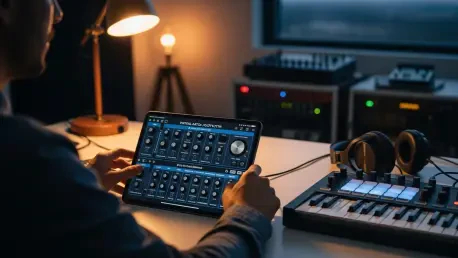

Staring down an empty session with only a glass slab and a pair of headphones has rarely felt this potent, because mobile producers now expect instruments to sound record‑ready, respond expressively, and reveal depth without demanding a manual marathon first. That expectation framed the arrival of ANALOGY8, an 8‑voice, virtual‑analog polysynth for iPadOS that promised a classic subtractive core sharpened by modern flair. Its pitch was straightforward yet ambitious: make synthesis welcoming through a knob‑forward interface while giving sound designers reason to linger. At launch, it shipped as an AUv3, slotting into hosts like Logic Pro for iPad and AUM, with a macOS AUv3 pledged as a free update. The question that followed was less about specs than balance—could it keep immediacy intact while unlocking the kind of motion, color, and control that mark current‑gen instruments?
Design, Architecture, and Modulation
Interface Choices That Serve Sound
ANALOGY8’s layout placed rotary controls at the center, a departure from the developer’s earlier slider‑heavy designs and a deliberate nod to hands‑on subtractive workflows. The change mattered in practice: knobs for tuning, shape, shift, mix, and per‑oscillator wavefolding sat within immediate reach, making the process of sculpting harmonically rich sources both quick and legible. Three multi‑wave oscillators formed the synth’s spine, joined by a noise generator with its own color and blend controls, so carving anything from bright, brassy unisons to brittle, granular‑tinged textures required little menu diving. Building on this foundation, the per‑oscillator amplitude envelopes—with velocity sensitivity—gave each source a dedicated dynamic profile. Snappier attacks on noise could simulate stick or pick articulation, while slower, evolving swells on a single oscillator yielded motion without resorting to LFOs. This approach naturally led to patches that felt layered rather than stacked.
Beyond source control, the routing canvas encouraged careful voicing. Two per‑voice multimode ladder filters—each switchable among lowpass, bandpass, and highpass with 2‑ or 4‑pole slopes—could be addressed independently, driven, or bypassed altogether. Assigning specific oscillators to specific filters turned routine pads into split‑spectrum ensembles, with, for instance, a wavefolded oscillator brightened through a 2‑pole highpass while a detuned companion took a 4‑pole lowpass path for body. Filter drive added pleasing bite and thickness, pushing harmonics without dissolving into fizz, and because each filter featured its own ADSR, contouring the handoff between brightness and warmth became a matter of milliseconds and percentages, not guesswork. In contrast to many mobile VAs that apply a single filter envelope globally, this split control felt exacting, musical, and easy to repeat when revisiting sessions in AUv3 hosts.
Per‑Voice Motion and the Case for Drift
Modulation cemented the instrument’s voice‑level ethos. Four modulation sources lived on each voice, and each source combined a variable‑shape, tempo‑syncable LFO with a dedicated ASR envelope and an analog‑style drift control. That hybrid design proved more than a convenience feature. For example, a slow triangle LFO could ride cutoff while the ASR injected a transient accent into resonance only at note onset, letting stabs punch without turning sustained passages into whistles. Meanwhile, the drift parameter subtly randomized phase and rate in a way that mimicked hardware instability, keeping chords from congealing into sterile blocks. Because modulation was assigned one‑to‑one—one source per destination—across 22 voice parameters, patches remained intelligible even when complex. There was less temptation to create inscrutable nests of routings that collapse under edits.
This per‑voice, rather than global, modulation aligned with modern performance practice on iPadOS and macOS. In hosts like Logic Pro or Drambo, velocity‑layered patterns and nuanced MIDI controllers benefit when each note carries its own micro‑behaviors. A flurry of sixteenths with slightly different LFO phases can read as ensemble movement, not a static chorus effect. By leaning on voice individuality, ANALOGY8 encouraged expressive sequencing where no two hits over a bar felt identical. Moreover, tying LFO sync to project tempo meant rhythmic patterns locked tight when needed, while free‑running states kept drones elastic. In use, this struck a pragmatic balance: predictable when arranging, alive when improvising. It also eased automation; mod destinations behaved consistently per note, so drawing lane moves in AUv3 hosts translated cleanly across takes and reopens.
Workflow, Effects, and Market Context
Efficiency From Preset to Production
Effects and readiness for production rounded out the package. The built‑in multi‑FX section offered a syncable analog‑style delay, a reverb designed to sit rather than smear, and a compressor/limiter that could catch peaks from driven filters without flattening nuance. This chain, while compact, sped up ideas. A dry pluck could become a chart‑ready arpeggio within minutes, with delay subdivisions locked to session tempo and the compressor trimming resonance spikes that often sneak into mobile mixes. The included preset library leaned into breadth—bread‑and‑butter polys, punchy basses, cinematic swells—yet remained instructive. Tweaking a preset exposed the signal path’s logic, revealing how per‑source envelopes and filter routing stitched together the sound. Because ANALOGY8 shipped as an AUv3, session recall in hosts preserved not only patch states but routings and automation, a non‑negotiable for mobile‑first workflows that jump between devices.
Price positioned the instrument as a low‑risk, high‑return tool. At £7.99/€8.99, it undercut many desktop counterparts while delivering an architecture that seldom felt compromised. That affordability tracked a wider trajectory on iPadOS and macOS: serious instruments with approachable UIs, AUv3 compliance, and tactile interaction that encourages learning by doing. Crucially, the promised macOS AUv3 as a free update suggested a single ecosystem rather than a split product line. Producers who sketch on iPad could expect parity on a laptop without re‑buying, and projects built in AUv3 hosts stood to travel intact across platforms. This continuity mattered for collaboration, too. Sending a Logic Pro project with embedded ANALOGY8 instances avoided the plug‑in mismatches that slow feedback loops, and the synth’s small CPU footprint left headroom for third‑party effects or multi‑layered arrangements.
Where It Pushed Past Standard VA
What set the instrument apart from “another subtractive” was not a single marquee feature but a handful of deliberate choices. Per‑oscillator wavefolding, rarely standard in virtual analogs, brought west‑coast‑leaning harmonics into a subtractive workflow without forcing a modality shift. Dial a touch of fold on Osc 2 while keeping Osc 1 traditional, and familiar filter sweeps gained conspicuous edge without becoming abrasive. The noise generator’s color control did similar heavy lifting, letting snare tops or wind‑like layers land precisely in a mix. With two drive‑capable ladder filters on each voice, saturation could be placed before reverb or delay in a way that emulated outboard signal chains. The result was less “VA sheen,” more intentional grit where needed. In practice, that gave basses weight under compression and kept pads from dissolving when layered with acoustic tracks.
The envelope‑everywhere design unlocked dynamics often reserved for modular rigs. Assigning unique amplitude contours to each oscillator and the noise source created interlocking motion without external modulators. A patch could launch with a percussive noise tick, let a mid‑rich oscillator bloom across a quarter note, and hold a low oscillator as a steady anchor—each with different responsiveness to velocity. Because each filter had its own ADSR, the timbral curve could disagree with the loudness curve on purpose, a trick that kept long tails lively in ambient contexts and made short leads bite through dense drums. These capabilities, combined with voice‑level modulation, encouraged composers to lean into performance nuance: aftertouch mapping to a single destination per voice avoided chaos, while tempo‑locked LFOs kept rhythmic programs tight in grid‑heavy genres. The through‑line was coherence—power delivered without sacrificing clarity.
What Matters Next
For producers considering adoption, a practical path had emerged. Start by building patches from a single oscillator and one filter to learn the panel’s cause‑and‑effect, then introduce wavefolding in small amounts to hear how fold interacts with filter drive. From there, route oscillators to separate filters to split duties—one for transient detail, one for body—and shape them with independent ADSRs. On modulation, reserve one source for timing‑critical moves synced to tempo, keep another free‑running with drift for humanized motion, and assign ASR transients to destinations that reward short bursts like resonance or pulse width. When moving into a full mix, commit the internal compressor sparingly to catch peaks before external processing, and print delay or reverb tails only when they serve arrangement clarity.
The market angle also called for attention. Pricing had favored experimentation, but long‑term value depended on cross‑platform parity and session portability. With the macOS AUv3 update promised, planning templates in Logic Pro and AUM made sense, mapping common macros to external controllers so patches translated on stage and in the studio. For teams, agreeing on a narrow preset subset and versioning changes within project notes reduced recall friction. Finally, given the instrument’s per‑voice strengths, sequencing strategies that exploited note‑to‑note difference—subtle velocity curves, randomized start times within a few ticks, gentle MPE‑style pressure lanes—paid off more than stacking global effects. Those choices would have turned a capable VA into a versatile writing partner, keeping immediacy upfront while letting edge emerge on demand.